Teaser
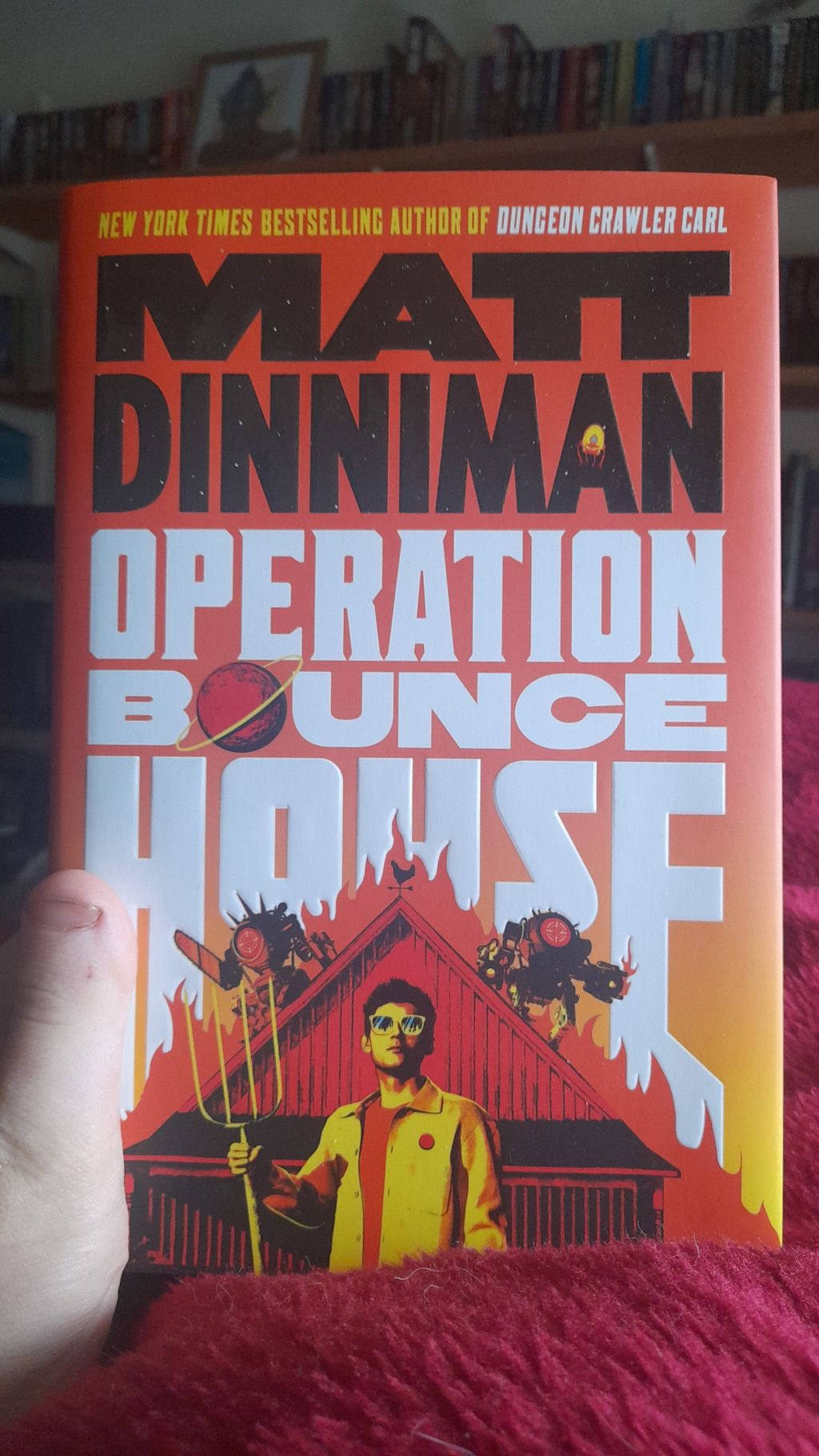
The call it Operation Bounce House. for a nominal fee, you can remotely pilot a mech and kill as many terrorists as you can. But there’s a catch. The ‘terrorists’ are just farmers, and they’re not too happy about having their planet invaded by murderous gamers . . .
Review
Matt Dinniman has risen to prominence in the online book community over the past year or so, largely on the back of his Dungeon Crawler Carl series. Operation Bounce House is not connected to that series, but share some of the same DNA. It’s science fiction for the gamer generation. For better, but mostly for worse. I want to preface my next few paragraphs by saying that 1) I am not much of a gamer, 2) I generally dislike written comedy, and 3) I have read a lot of science fiction books before this one.
Operation Bounce House is my least favourite book of the past two years, if not further. The only enjoyment I derived was from the fact it was a buddy read and I had someone to talk about the book with. Beyond that, it’s hard to find any redeeming features. That being said, I don’t see much point in writing an endlessly harsh review just because a book wasn’t to my liking. That’s not what I do here. Instead, I’m going to unpack exactly why this book failed to land for me. There could well be spoilers.
The biggest stumbling block I encountered was the humour. It oozes off the page. My personal taste in comedy leans towards sketches and stand-up routines. Written jokes? Less so. Especially the puerile kind of humour in Operation Bounce House. Maybe I have a low opinion of terminally-online gamers, but the jokes in this book feel geared towards twelve year olds. But the book is ostensibly for adults. Because while there are the obligatory jokes about bodily fluids and gas, there’s also never a missed opportunity to crack a foul-mouthed quip about sex and all that entails. In short, the kind of jokes teenage boys tell each other when they think they’re being edgy and original. When some of the characters are chronically game-addicted teens, this makes some sense, and serves to make the villains unlikable. However, the main characters are all in their twenties, and have the exact same sense of humour as their enemies.
These twenty-somethings have ostensibly grown up on a frontier world with grandparents but no parents around, and yet they feel like stereotypically rebellious teens. They have a band, they struggle to talk to girls. everybody’s personal evolution has been stunted in the service of crude jokes. The butt of many of these jokes (and source of much of the book’s considerable profanity, makes a living as an adult actress on the book’s equivalent of OnlyFans (another way in which the book’s history is rooted firmly in today’s online world. As the book progresses, we meet some of her clients (and everyone agrees how wonderful and sexy she is), and that’s when we find out that she has the physical stature of a twelve-year old boy.
The implications of that are not good. In fact they’re downright horrific. But the book just cracks a joke and moves on. It doesn’t take any time to dwell on the logical fallout of its worldbuilding. There are numerous points where the book briefly brushes up against something with depth and substance, but each time it tucks its tail between its legs and scurries away to make more childish jokes.
This leads to some incredibly infuriating situations. This is one of the first books I’ve read that genuinely features discussion of AI generated art. This stuff is weaponised in defence of our poor farmers (and I’m not even going to go into the painfully idealistic view of downtrodden colonists fighting off an evil homeworld that is so American it hurts), and while they do end up shooting themselves in the foot, AI deepfakes end up saving the day on multiple occasions. Is the book pro-AI? I don’t think so. It’s hard to tell when it takes no stance on anything, nor even gives opposing views a chance. Depiction is not endorsement. We know this. But discussion is still an important part of the genre. Later on, these ‘innocent farmers’ casually step into the role they’ve been forced to play, casually mentioning how they might crash a few civilian airliners to take out enemy politicians. It’s frankly horrifying how these topics are glossed over.
Few books have managed to make me this genuinely angry. But even more so, I am confused. How is this book popular? Is it just marketing? Perhaps. But the likelier answer is that this a book that genuinely entertains thousands upon thousands of people. I am not the arbiter of good taste. If jokes make you laugh, then they are funny, no matter what my say on the matter is. But I think the best answer comes from Dinniman himself. In a recent interview (I want to say on SFFAddicts, but don’t quote me on that) he said something to the effect of wanting to write books that gave people the same enjoyment they got from gaming.
That, to my mind, explains a lot. This is a book for the gamer generation. People are enjoying it because it’s a the same thing they enjoy, but in a new medium. This is not a science fiction book for people who are familiar with science fiction books. It might not even be a book for people who consider themselves, first and foremost, readers. The ideas seen here have been covered elsewhere, earlier and better. Off the top of my head Orson Scott Card’s Ender’s Game handles simulated warfare better, while the idea of a gamified war where you can’t really die shines through in Jamie Sawyer’s The Lazarus War. Even in straightforward books like John G. Hemry’s Stark’s Command we see a more nuanced look at how war is broadcast to the masses.
There is nothing new for me in Operation Bounce House. That is not a failing. What is a failing is the refusal to engage with any of the ideas it teases readers with. Cracking jokes is all well and good, but at some point, you need to offer something of substance.
I am clearly in the minority here. This is a book that speaks to more people than this tiny blog ever will. And I dare say that if Operation Bounce House convinces just one reader to pry a little deeper into literary science fiction, then it might just have all been worth it.
Book Stats
- A Standalone Novel
- First Published 2026
- 390 Pages

 At Boundary's Edge