Teaser
For reasons unknown, aliens have visited Earth. they didn’t stay long. In their wake, they have left Zones where reality is no longer constant. Zones ripe with alien technology that people will kill to get their hands on . . .
Review
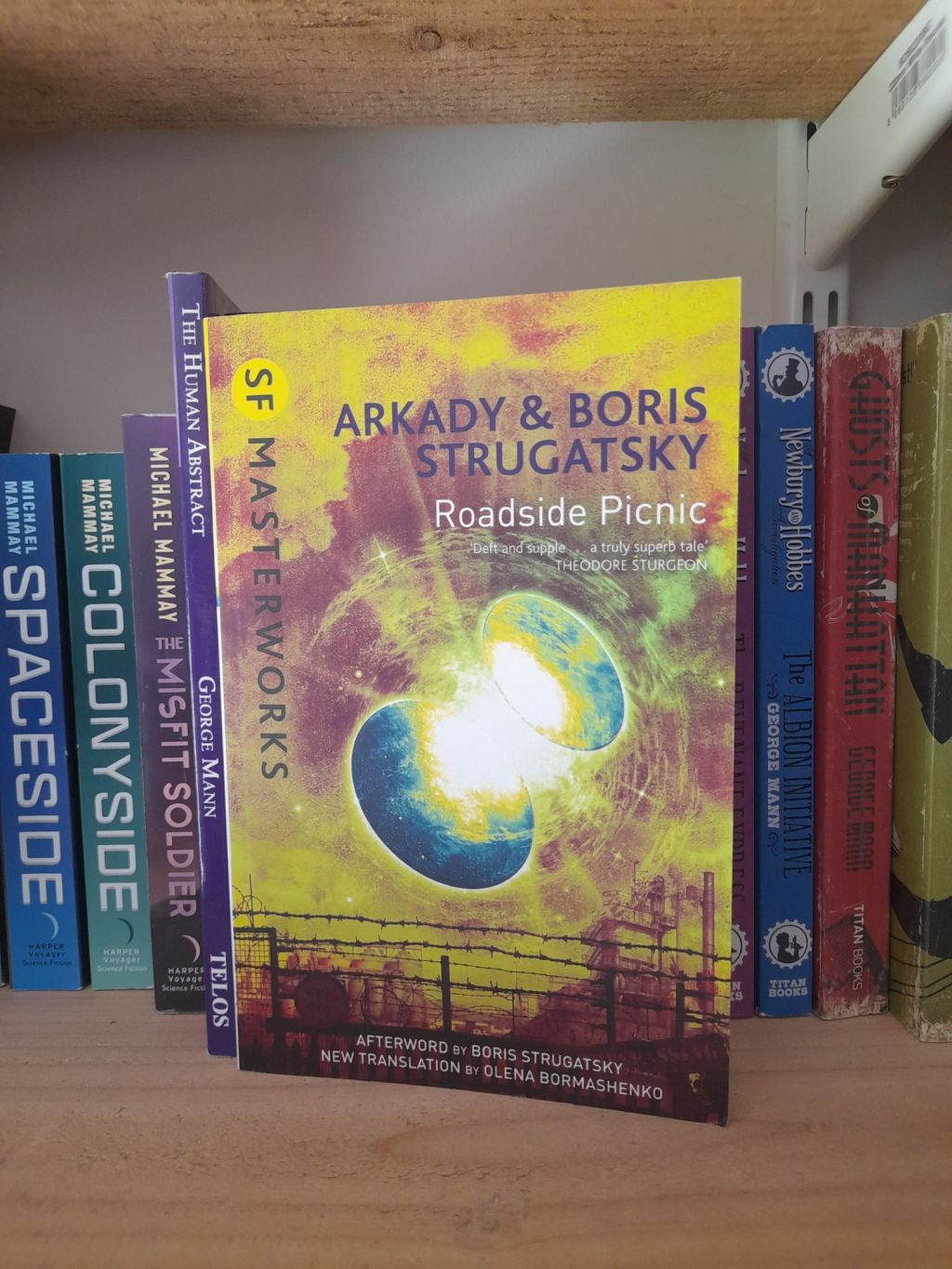
The April pick for the Boundary’s Edge Book Club was another SF Masterwork. This time taking us back in time to the seventies. More importantly, it took us deep into the world of Soviet science fiction. This is an area I have limited knowledge about, but which does seem to have something of a cult audience in anglophone science fiction circles. The Strugatsky brothers are perhaps the most famous Soviet authors, and I say perhaps because Stanislaw Lem also exists. As readers of this blog may recall, I was not a fan of Lem’s Solaris, and on the basis of Roadside Picnic, I am tempted to conclude that Soviet SF is simply not my thing.
The central idea for Roadisde Picnic is an intriguing one. We never meet the mysterious visitors. We only ever see what they leave behind. These alien artefacts range from power cells to toxic slime, to the potential existence of a wish-granting orb. There’s neither rhyme or reason to the objects and their uses, and the attempts to understand them largely occur off the page. Instead we spend most of our time with those who explore the Zones in search of alien technology: the Stalkers. These Stalkers are where you might have encountered the book’s ideas before, because it’s the name carried on through both game adaptations and film adaptations of the book, though I understand that these adaptations are rather loose.
As I have said, it’s a good idea. It’s in the execution that things start to fall apart. It’s tempting to put this down to the translations, which are a fiendishly difficult proposition at the best of times. But I don’t think that’s the issue. Sentence by sentence, paragraph by paragraph, the book flows nicely. It’s in the actual storytelling that what the book does and what I want it to do start to diverge. You see, this is an incredibly vague book. Not just in what the aliens came to Earth for (the best scene of the book is an exchange of theories about this), but in the way the narrative unfolds. There’s an old adage of ‘show don’t tell,’ an adage that I disagree with. Sometimes it’s good to be told things outright. The Strugatsky brothers do neither. Things occur without any particular logic. Characters blur and become indistinct. It’s never clear where the book is going, or even if it’s going anywhere at all. By the time we do get to the end, it’s an abrupt one. A vague philosophical cry that comes out of nowhere, and because it’s the end of the book, goes nowhere either. It’s all a bit of a letdown really.
I think the issue is only partly with the book, but mostly with me. While the book has its failings, it’s also not the sort of book I enjoy. It’s less about the rigorous science fiction I enjoy, and more about using science fiction motifs to create a sense of alienation. Not so much science fiction, as weird fiction. And while I appreciate the idea of the weird, I frequently find that the actual execution of that particular genre is never as satisfying as the idea of it.
If you want to get a sense of what science fiction from beyond the English-speaking world looks like, then this is a fantastic way to explore the wider world. But if, like me, you prefer your stories to be a little more concrete, then you might find the experience a lacklustre one.
Book Stats
- Translated by Olena Bormashenko
- A Gollancz SF Masterwork
- Originally Published in 1972
- 193 Pages


