Teaser
With a new age of peace dawning, the RCN can repurpose its warships for less violent endeavours, like the pursuit of knowledge, and the exploration of deep space . . .
Review
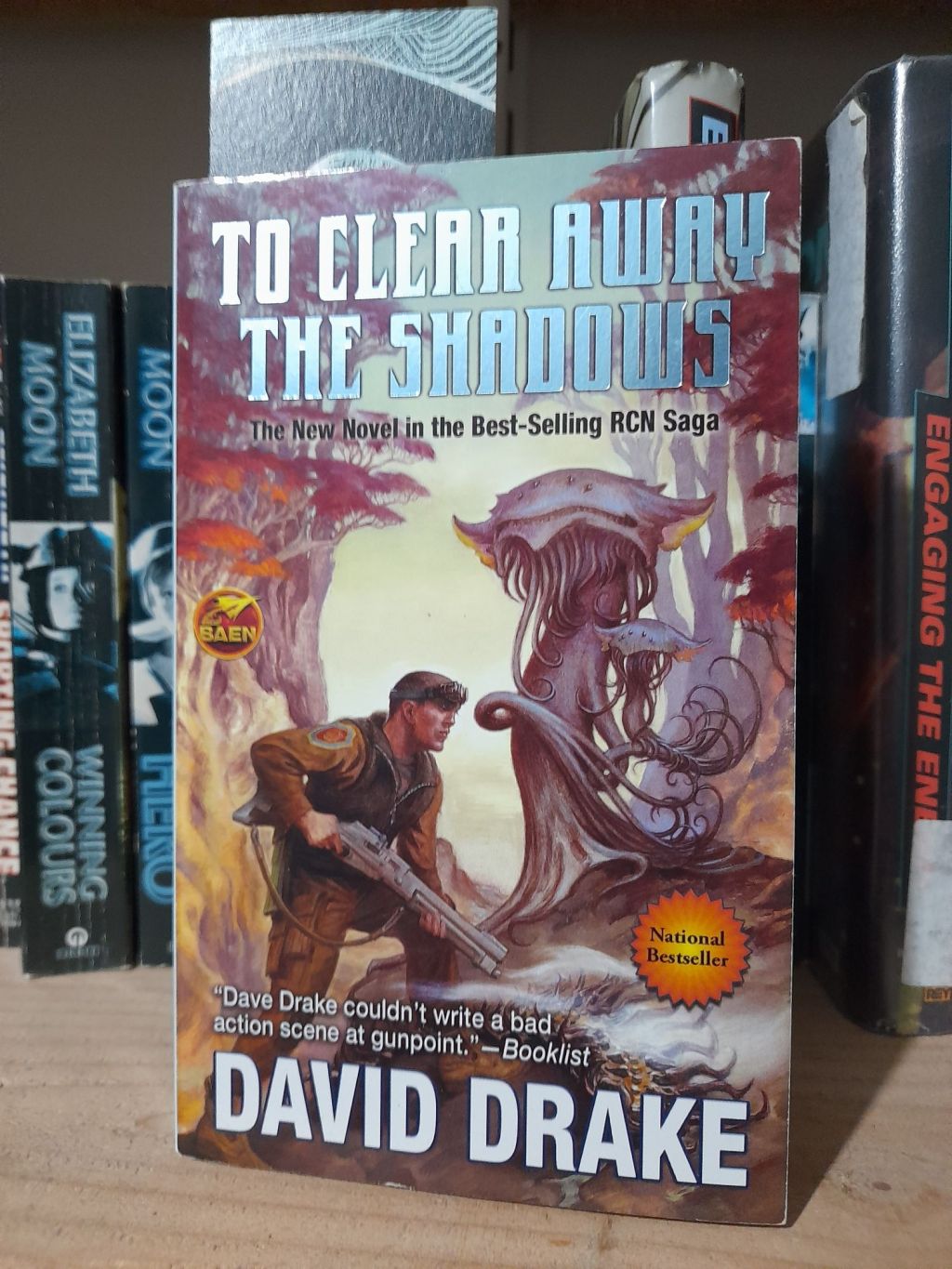
When I think of Baen books, one of the first names I think of is David Drake. Coincidentally, the other name I tend to think of is David Weber. Yet while Weber looks like he can single-handled keep Baen sustainable as a publisher, it’s Drake’s books that were picked up by a UK publisher. My RCN collection is a mix of Baen and Titan editions, with this final book in the series never being printed in the UK.
To Clear Away the Shadows is a slightly awkward book to talk about. While ostensibly part of the RCN series, it features neither Leary nor Mundy, the protagonists of the other dozen novels. It was also one of the last books Drake wrote before retiring due to ill health. I can’t help but wonder if those health concerns played into some of the stylistic choices of the book, in which case it feels unfair, maybe even disrespectful, to criticise them. Nevertheless, it’s impossible to really talk about the end of the RCN series without discussing those choices. So that’s what I’m going to do.
Whereas the other RCN books were broadly military SF with inspiration coming from direct lifts of historical events, To Clear Away the Shadows takes its premise from the age of scientific voyages such as Charles Darwin’s journey to the Galapagos Islands. As such, it’s a slightly gentler novel. There’s still action and adventure, but the stakes are much, much lower. There are also two stylistic choices that set it apart from the rest of the series.
The first of these is the wider narrative structure. Drake does away with chapters, instead braking the book into chunks, each about fifty pages long, set on different planets. The resulting feel is like a series of Star Trek novels. Not directly connected to one another, but with each stop on the journey having a different problem that needs to be solved. Unfortunately, these sections are each too short to have any real depth. Aside from one double-kidnapping, things just speed past very quickly, and it’s easy to gloss over. Even the grand finale of the book, and therefore the series, is wrapped up incredibly quickly, almost with a sense if it being swept under the carpet. Each section could have been expanded into an entire novel, creating a new series with a markedly different feel to the first dozen RCN novels. Instead, we have what feels like a summary of a larger work. A highlights reel of something much more involved than we actually get.
The second choice is a matter of perspective. Half of the book is told in the third person, and half of it in the first person, that person being Harry Harper. The changes from one perspective to another happen with no real rhyme or reason, as Harper is present in most of the third-person sections too. Nor do we get any warning that the perspective is about to shift. Without clear chapter delineations, we’re flung between narrow and broad scopes and left to deal with it. Shifting perspectives like this is a pet peeve of mine, and I think the book would have been better served by sticking with one. Either one would be fine, as both are compellingly written. It’s the constant change that proves to be the sticking point.
The RCN series had its ups and downs along the way. This is, after all, a series that ran for two decades. This final volume is perhaps better treated as a bonus story rather than part of the series proper, or even as a teaser of what Drake is capable of, and while it’s not the worst the series has to offer, it falls far short of being the best. It’s fun and charming when it fires on all cylinders, but ends up landing somewhere in the middle of the pack.
Book Stats
- A Republic of Cinnabar Navy Novel (#13)
- First Published 2019
- 342 Pages


