Teaser
Humanity has spread out among the stars in an adventure lasting thousands of years. Yet there is still one planet that is held special. Earth. The world where it all began . . .
Review
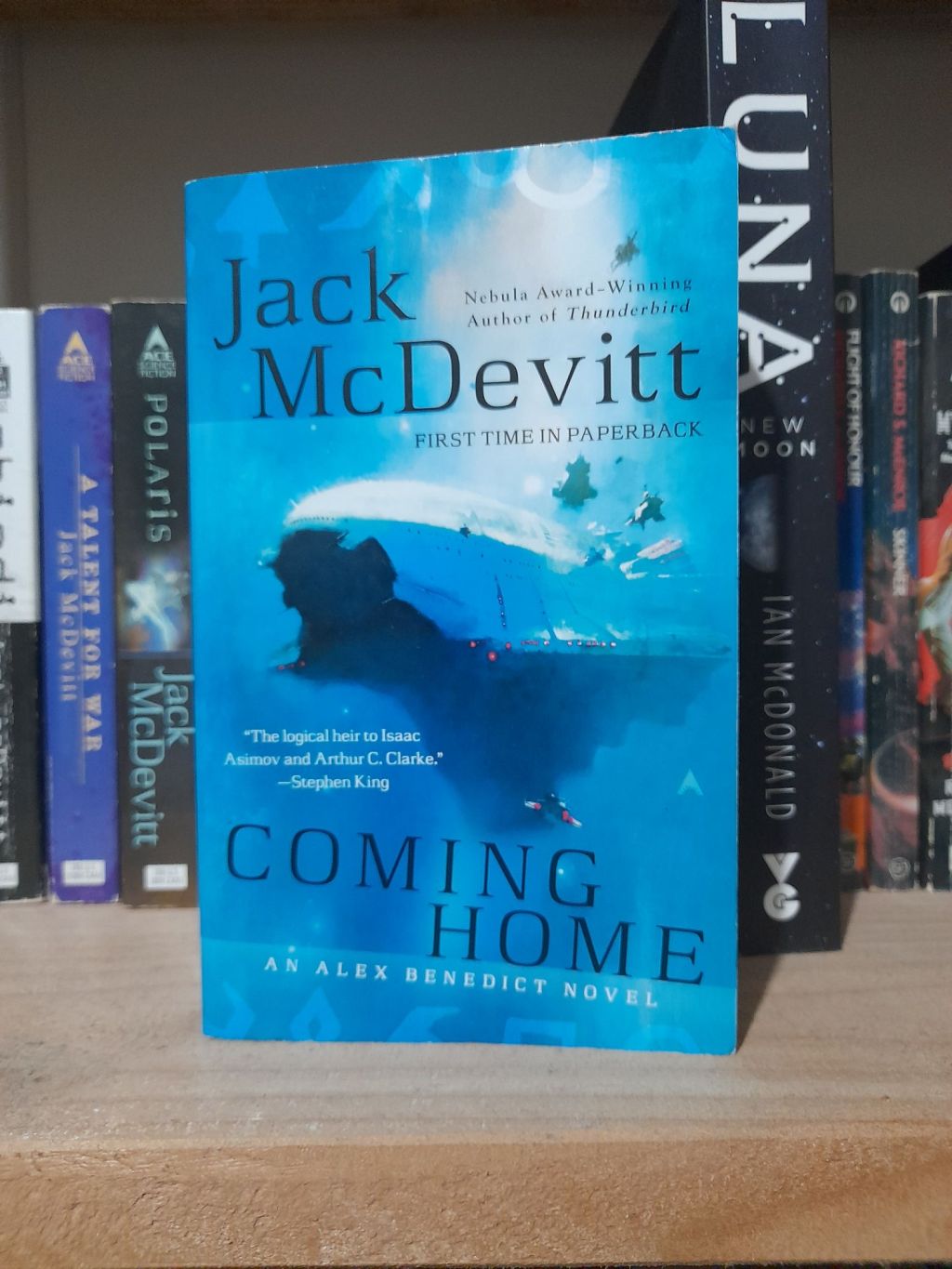
You know the deal by now. Step One: I read a Jack McDevitt Book. Step Two: I tell everyone I know that they should be reading Jack McDevitt’s books. If I broke this book down into plot, style, characters, and all those other bits readers like to talk about, then I’d say they’re all nigh-on perfect. That’s not bad for a review, but it’s also what I’ve done for pretty much all of McDevitt’s Alex Benedict novels. This time around I’m going to approach the book a little differently. I hope you’ll stay with me.
This is a series about historians. You can view them as treasure hunters, tomb robbers, or archaeologists. All are true, but more than that, they are people interested in history. But the books are set well around ten thousand years in our future. They have twice as much history of civilisation to look back on as present-day archaeologists. A lot more space, as well as time. Previous books have tackled missing spaceships, strange asteroids, and war with aliens. Coming Home, however, lives up to its name. It’s still largely concerned with future history, but it takes place somewhere we all know: Earth. And what grand historical events? Something very close to the heart of science fiction. Humanity’s first missions to other worlds.
McDevitt has always been very good at weaving the real and the unreal. Look at the epigraphs of each chapter. Sometimes you’ll find Shakespeare. Sometimes a Romantic poet. Sometimes an extract from a novel that doesn’t exist. Sometimes details on the lives of people who won’t be born for thousands of years. Coming Home takes things to the next level. The Apollo missions play a key role (unfortunately, I fully believe that lunar vandals would be willing to steal Neil Armstrong’s footprints), but alongside this we have references to Mars missions, and the first crewed voyage to Saturn. Of course, at a remove of several thousand years (including an unfortunate Dark Age) history and myth become muddled, especially in the absence of concrete proof. There’s a brilliant section that muses on the historical identity of characters such as Dracula (presumably a blood doctor of some kind) and Sherlock Holmes (a clear influence for the narration-by-sidekick approach this series takes).
One of the most fascinating ideas put forward by coming Home is that of the Golden Age. It’s a term we see thrown around a lot, both in fiction and reality. Look no further than the Golden Age of Science Fiction to see how definitions can shift and change over time. McDevitt suggests, perhaps optimistically, that the mid twentieth century onwards is humanity’s golden Age. Of course, this is from the rose-tinted perspective of his future historians, but it’s enough to make you think. Look at the news, and you’ll see war, plague, economic collapse, and environmental disaster. It looks bad out there. But if you compare the modern world to any previous century, it changes your perspective. If you’re reading this, then you have an internet connection. You can talk to people from around the world without delay. There’s a good chance you don’t have to worry about where the next meal is coming from. You probably have access to heating and drinkable water. On a more historic note, humans have been to space. Since 2001, there has never been a point at which all human beings were on Earth. Taken from that perspective, and if it’s those trends that continue, maybe we really are in for a Golden Age. Maybe one of you reading this will go into space. Maybe we will all be remembered by history.
Coming Home is as fine a grand adventure as any of McDevitt’s novels, but it’s also a reminder of where we came from. Much like Carl Sagan and Voyager 1, McDevitt takes us on an epic journey, then turns around and says, ‘Look. This is where we came from.’ In truth, most of us are going to stay on this pale blue dot our entire lives, but just because we don’t have access to the stars, it doesn’t mean we can’t dream.
Book Stats
- Alex Benedict #7
- First Published 2014
- 356 Pages

 At Boundary's Edge