Teaser
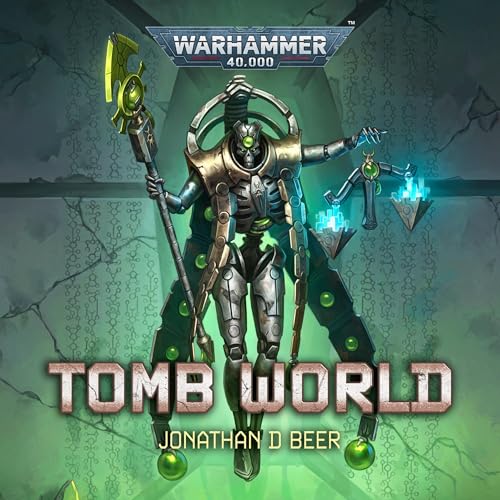
Praetorian Khemet of the Necrons has endured an eternity of torture. Freed at last, she is given one final chance to redeem herself. All she needs to do is conquer a world overrun by the Imperium of Man . . .
Review
Recent years have seen a fair few Necron-focused novels from Black Library. As well as appearing as the villains in everything from Indomitus to The Silent King as part of Warhammer 40,000’s ‘main story,’ we’ve also been treated to some stories told from the Necron perspective. Robert Rath’s The Infinite and the Divine takes a lot of the credit, but there’s also Nate Crowley’s Twice-Dead King duology. Now joining their ranks is Tomb World by Jonathan D Beer.
Tie-in fiction generally assumes that the reader has an awareness of the franchise. Few people will read Shadows of Mindor if they don’t already know who Luke Skywalker is, for example. Warhammer has always had an odd relationship with its base franchise in this regard. The vast majority of characters are original to the books, with only a rare few having models. However, the worldbuilding itself largely stems from rulebooks that will have minimal interest to fiction fans. You can generally establish what sort of weaponry a character is using without knowing the tabletop stats of those weapons, but when it comes to the intricate workings of Necron hierarchy, it’s easy to lose oneself in the mire of unfamiliar names and pseudo-Egyptian jargon that these undying robot legions employ.
In that regard, I think that Tomb World has a higher barrier of entry than a lot of other novels from Black Library. Our protagonist Khemet begins the novel with no idea what is going on in terms of plot. That’s fine. But the bigger problem is that the aspects of the world which are familiar to her are a perplexing mystery to anyone unfamiliar with the rulebooks. I’ve been reading Warhammer novels for almost a decade now, and I spent the first act of this book completely lost. with that introduction, it takes some time for the book to really hit its stride.
When it hits though, it hits hard. The second act introduces a slew of new characters. Human ones. Ones we can understand even if their vocabulary is full of trademarked terms. Once we get to see the slow war actually unfolding, the book absolutely kicks up a notch.
The nature of the war is also a little different to what I’ve read in other Warhammer novels. the Necrons are effectively immortal, and therefore can afford to think along different timescales to humans. Khemet’s planned war is based on the assumption that it will take several years to show results. Every devastating assault and insidious ploy comes months apart from the others, and even though the book is fairly short, it really does feel like someone playing the long game. The image of Necrons emerging from the sea is also one that will stick with me for some time.
It is a shame that I struggled so much with the opening stages of the book, because when it shifts focus to the humans, it has some of my favourite depictions of humanity on the ropes. The middle act of the book is probably some of the strongest Warhammer writing I’ve come across recently, even if the book as a whole is at the weaker end of the recent surge of Necron texts.
One last thing I want to add as a note of praise is the writing itself. Warhammer books have historically tended to be fairly tradition third-person, past tense narratives. Tomb World is written in the present tense, and that really adds to the cinematic scope of the action scenes. We might not be able to understand the Necron psyche, but we can certainly watch their deeds unfold while we as readers are powerless to intervene.
Audio Stats
- Narrated by Gabrielle Nellis-Pain
- A Standalone Novel
- Published in 2025
- Runtime 10hrs 1min

 At Boundary's Edge