Teaser
It is called the Eschaton, and it is not God. It is, however, from the future, and utterly determined to see its own existence come to pass. Those who threaten the Eschaton will suffer the most dire consequences . . .
Review
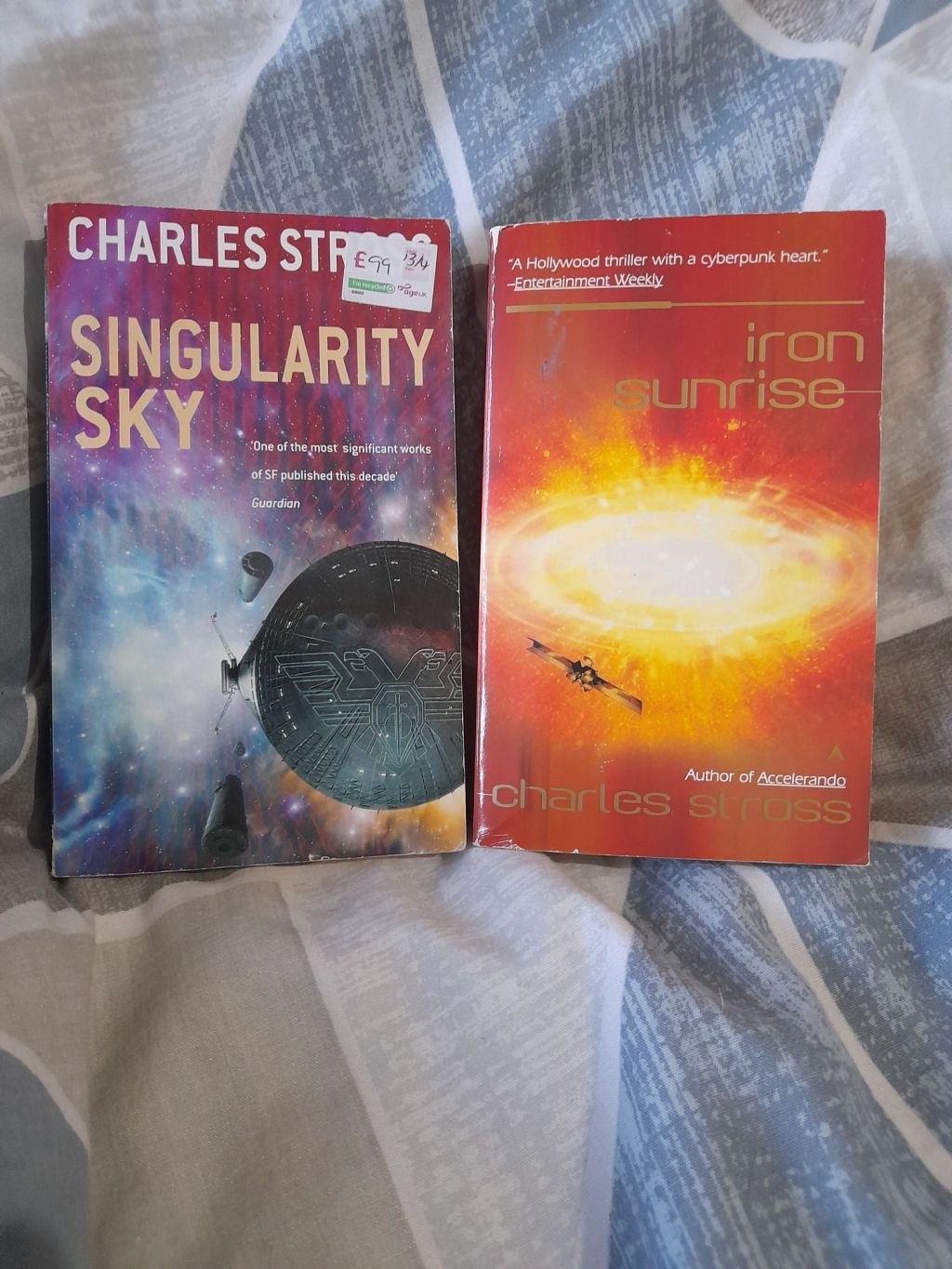
Charles Stross is one of those names in British science fiction who have become well known (and well-regarded) without ever quite breaking through to become big. Part of the same generation of writers that includes luminaries such as Alastair Reynolds, Ken MacLeod, and Stephen Baxter, Stross’ work blends hard science fiction with a distinctly British sensibility. His most famous work, the Laundry Files, is one that I’ve always steered away from on account of it looking alarmingly like urban fantasy with added maths, but such is his reputation that I knew it was only a matter of time before I picked up one of his books. That picking up actually happened in the US two years ago, and it was the second book in a series. It wasn’t until I found book one much more recently that I was ready to dive in.
Let me tell you, it’s been quite an experience. These books are, to say the least, utterly unique.
One of the never-ending debates in science fiction communities is this: Is science fiction political? My answer is a cowardly: Yes, but not always. Rather, I think science fiction is cultural. But since politics is also cultural, the Venn diagram containing the two is very nearly a single circle. Is a book about plucky rebels overthrowing an empire political? Well, empires are political bodies, but that doesn’t mean the author has intended to make any great political statement through their work. Maybe they just like fights. Readers bring their own political ideas to reading, and it’s in the conversation between author and reader that the bets parts of fiction happen. The only politics in science fiction I’m truly suspicious of are the ones that are clear analogues of (or direct reference to) today’s politics, where ‘today’ is whatever hot topic was alive when the book was being written. Thankfully, good science fiction tends to be a little subtler than that, showing us universal cultural issues rather than todays news cycles.
I say this because in the opening chapters of Singularity Sky we have a lot of politics being thrown around. The plucky rebels here are an explicitly Marxist group, and the evil empire they’re seeking to overthrow is just Tsarist Russia transported onto another planet. Okay, so it’s not quite ‘today’s’ politics, but it is current schools of political thought written into the text without so much as a mask of metaphor. My personal tastes aside, it is interesting for a book to be so upfront. A thematic slap in the face to make sure we’re paying attention. Personally though, I was a little distracted by the idea of telephones raining from the sky.
It’s a striking image to begin a book with, and the idea of the Festival and its unique methods of contact and bartering are fascinating. That’s easily enough fodder for a book. Throw in the political revolution and we’ve got a lot to chew on. But then Stross throws in more. The Eschaton. The future of humanity reaching back into the past to make sure no one aborts its existence. This is a book that sets its sights high, but is also looking in so many directions that it can never quite stay focused on one goal. I don’t mind a kitchen sink when it comes to space opera, but in idea-driven fiction like this, I feel like the ideas should be clearer. Somewhere along the way I got lost, and once I was lost, I found that I didn’t have much interest in fighting my way back.
Iron Sunrise opens with equally striking visuals and big ideas. Destroying suns through plausible scientific means? Sign me up to read about that. But again, the ideas keep coming. There’s too much to take in. The individual pieces of the puzzle are pretty enough to look at, but the whole ends up being far less than the sum of its parts. It’s shame, because the writing itself is good. Stross has a way of adding humour that only occasionally slips into farce, and that’s frequently due to another of my pet peeves: written accents. The less said about those, the better. Appropriately enough.
Maybe I came to Stross with my expectations set too high. Maybe the issue with these books is my tastes. Or maybe it’s because they mark the debut of someone with grand plans. I know that Stross did plan a third book in this series, but abandoned it due to complications with the physics of his worldbuilding. Maybe that’s why these duology feels unfinished and lacking in focus. The story is complete, but it is also underwhelming.
I’m definitely interested in reading more by Stross, but I’m going to recalibrate my expectations before doing so.
Series Stats
- Two novels
- Published 2003-2004
- 822 pages total

 At Boundary's Edge