Teaser
When a man appears suddenly in the middle of a scientific experiment, everything we know about the world is cast into doubt. Is he truly the Neanderthal he appears to be? And if so, where did he come from . . ?
Review
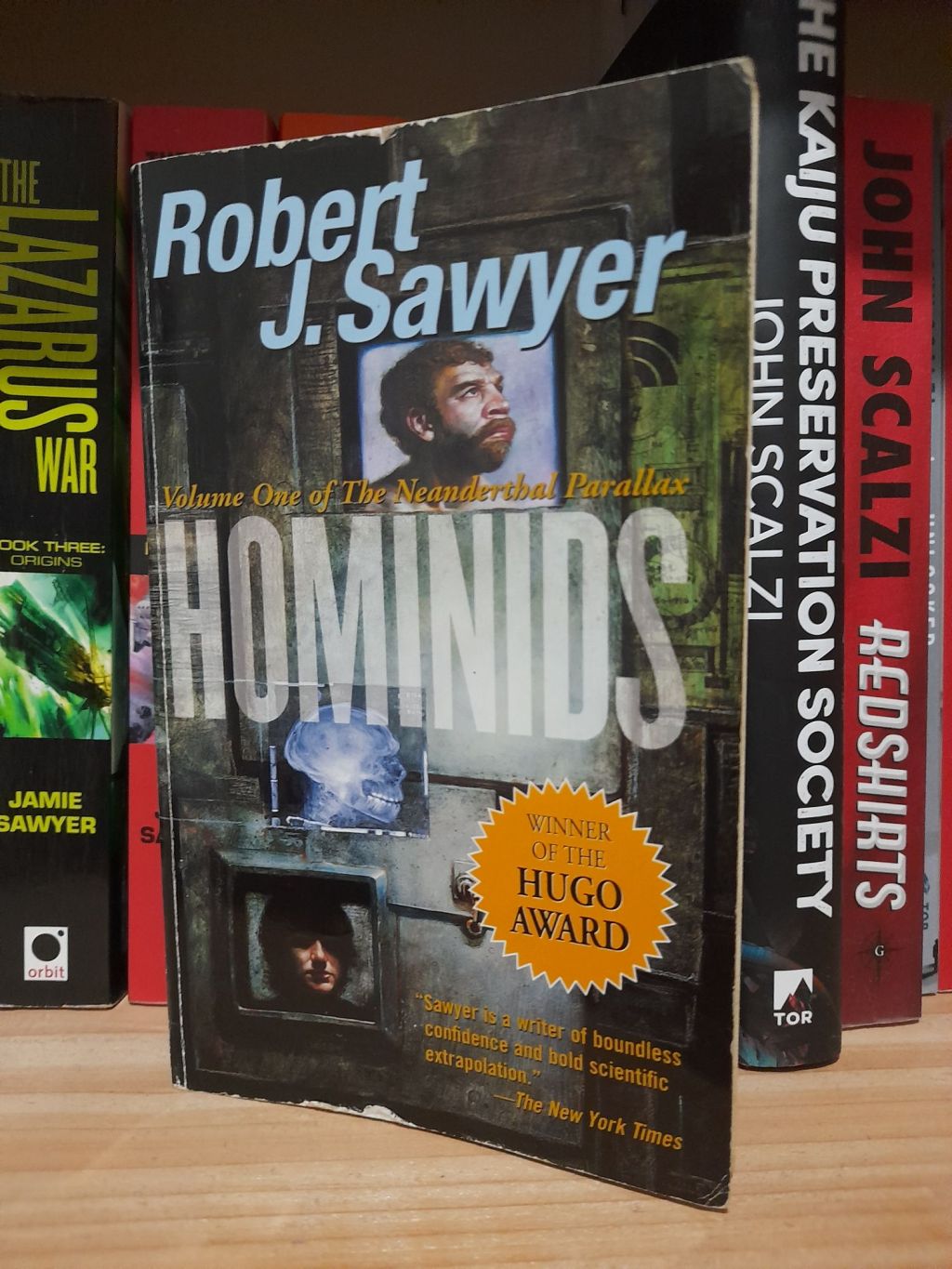
Hominids is one of those books that surprised me. I know of Robert J. Sawyer by reputation, but have never read his work before. Though the TV adaptation of FlashForward has been on my radar for several years now. I know he’s held in high regard, and that Hominids won him the Hugo Award for Best Novel. since I’m slowly working on a readthrough of all the major SF literary awards (and a few minor ones), I knew I’d get round to him someday. That day’s arrival was hastened when I found a copy of Hominids in the wild. And yet, it didn’t look like my kind of SF. Maybe I’m still scarred from Isaac Asimov’s The Ugly Little Boy, but the idea of a caveman coming into the present day didn’t thrill me the way interplanetary exploration and sweeping space operas do. I approached Hominids with hope, but also a sense that I was reading it to fulfil an obligation.
Reader, I could not have been more wrong. This book is absolutely brilliant.
My Asimov concerns were immediately set to rest. Ponter isn’t a helpless victim in this, he’s a man with agency. Nor is he a hapless primitive. He’s not from the past, you see, but a different version of the present. One in which Neanderthals rather than regular homo sapiens emerged as the dominant branch of humanity. Ponter has a computer that helps him quickly learn English, which is the single most relieving part of the book. There’s no grunts or slow language lessons, but nor does it invalidate the cultural differences between the two civilisations.
Half the book takes place in our world as the scientific community, and then society as a whole, reacts to the arrival of a random Neanderthal. Some of the most entertaining parts are the news headlines from around the world, though there are of course more personal experiences of those who get to know Ponter more closely.
Meanwhile, in the world Ponter left behind, his sudden disappearance triggers a murder trial. This half of the novel lets Sawyer run wild with his imagination as he depicts a present-day Earth built around wildly different cultural, sociological, and biological norms. You can tell from the lengthy afterword how much research Sawyer put into his secondary world, and it all pays off splendidly. There are so many layers to this other timeline, all rooted in archaeological evidence from our own world, alongside some wild theorising. Sawyer tackles everything from Neanderthal family units and policing methods to their relationship with nature and their (lack of) any form of religion. Sawyer takes his time to explore it all, and wisely never positions one world as better or worse than the other. It is absolutely fantastic stuff.
It should also be noted that although this is the first book of a trilogy, it also works perfectly as a standalone novel. Present-day (at least at the time of writing) is a little way outside of my comfort zone, but Hominids is the perfect example of how to do it right. The early 2000s are a slight gap in my Hugos knowledge, but Sawyer’s work absolutely deserves the accolade. If you haven’t read it already, I highly recommend it, and I know that I’ll be keeping an eye out for more Sawyer next time I go on a book crawl.
Book Stats
- The Neanderthal Parallax #1
- Published in 2002
- 417 Pages


 At Boundary's Edge