As most regular readers of the blog will know by now, I read quite a bit of Military SF. It’s in my top three subgenres, alongside Space Opera and Hard SF. When it comes to military SF, I’m looking for two things. First and foremost, I’m after a good story, the same as I am with any book of any genre. But I’m also looking for a book that interrogates the idea of the military. Books that go beyond action and show the role of the military in a society, and how the military becomes a society unto itself. I also love the nitty gritty of supply chains and tactical debates. All the good stuff.
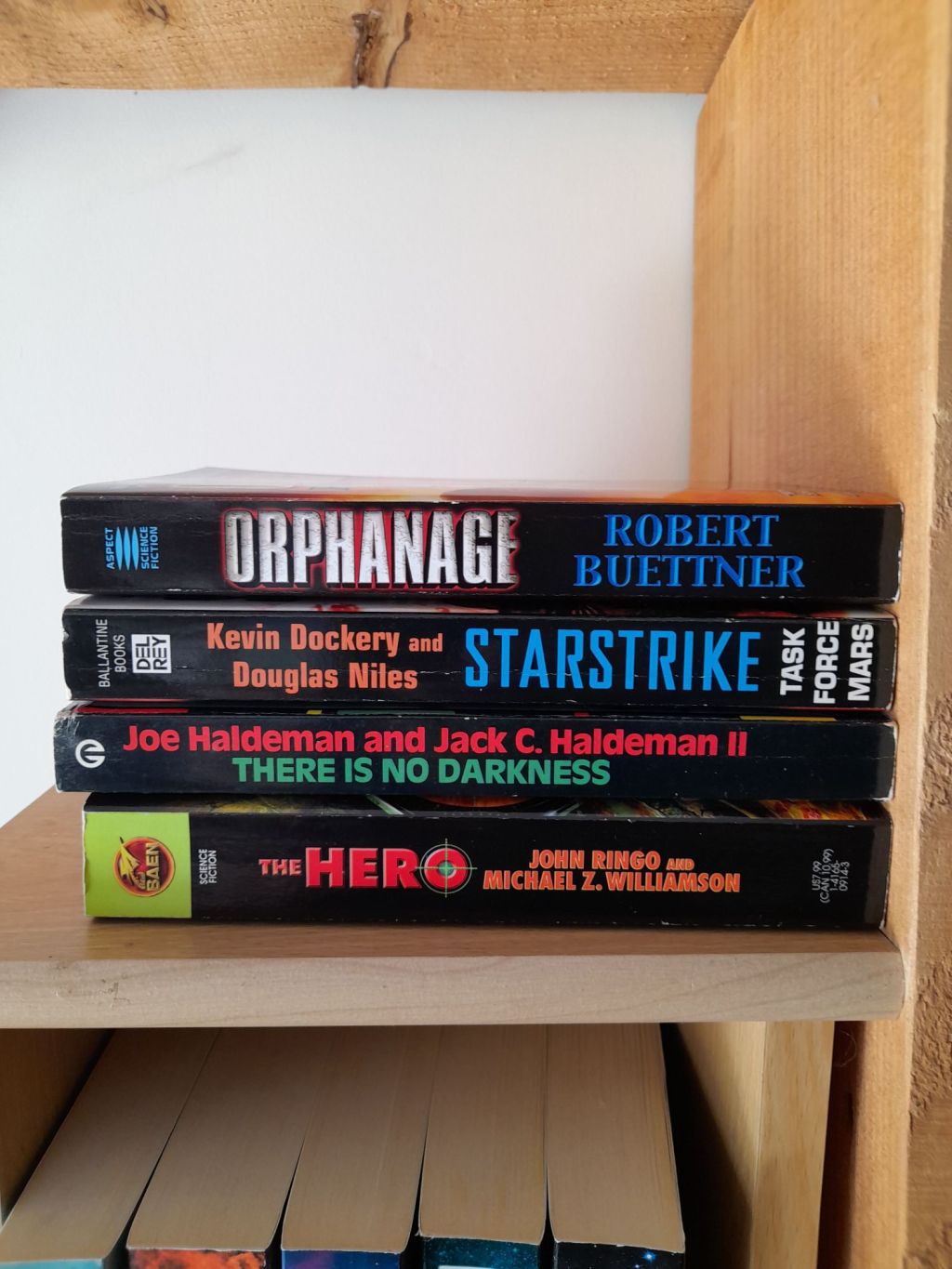
Unsurprisingly, most of the best military SF is written by authors who have a military background. There is something to the old adage ‘write what you know’ after all. It’s also not a coincidence that the majority of military SF comes from American authors. The US has a much more public relationship with its military than most other countries. This has led to Military SF leaning towards an American interpretation of the world for some time. But not all books are made equal. Today I’m going to run through four US-authored Military SF books that I’ve read recently, and see if we can draw any lines between them.
There is No Darkness, by Joe Haldeman & Jack C. Haldeman II
Joe Haldeman served in the Vietnam War and wrote the magnificent Forever War series influenced by his experiences. This novel is cowritten with his brother, from whom I have read only a few baseball-focused short stories before. 1983’s There is No Darkness is a slightly disjointed novel (the result of being expanded from short stories) but largely tells of a school for future military leaders. the weaker parts see the youngsters opting to enjoy some gladiatorial combat, but the strongest arc is found in the middle of the book, where they are conscripted into a war fought on historical terms. War is something truly horrible here, with salvation coming not through force of arms but through legal trickery.
Orphanage, by Robert Buettner
Published in 2004 (when America was joined by its NATO allies in a war that soon spread across the Middle East), Orphanage is a coming of age story about an eighteen year-old Jason Wander who joins the army in the wake of a devastating alien attack on Earth. The parallels with the 9/11 attacks are painfully obvious. This is a book that is perhaps unconsciously patriotic, but it’s notable that as the whole world is attacked, it’s the US that leads the counterstrike, though it is also worth noting that one of the supporting characters is an Egyptian Muslim, and her faith is not critiqued upon, which is refreshing for the time period. Though predictable in its plotting, Orphanage is a very well-written book, and Buettner doesn’t pull any punches when he sends his protagonists into battle.
The Hero, by John Ringo & Michael Z. Williamson
Also published in 2004, The Hero avoids some of the narrative pitfalls of its contemporary by taking place in the distant future. It also has the benefit of slotting into a larger, pre-existing future history. However, the background worldbuilding is indicative of an conservative American mindset. The military is elevated above pacifist civilian leadership, attempts to control gun ownership are derided, and the Republic exists because it declared independence from an older power through military means. There is a deep-rooted distrust of anyone unwilling to fight, even when violence causes all of the problems in this book.
Strike Force Mars, by Kevin Dockery & Douglas Niles
I only realised how many of these books were co-authored when writing this article. Douglas Niles is best known to me as an author of Dungeons and Dragons novels, but his 2007 team-up with army veteran Dockery takes place in the near future. We see the Navy SEALs put on a pedestal as the ultimate fighting force. So great that aliens will have humans fight alien wars on their behalf. This is, bluntly put, not a very good book. It’s almost all action, pausing only so that the conventionally attractive alien can be romanced successfully. It doesn’t add much to the overall conversation, but rides the tide of mid-2000s Military SF. A simplistic tale, if one that does nothing to actively offend the reader.
My initial takeaway from these books is that it’s harder to write morally complex military tales when your own military is engaged in a(n ostensibly) defensive war. To get a better idea, I’d have to continue my Military SF reading to incorporate more countries. So if you have any recommendations for Military SF written by non-US authors, I’d love to hear from you.


