Teaser
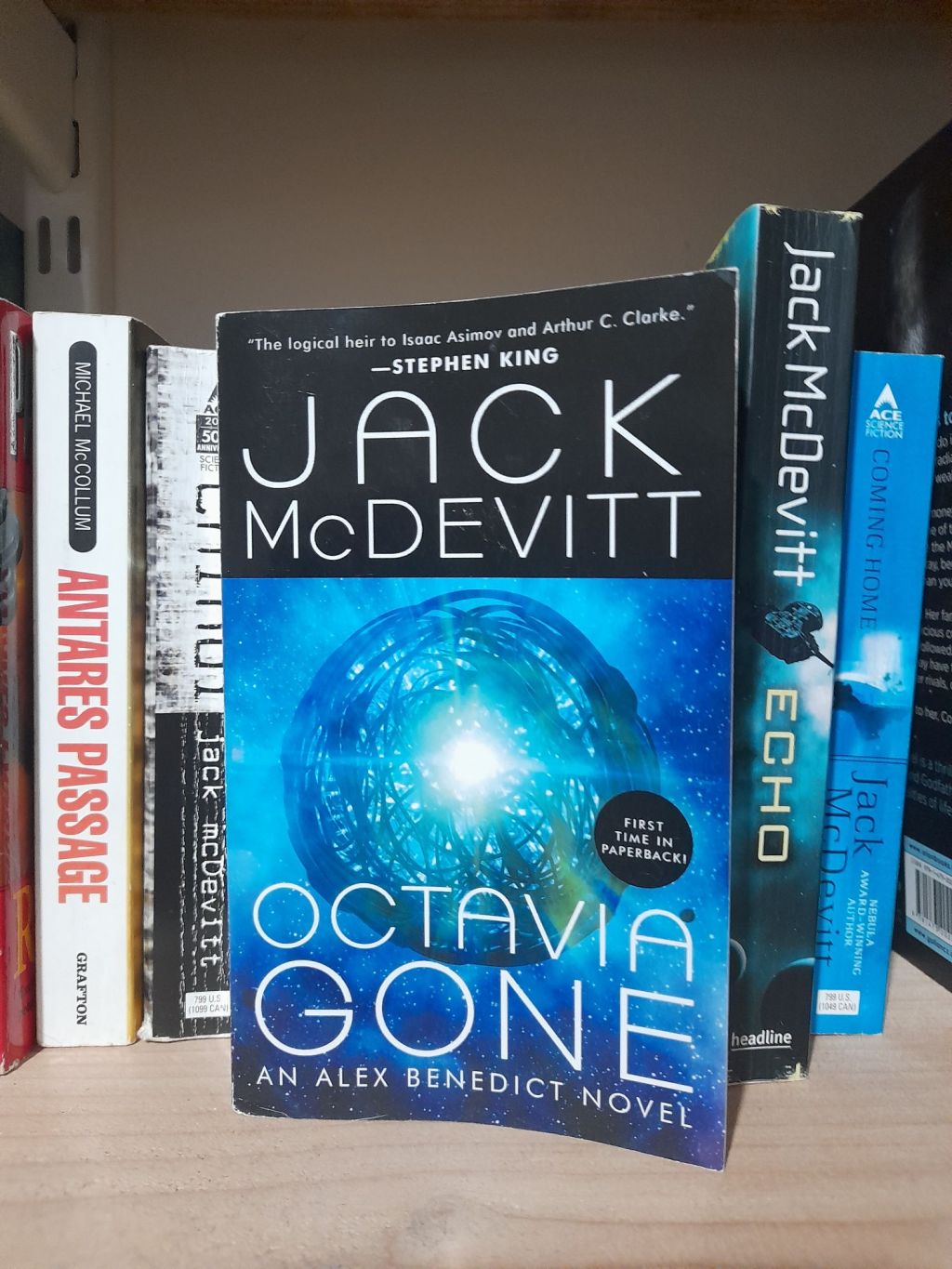
It has been over a decade since Octavia station disappeared near a black hole. But when Alex Benedict and Chase Kolpath begin their investigations, they discover a mystery far older, and far, far stranger . . .
Review
One of the common misconceptions about science fiction is that it seeks to predict the future. Now, there are certainly some books where that is the goal, but they by no means make up the majority of the genre. What is true is that science fiction looks at the world as it is, and hypothesis on what might change. Sometimes these changes are rooted in creations of the author’s imagination (Here I refer you to all alien invasion stories) but there are also more serious attempts to extrapolate from our present da situation. Not to predict the future, but to examine possibilities. These are the sort of story on which the genre was built over a hundred years ago. Stories which ask the greatest question of them all: What if . . . ?
Broadly speaking, Jack McDevitt’s Alex Benedict novels are not seeking to extrapolate plausible futures. These are adventure novels that sit in the demilitarised zone between full-blown space opera and more rigorous hard SF, with a dash of crime thrown in for good measure. They are set thousands of years in the future, but are filled with a love of logic and deduction that few other authors can rival. They are also built on a near-century of science fiction preceding them. This means that a lot of those extrapolated ideas end up in these books. In Octavia Gone, the eighth Alex Benedict novel (though one that possibly features the least of Benedict himself), the grand idea running through it all is Artificial Intelligence.
There are two types of artificial intelligence at work here. One is of alien origin, and the other is more human. To discuss the alien side would be to delve into full-blown spoilers, but suffice it to say that they are of a form you’re likely to have encountered before. Fully autonomous robots that can think and, to an extent, feel for themselves.
It’s the more mundane use of artificial intelligence that stands out the most. Throughout this series we’ve seen the use of avatars. In short, an avatar is an snapshot of a deceased individual formed by uploading an amalgamation of their digital footprint. These prove useful when studying a long-dead hero, or for tracing the ownership of historical artefacts. Why read books about the people when you can just ask questions directly. More generally, they allow for a form of digital afterlife. An avatar can read a will, while those who miss their grandmother can still talk to them on a daily basis.
If any of that sounds familiar to you, it’s probably because we now live in a reality not too divorced from such a future. The rise of LLM technology and deepfakes now means that you can create something worryingly similar to an avatar. Within the last few years, Facebook created an option to have a bot continue posting from your account in the event of your death, and it was recently announced that a digital replica of Ozzy Osbourne was being created with the permission of the late rock legend’s family. We are now well into an era where you can have an entire conversation with a robot that responds in real-time. A lot of the time people will do so willingly, asking a chatbot for information rather than seeking it out for themselves. But there are also bots out there programmed to act as if they are real human beings.
This is all incredibly dangerous. For McDevitt, avatars are a narrative shortcut for his characters to acquire information. For the real world, chatbots are actively damaging human literacy rates and ability to think for ourselves. Still shortcuts, but ones that run extreme risks of unreliability, and that’s even if we don’t assume malicious misuse. In Octavia Gone, avatars might not know the answer, and they will confess as much. Because they maintain their originator’s personality, they might even actively hide information or play coy. In real life, we are not so lucky. Not a day goes by without a new scandal breaking about ‘artificial intelligence’ confidently giving out false data, either because it cannot distinguish between reality and fiction, or because when asked for an answer, it’s programming forces an answer out, regardless of accuracy.
Octavia Gone was published in 2019, before the surge in LLMs, so it’s not McDevitt’s fault that he is so widely off the mark when it comes to the depressing reality of so-called AI. But reading it in 2026, it’s hard not to be annoyed by how differently things have turned out. I admire McDevitt’s optimism and enthusiasm for science, but I can also wholeheartedly say that the world was a better place when this book was written. Before the scourge of chatbots of predictive AI was forced upon us by people with more money than sense.
I dare say we are going to witness a major shift in science fiction over the next few years. At least in one tiny niche. We use to have lofty ambitions about artificial intelligence and sentient robots. Now we have the AI label being slapped onto software that does little beyond regurgitating small parts of the vast crop of information it has harvested. And if you need any proof it’s not the revolutionary technology it’s cracked up to be, consider the fact that we’re being forced to use it, or at least offered it for free. Even as I type this, a little box asks me if I want a machine to rewrite my words. No. No I don’t. This new, poorly implemented version of AI is here to stay, and I suspect it will pus the science fiction conversation about such tools in an increasingly pessimistic direction. We’re unlikely to have any rose-tinted yet well-thought arguments about the role of artificial intelligence in fiction for some time. So if you want that, you might have to look back. To the pre-pandemic era when avatars were still cool rather than creepy and robots were our friends, not our competitors.
Octavia Gone is another brilliant book in McDevitt’s long-running series, but as with all science fiction, it is increasingly a product of its time.
Book Stats
- Alex Benedict #8
- Published in 2019
- 440 Pages


