Teaser
In a fragmented galaxy still recovering from a devastating conflict, the Carlysle family have established their own interplanetary company. But not everyone is happy with their monopolisation of wormhole technology . . .
Review
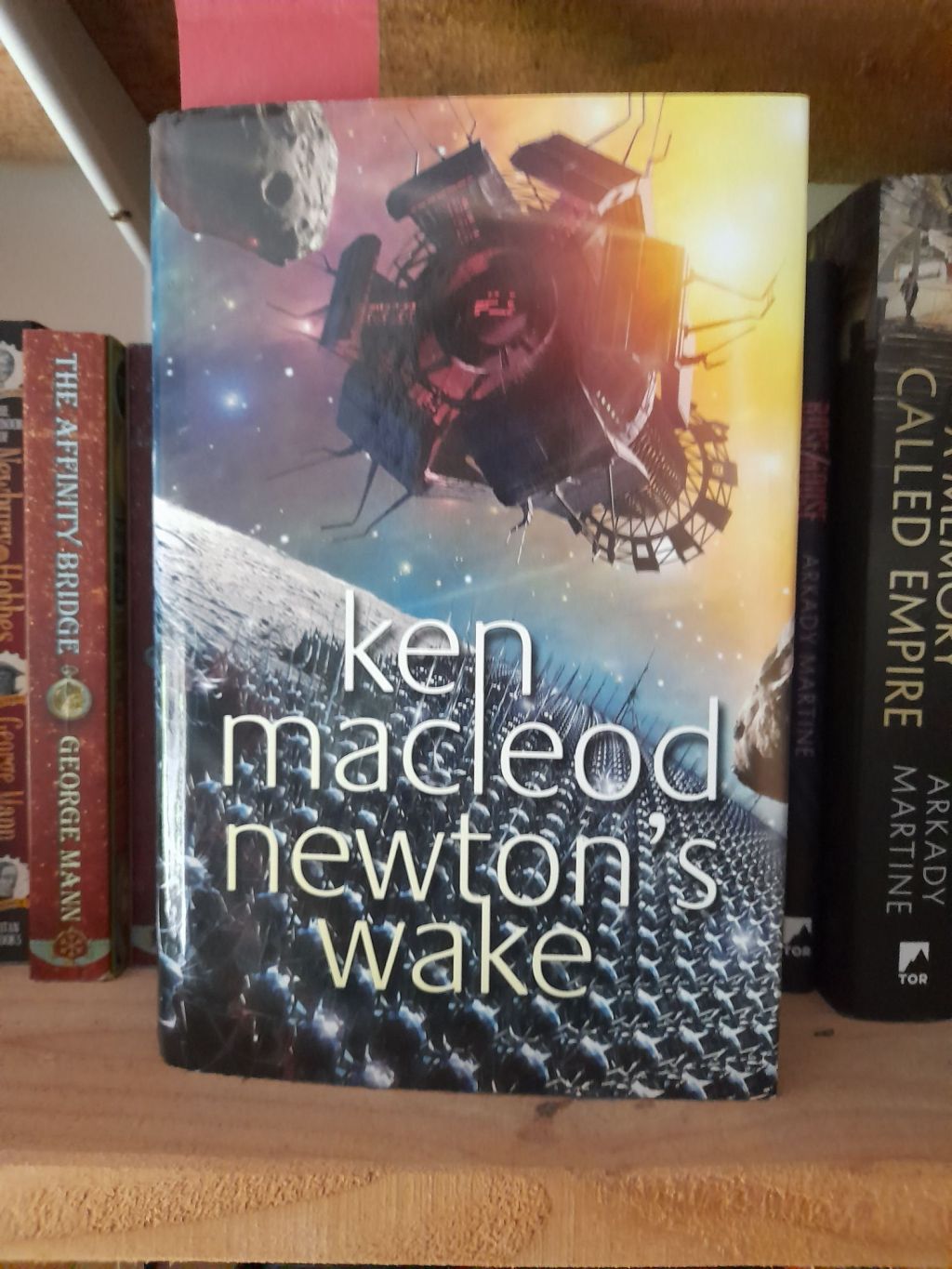
When the opening chapter of a book reminds me of Stargate, it’s generally a good sign. As it happens, that first chapter is pretty much the only SG-1 adjacent part of the book, but it still put me in a good mood. Wormhole technology is an underrated mode of transport in science fiction, so it’s nice to see that MacLeod was making use of it back in the day.
Ken MacLeod is an author of impressive pedigree. In the late nineties and early two-thousands, he was regularly nominated for the major SF awards, including the Hugo, which otherwise has a tendency to overlook the bigger names of British science fiction. Much like his contemporary Stephen Baxter, MacLeod seems to have flow under the radar as far as popularity is concerned, but whereas Baxter is focused on weird scientific ideas, MacLeod’s specialty appears to be politics.
In MacLeod’s post-Singularity future, humanity is divided not into varying empires, but along political lines extrapolated directly from real history. The communist branch of humanity, for example, comes with a Mt Rushmore featuring Lenin, Mao, and Il-Sung. The politics are not subtle, and put me in mind of another Scottish author, Charles Stross. Hardly surprising, as both authors travelled in similar circles. Circles that also included Iain M. Banks. There must be something in the water up in Scotland that leads to politically-charged space opera.
As a fun fact, you don’t have to do a deep dive on MacLeod to discover his Scottish nationality. It bleeds through onto the page. The Carlysle family speak in a thick Glaswegian accent. We’re not told this, we are shown it. At times it’s impenetrably overwhelming, but once you get used to it, it brings the characters alive. The same, alas, can not be said for MacLeod’s Asian communists, who speak in the worst broken English I’ve come across since The Man in the High Castle. I’m not the right person to say if this is offensive or not, but it lacks the authenticity of the Scots.
Happily, the plot is strong enough to overlook such weaknesses. It’s a fairly simple story of a mysterious artefact coming to the attention of various feuding parties. There are arguments, politics, and an inevitable big battle. Running alongside this is a deep look at what happens after humanity and machines merge. What happens when we can use technology to bring back the dead. What happens when the humans who fought for and against the rise of the machines are left to pick up the pieces when the mechanical combatants have left for further shores. When MacLeod is dealing with these aspects of the story, he is firing on all cylinders. It’s an even-handed look at all sides of the conflict, being sympathetic and scornful in equal measure.
Much as I enjoyed Newton’s Wake, I have to admit that it fizzled out a short while before the end. It’s not so much that the plot stalls, but more that it has nowhere to go. There’s too much going on in MacLeod’s future to be contained in one fairly short novel. Too many ideas that we don’t have time to explore. Yes, this is a self-contained story, but it feels like it should have been the start of a longer series. There is so much build-up here, but nowhere near enough pay-off. It’s not that this is bad, just that I wanted more from it.
Newton’s Wake is a good book, and I feel like it’s a good introduction to the works of Ken MacLeod. I can easily see why it was nominated for the major awards, and hope that the rest of his work is able to deliver on the promise shown here.
Book Stats
- A Standalone Novel
- Published in 2004
- 369 Pages


