Teaser
As global sea levels continue to rise, drowning the entire world, one group looks to the stars for salvation. But even if they can get off the ground, will they find a new world . . ?
Review
It’s no secret that Flood was far from my favoruite Stephen Baxter novel. In case you need a recap, Flood saw underground aquifers burst leading to the sea level rising by some eighteen kilometres, more than enough to cover the entirety of Earth’s surface. It was also an unrelentingly bleak novel. Dubious science aside (though as ever Baxter has some backing for the seemingly ludicrous cause of his flooding) it hammered home why I don’t enjoy apocalyptic novels or, and recently there’s been a lot of crossover between the two genres, climate fiction. It’s not that I’m desperately searching for hope in my fiction, but there’s only so much misery and death I can read about before deciding that if total annihilation is guaranteed, I can probably skip the book and read something with a bit more variety.
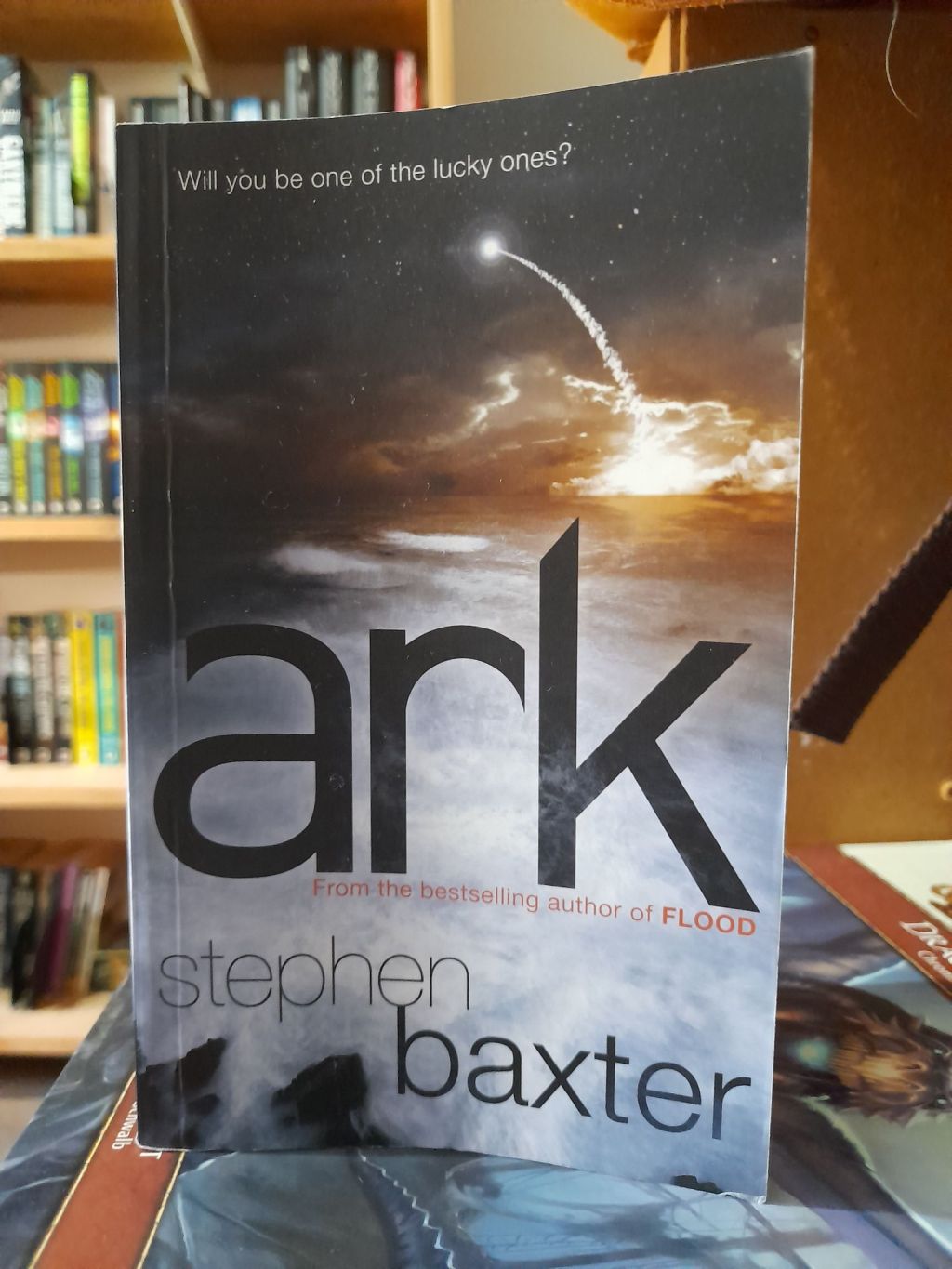
In Flood, we saw one of humanity’s Ark projects in the form of a massive boat. It didn’t turn out well, and the scattered survivors ended up living on rafts. Ark is a sequel, but contains a lot of timeline crossover with its predecessor. Thankfully, this time around we’re spared the endless trudging around in search of higher ground. Instead we set our eyes even higher. Space, to be precise. Because if a regular ship won’t save humanity, maybe a spaceship will. The first half of the book chronicles the building of this Ark, and all the sacrifices made to get it off the ground. Depressing though the book as a whole is, there is at least some optimism in this latch-ditch effort to get off the planet before everyone drowns.
The second half of the book is pure Baxter. It’s still bleak stuff, but it’s rather a lot less soggy this time around. Obviously, leaving Earth in a tiny, nuclear-powered spaceship doesn’t go according to plan, and soon their are disputes and rivalries, and even this microcosm of society starts tearing itself apart at the seams. It’s this detail-oriented exploration of how a long-term interstellar voyage might actually go that lets Baxter show off. And I mean that as a compliment. Whether it’s toying with the idea of an Alcubierre drive or exploring the draconian measures that might be needed to maintain order in a tightly closed system, Baxter has thought of everything. There’s even some musings on the Fermi Paradox thrown in for good measure.
It’s hard to talk about the end of the book without ruining it, but the ending of the book is also what left an impression on me, so talk about it we must. Over the final hundred pages or so, Baxter revisits elements of Flood alongside the new material on offer here. We finally learn the nature of the other Ark, and honestly it seemed the most logical to me, though naturally it too takes a dark turn. By the end of the book, Baxter has provided five possible options for the future of humanity (six if we consider extinction an option). My issue is that all of these options are left unexplored. We don’t get to see how any of them turn out in the longer term. There are even character arcs that feel as if they’ve been cut short. Now, there is a third book in this series, which in Baxter tradition is a collection of short fiction. There are probably some answers there, but Landfall is very hard to come by these days. So we’re left with an ending that’s ultimately rather unfulfilling.
Ark is leaps and bounds stronger than Flood, and for all that it comes rambling to a sudden halt in it’s latter stages, it’s just as rich with ideas as the best of Baxter’s fiction. Worth a read even if you weren’t convinced by Flood.
Book Stats
- Flood #2
- Published in 2009
- 535 Pages


