Teaser
War is coming. A war that will decide the future of humanity. Yet though all hope seems lost, there is one factor nobody can predict: The actions of a handful of pilgrims on the remote world of Hyperion . . .
Review
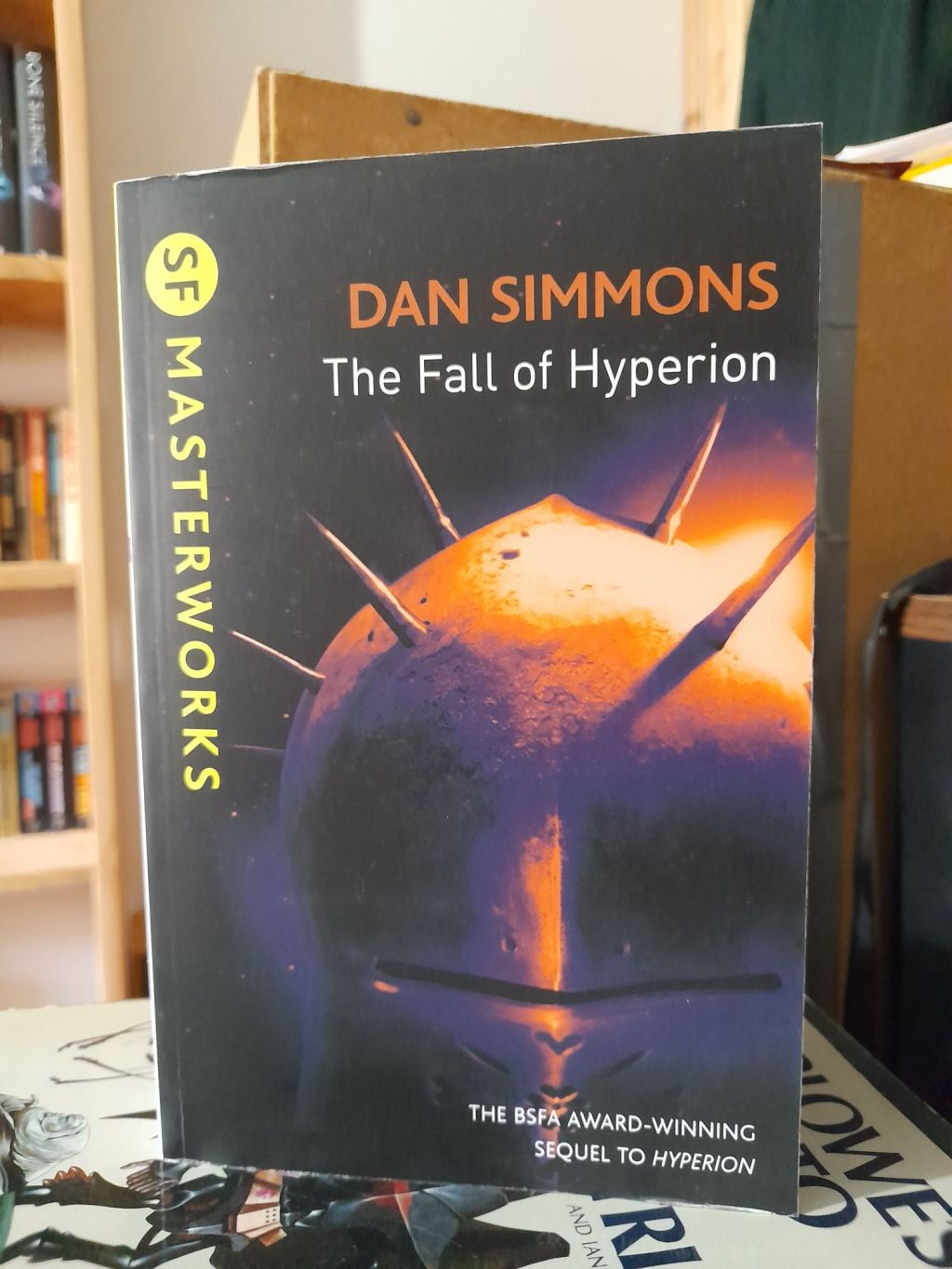
It has been a very long time since I read Hyperion. A little under six years, actually, though it feels longer. Ideally, these two books should be read much closer together, because they’re essentially two halves of one story. But we all know how life gets in the way. So, armed only with a quick scan of the Wikipedia summary of book one and my reliable buddy reader, I set out to read Fall of Hyperion.
For those who also need a refresher of Hyperion, it was a pastiche of Chaucer’s Canterbury Tales that saw six pilgrims explain why they wanted to go to Hyperion and face the machine-monster known as the Shrike. Those characters make an appearance, a very important appearance, in this sequel, but for much of the time we spend the book in the company of a new character. Though masquerading as an artist named Severn, our first-person narrator is in face an artificial intelligence in the form of a resurrected John Keats. As in the English poet, John Keats. Because if there’s one thing Simmons wants you to know, it’s that he’s very well-educated and enjoys making references to the English canon of literature.
Structurally, Fall of Hyperion is much more accessible than its predecessor. It’s got three acts, and is very much a traditional novel. Keats is a fascinating narrator as he grapples with his numerous identities. Simmon’s weirdness comes through in Keats’ dreams, in which he experiences the lives of the pilgrims from the first book as they enter the Time Tombs and face the Shrike. I say face, I actually mean hey are hunted down one by one. When not dreaming of death, Keats is embroiled in the war that will end the human Hegemony, which is as close to straight space opera as the book ever comes.
As well as poetic and literary allusions, Simmons isn’t afraid to tackle existential questions and religion. A major part of the war is the belief that whoever wins will be able to establish their own god at some unspecified future point, and that said god might already be playing their hand. This struck me in particular because it’s damningly close to the latter half of Christopher Ruocchio’s Sun Eater series. Throw in Simmon’s lengthy exposition chapters featuring Ummon, and you can see where Ruocchio is getting ideas for Brethren and the Absolute from. I always knew Hyperion was an influence on Sun Eater, but I hadn’t realised how direct the parallels are. What I will say is that, aside from a throwaway paragraph about the future of Islam which is rather Islamophobic, Simmons generally treats religion quite even-handedly. People have beliefs, and there is some validity to them, but nothing concrete is ever confirmed. Unless that is still to come in the sequels.
The end of The Fall of Hyperion does fall apart ever so slightly. The war ends in drama, and hard choices, and left me wholly satisfied, but the reveals on Hyperion itself were incredibly underwhelming. As is often the case with time travel, Simmons ends the book tied up in so many knots that attempts to unravel them leads to the feeling that he’s pulling things out of the ether in the hopes that it will make sense. Sometimes it does, but sometimes these new ideas are so out of place that they left me scratching my head.
If you’ve read Hyperion, you owe it to yourself to read The Fall of Hyperion. I intend to go further with the series, hopefully without another six year gap, but if you’re not entirely sold on the Canton, then this is a fine place to stop.
Book Stats
- The Hyperion Cantos #2
- First Published 1990
- 535 Pages


