
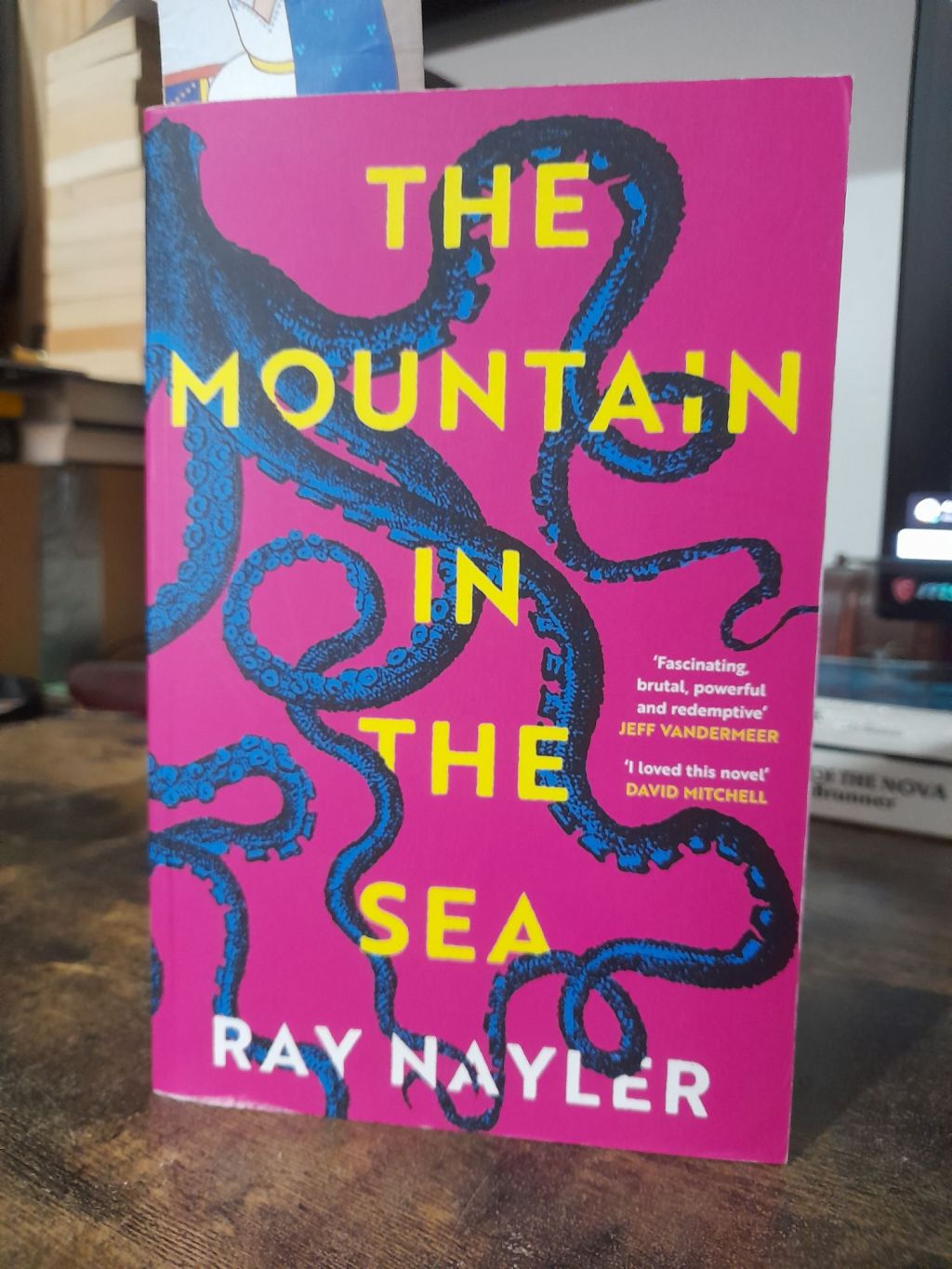
Teaser
What if first contact with a nonhuman intelligence happens not in outer space, but right here on Earth? What if there are beings beneath the sea that we cannot begin to understand? And what if the truly alien mind is something of our own creation . . ?
Review
Ray Nayler isn’t necessarily the sort of author I would choose to read. He’s won the Locus Newcomer Award for The Mountain and the Sea, which was also shortlisted for the Nebula and Arthur C. Clarke awards. That was enough to catch my eye, but as with many recent winners of the Clarkes, it didn’t sound like my sort of science fiction. To be cynical, it sounded like the sort of science fiction that high-minded people could read and enjoy while telling themselves it’s not really science fiction, because it doesn’t have spaceships and lasers in it. To be more charitable, it sounded like the sort of thing Adrian Tchaikovsky might write if he was less interested in outer space. It’s this latter thought, along with a free copy from a friend, that led to me finally giving Nayler the chance he deserved.
The Mountain in the Sea is set in the near future, though precisely when is left frustratingly vague. National borders have shifted around, tech companies have reached new heights of power, and artificial intelligences are everywhere. Across three threads, we follow; Dr Ha, investigating the possibility that octopuses have a developed language, Rustem, a hacker tasked with cracking open a secretive project, and the Sea Wolf, a fishing ship crewed by slaves, but governed by an artificial intelligence. The three storylines are not equal. Rustem’s is so isolated that even when it’s connection to the main story is revealed, I can’t help but feel it should have been a separate book. Likewise, the saga of the Sea Wolf is great in isolation, but we didn’t need all those details to appreciate it’s impact on the rest of the book. So we end up with a book that can be cleaved into two halves. First, there’s a thriller about artificial intelligence and its effect on nature. Secondly, there’s a lengthy study about the nature of animal intelligence. These two halves mirror one another, but don’t quite cohere into a single novel. What this means is we get two brilliant stories in one slightly messy volume.
At its core, this is a story about how humans treat intelligences other than our own. When it comes to octopuses, I don’t know to what extent Nayler sticks to reality, and what he has invented wholesale. I do know that a lot of research went into this book, and I personally would have loved an annotated and footnoted version. It’s generally recognised that octopuses are intelligent animals, but Nayler spends less on how intelligent they are, and more on how we could even begin to measure intelligence. Octopuses see the world differently, they may as well exist in a different world to us. Every way we have of measuring intelligence is based on our own biases, and trying to force that narrow worldview onto octopuses will only lead to disaster. Some of the best parts of the book are extracts from Ha’s thesis on octopus intelligence.
Given their shaky relationship to the bulk of the novel, the accounts of the Sea Wolf and Rustem do feel weaker in comparison. The book’s action largely stems from these halves, which take an unflinching look at the horrible way humans treat the world, animals, and other humans. The political wrangling is somewhat undercut by the hazy future worldbuilding, but it’s brutal stuff nevertheless. And if you’re on the fence about the artificial intelligence angle, I have three words for you: Robot Buddhist Monks.
It’s not always the easiest book to wrap your head around, but The Mountain in the Sea is a ferociously intelligent debut, and definitely deserving of its awards and nominations.
Book Stats
- A Standalone Novel
- Published in 2022
- 452 Pages


