Teaser
It has been four years since Data sacrificed himself to save the Federation. Now, his father Noonien Soong has devised a plan to bring the beloved android back. But Soong’s quest will have devastating consequences, not just for Data, but for the galaxy as a whole . . .
Review
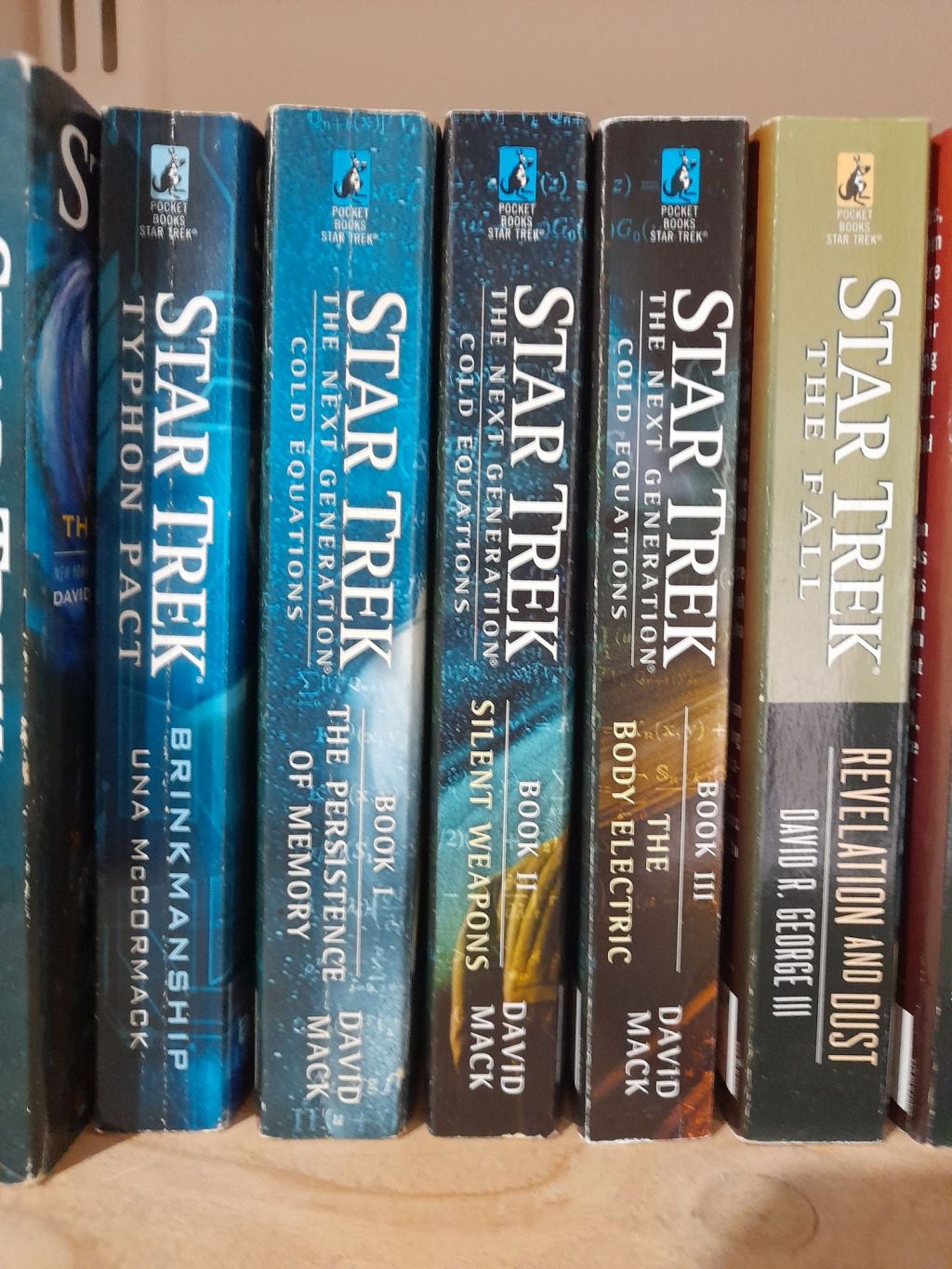
One small oddity about this trilogy is that I’m sure I’ve seen a quote from David Mack talking about it originally being envisaged as an end to the Litverse timeline. Either I imagined that, or the associated interview has been swallowed by the internet, because I can now find no trace of it. Regardless of this, the Litverse would go on for another several years before being ended in a David Mack novel, so this is not an ending, but a mega-sized outing for the Enterprise crew. As with most other series in the Litverse, each Cold Equations novel tells a standalone tale, but when taken together makes a larger whole. Perhaps because of its singular author, it’s a lot more cohesive than, say, Typhon Pact or The Fall, between which it is set.
As I expected when I saw Mack’s name on the covers, I really enjoyed this trilogy. It manages to tread the thin line between showcasing scientific exploration as championed in Star Trek as a whole, while also reflecting the complicated picture of the Alpha and Beta Quadrants that emerged in the wake of Mack’s Density trilogy. However, it does suffer from two of the pitfalls that have besieged not just the Litverse, but Star Trek in general for the past decade and a half.
The first of these pitfalls is the resurrection of Data. Call me a traditionalist, but I like it when dead characters stay dead. I didn’t like it when Janeway came back from the dead, and I don’t like it when Data is resurrected in the opening book of this trilogy. And no, that’s not a spoiler. That’s literally the premise. There’s a very similar hand-waviness to Data’s return as there was in Picard‘s third season. He’s back, but only by combining his programming with that of another. Is it Data? The characters debate, but the book’s answer is a fairly solid yes. Mack pulls a smart move by largely keeping Data away from his former crew for the rest of the trilogy, thus avoiding the trickier questions, but I still feel like bringing back the dead undercuts not only their sacrifice, but the development of other characters in the years since.
The second pitfall doesn’t raise it’s head until the third book. Here, there is a threat to the entire galaxy. This particular plotline, with various threats behind it, has reared its head in pretty much every season of Star Trek since 2016, and it remains uninspired. Stakes that high never feel as if they have any weight to them. Ironically, it would have felt more real if this really were the end of the Litverse, whereas the actual end of the Litverse felt more like burning down the house on your way out. That being said, Mack again plays the trope brilliantly, relying not on explosions and gunfights, but on the simple(ish) act of proving the value of the human experience.
In spite of playing with ideas I generally don’t have much time for, the Cold Equations trilogy is very much an enjoyable ride. There’s a lot in here that explore the treatment of machine intelligences in the Trek universe that still holds up. Even if we know that the galaxy won’t be destroyed, there’s palpable sense of threat, and people do get killed. People we’ve spent several books getting to know. There’s also time for quieter moments of romance between crewmates and touching family reunions. All these little moments are what make the books shine.
Cold Equations shows both the strengths and weaknesses of the Litverse, and that there are far more of the former than the latter. I’m rapidly running out of books set during this aborted timeline, but if there are more gems like this hiding out there, I’ll happily get round to those last few dives into a story cut short before its time.
The Persistence of Memory
Silent Weapons
The Body Electric
Series Stats
- A complete trilogy
- Published 2012-2013


