
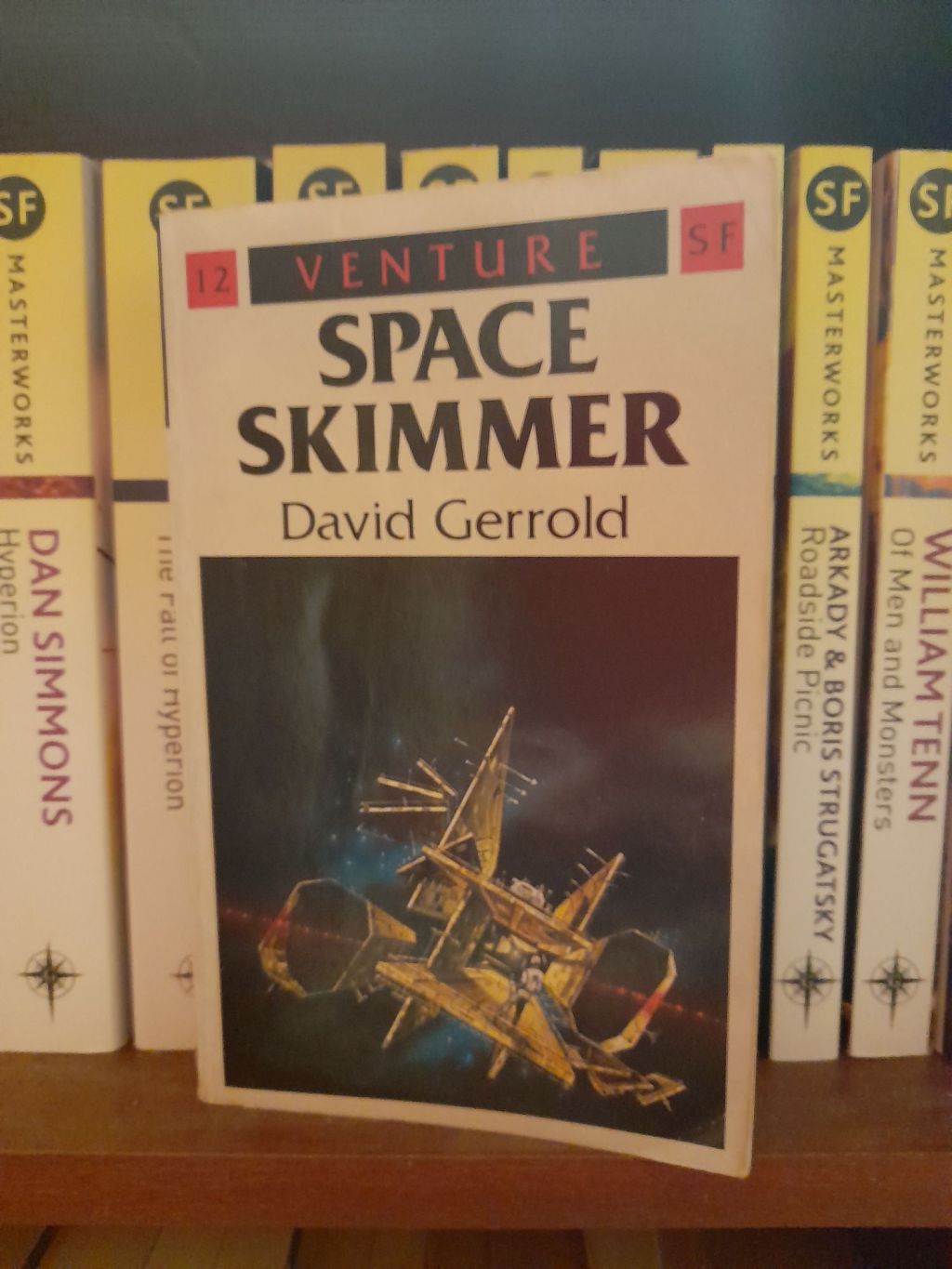
Teaser
The Empire has fallen. Once joining all of humanity from core to spiral arms, now the trade routes have thinned. Rumours persist of a way to reunite the fractured humanity, but do they have any basis in fact . . ?
Review
Once again, the Venture SF range has delivered. The idea behind the series was to deliver action and adventure in the classic SF vein. To my mind, that conjures up images of some of the very first SF I ever read. Golden Age icons like Isaac Asimov, or forgotten gems like H. Beam Piper. Both of those authors hit their peak in the fifties and sixties, were guided by John W. Campbell, and told sweeping stories of galactic empires caught in decline and the fight to preserve and retain lost knowledge. The Venture SF range played with these ideas courtesy of John Brunner, but it’s with David Gerrold’s Space Skimmer that those vivid images of fallen empires are finally brought back to the foreground by some excellent writing.
On a structural level, this is a deeply weird book. There are no chapters, though at several points I wondered if the chapter breaks were present but simply unmarked. There aren’t even sections or delineated acts. What we have is around two hundred pages of scenes. These scenes take us on a single story, but skip merrily across the galaxy. Broadly, the book is about a man called Mass and his quest to find a near-mystical type of spaceship (the titular skimmer). That’s underselling it a bit, however, because as he travels, Mass gains new allies (one per planet, rather conveniently), and we soon end up with an odd little study of what it means to be human.
The extent to which Gerrold is building on earlier works is clear, with Mass’s companions including robots and telepaths, but he’s also willing to go into some of the more unusual corners of the galaxy. Mass is from a high gravity world, and is therefore short and squat, much like a dwarf from an epic fantasy novel. His robotic companion fully believes himself to be a human, and therefore that organic beings cannot be human. Meanwhile, telepaths are bought and sold as merchandise. There’s even a Niven-inspired nobleman who has been bred for luck. There is so much packed in here that any one planet could have been a novel in itself. What stands out, however, is that two decades after Asimov, Gerrold’s Galactic Empire does not consist of an infinite number of Earthlike worlds. There might not be aliens, but there is a shocking diversity of human offshoots.
However, while Gerrold is in conversation with the Golden Age, he is not living in it. This is a book from the seventies, which means we find ourselves in the midst of the New Wave. Perhaps this explains the structural oddities. Aside from the lack of chapters, we also have lengthy sections that read as stream of consciousness. Paragraphs interrupt and intersect one another. Block capitals abound throughout. By the time the telepaths get involved, characters regularly speak and think over one another, and it grows increasingly hard to keep track of who is doing, saying, or even thinking what. The novel ends in a cacophony of interlocking thoughts as minds debate the nature of humanity, individuality, and the meaning of life.
Standing at the crossroads where Golden Age meets New Wave, Space Skimmer is not only an entertaining book, it’s also an incredibly interesting piece of science fiction history. It might not be the strongest of the Venture SF range, but it might just be the one I’m most grateful to have discovered.
Book Stats
- A Standalone Novel
- Published in 1972
- 218 Pages

 At Boundary's Edge