
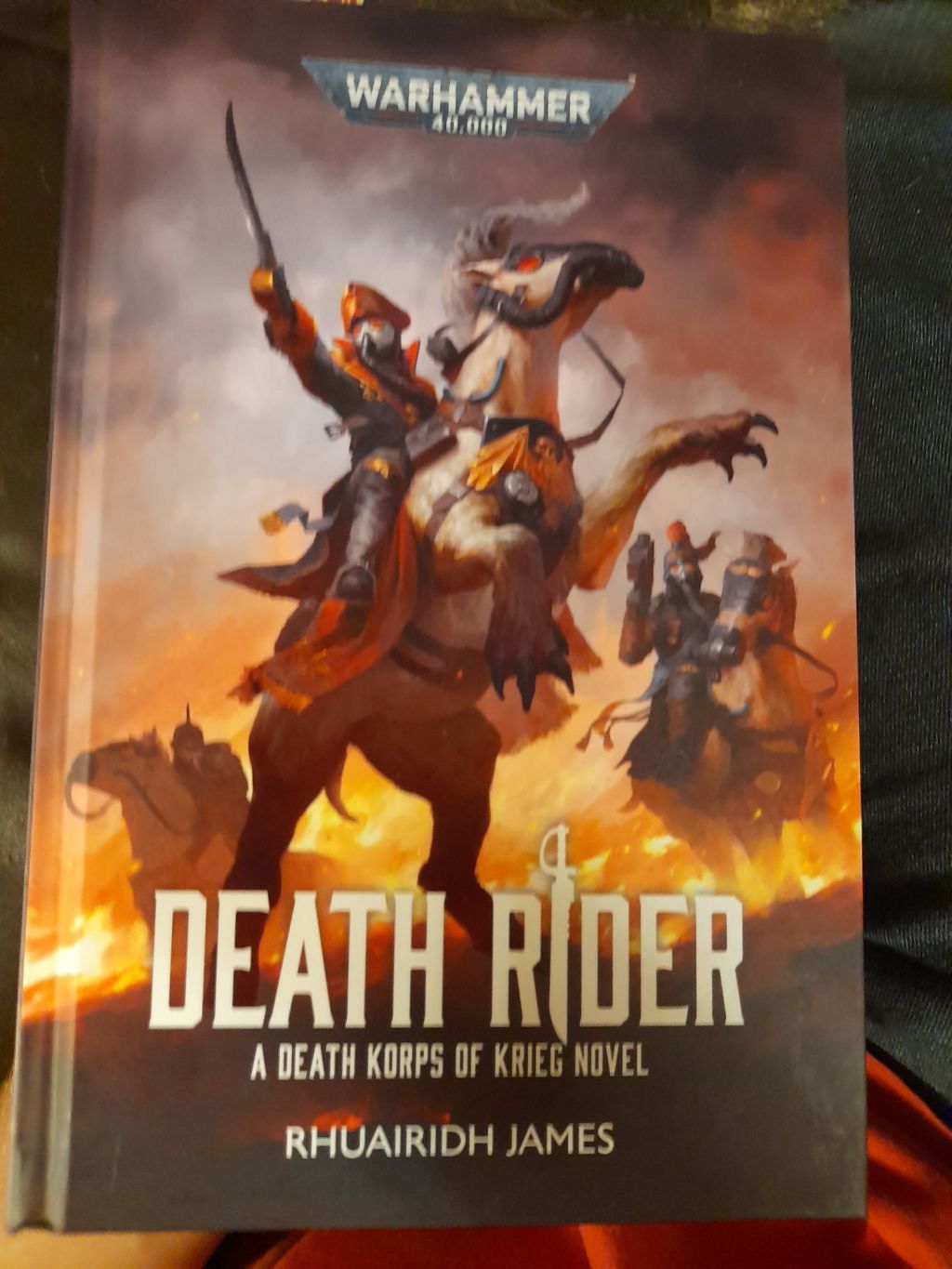
Teaser
Rezlan VI is a dead world. An irradiated wasteland fought over by humanity and the t’au. For commissar Valian Hesh, the only chance of survival is retreat. But if there is one thing the Imperium will not tolerate, it is cowardice in the face of the enemy . . .
Review
If there’s one story that Black Library loves telling, it’s that of a commissar assigned to a regiment they’d rather not be on the same planet as. It’s the archetypal odd couple of the grim and dark future. Initially, that seems to be the case here, with Valian Hesh attached to the suicidally fanatical Death Korps of Krieg. However, Death Rider is not the usual story of two very different soldiers learning from one another, finding common ground, and eventually earning some mutual respect. In fact, there’s very little conflict between Commissar Hesah and the Korps.
A lot of this stems from a long-running issue I have with the Krieg. As a concept, they’re great. Faceless killers who just shut up and get the job done, no matter how many of their own lives it may cost to do so. The Astra Militarum’s worst traits distilled into an effective fighting force. However, as characters in a story, they don’t make much of an impact. Honestly they’re quite boring. even those few we get to know by name turn out be be rather muted personalities. Part of this is reflective of the Krieg outlook on mortality, but that authenticity doesn’t make for interesting reading.
This is James’ first full-length novel for Black Library, following on from the riotous novella Da Gobbo’s Rides Again. By Black Library standards, Death Rider is on the more experimental side. It’s the same length as usual, and has a three-act structure, but within that are some found documents showing how events from the novel are depicted within the universe (I particularly enjoyed the lengthy description of a painting that puts a rather glossy outlook on a tragic event), but there are also extensive flashbacks. This makes for a disjointed narrative, but not quite as much as the ‘battle trance’ that spreads a few scattered seconds of thought across three pages. Some of these stylistic choices didn’t work for me, but it’s nice to see something a little different from Black Library.
Between stylistic decisions, the presence of the lifeless Krieg, and possibly a little bit of Warhammer burnout on my part, I spent a fair bit of time not enjoying Death Rider. The first half of the book was a muddled crawl that I honestly found quite hard to follow. It’s not a particularly complex book, but I did find it difficult to keep track of why events were happening. I was, in a word, confused.
However, in its final hundred pages or so, the book finally kicks into gear. That confusing muddle was all a slow set-up for a very strong finale. It made me wonder if that confusion was intentional, meant to replicate the experience of the soldiers caught in the middle of a war where betrayal lurks around every corner. Maybe, maybe not. What I can say for certain is that once Hesh has all the information, the novel is much, much stronger for it. The narrative hurtles towards a brilliantly violent ending, and James pulls no punches once the swords are drawn and the bombs start falling.
All things considered, this won’t be making any of my favourites lists, and it certainly lands among the weaker Black Library books I’ve read recently. That being said, if you have the time, it’s worth pushing through the rough early stages of the book to get to the finale.
Book Stats
- A Standalone Novel
- Published 2026
- 293 Pages


