
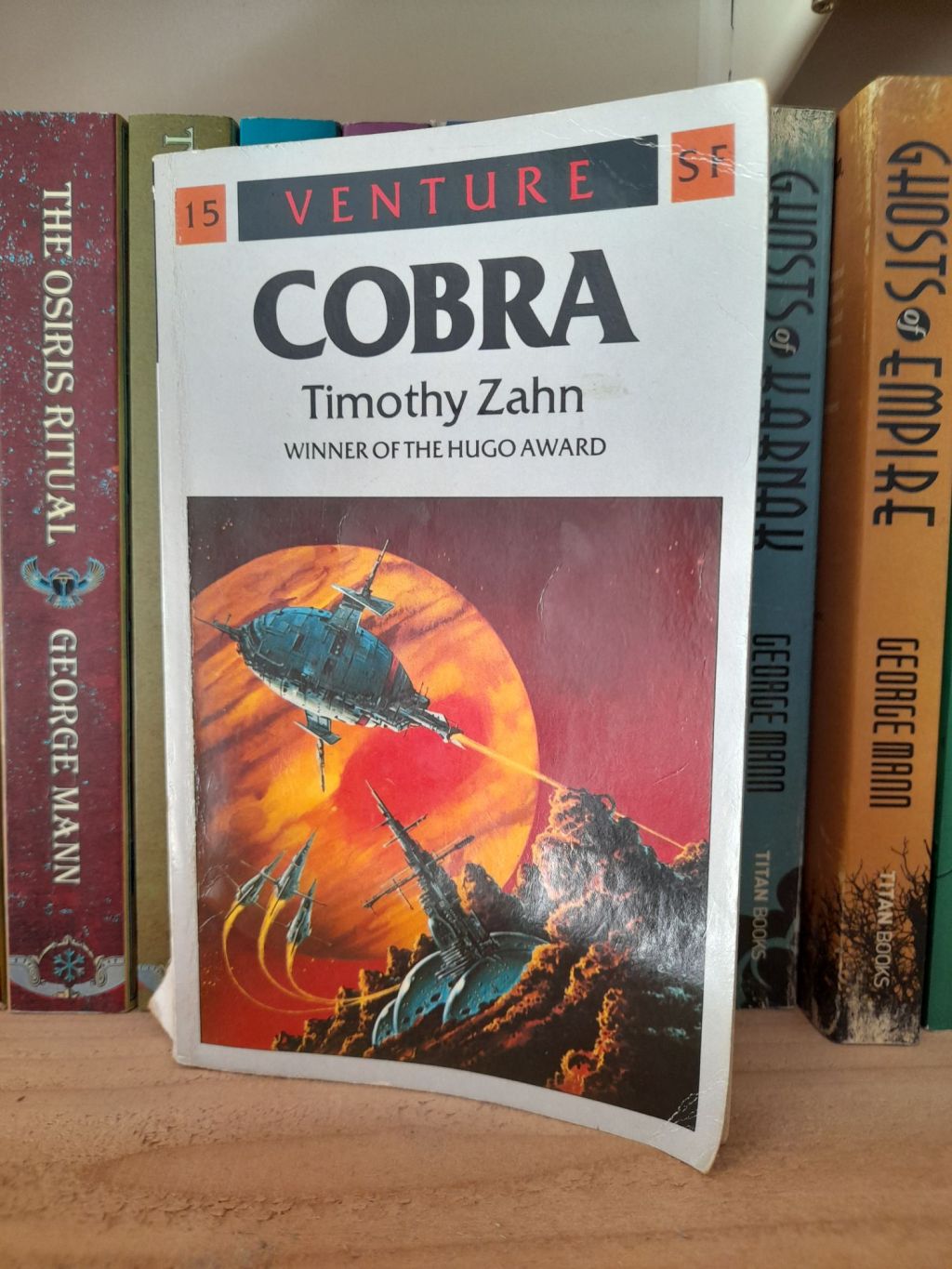
Teaser
The government calls them Cobras. Humans modified to be the ultimate soldier. But when the war comes to an end, what is to be done with them? Can the Cobras reintegrate into society, or is humanity better off without them . . ?
Review
If Timothy Zahn’s name is remembered a hundred years from now, it will probably be for creating a character called Grand Admiral Thrawn, and kickstarting the Star Wars tie-in novel continuity. But there’s more to Zahn than just being the Star Wars guy. Good as his tie-in works are, he also has an impressive body of original work. A body of work that continues to grow to this day. But if we go back to the eighties, before he found such wide acclaim, we find Zahn having garnered attention (and a Hugo Award) for his shorter fiction, but now stepping into the world of novels. The first of these was the Blackcollar. The second was Cobra.
Cobra is adapted and expanded from a pair of short stories by Zahn, but most of the material is new. This is common of books from the period, and a tradition which goes back to science fiction’s Golden Age. Seeing the original stories set in a new context, we can see how Zahn’s ideas develop over time. This is a story that takes place over decades, with each chapter taking place at a critical moment for the Cobras. We see them in action, then trying to adjust to civilian life, and finally being sent to create a society of their own.
As I work through the history of science fiction, I find the nineteen eighties hard to categorise. This was when the New Wave had largely been reabsorbed into mainstream SF, while traditional hard SF was having something of a renaissance. Reading Cobra, a thought occurred to me. Maybe this is the era in which the lines between subgenres start to be drawn more clearly. After all, we can see the formation of modern military SF at this time, and early chapters of Cobra owe a certain debt to Joe Haldeman’s The Forever War. It seems like we’re going to get something similar. But then the story pivots to the foundation of a new society on the far edge of human space. A foundation that brings to mind Isaac Asimov’s Foundation. Here again we see a group in exile from a polity they are still working to save. We see external threats balanced by internal politics, and of course we see the jumps ahead in time, tracing one human life, it must be said, but also the birth of a new society.
Tying together the grand traditions of the Golden age with the cutting edge of new genre identities, Zahn’s early work rises above its occasionally pulpish writing style to create something that feels at once familiar and boldly new. It might be hitting a whole load of tropes along the way, but it has an earnest enthusiasm for science fiction that is refreshing in this day and age. Forty years on, and Zahn’s sense of adventure is as appealing as ever. Fans of his Star Wars work will find a lot to like here, while also encountering a harder edge to the politics, and a darker view of the world as a whole than the constraints of galaxies far, far away would allow only a decade later. This is an earlier work, yes. But instead of feeling rougher, it feels formative. You can feel Zahn honing his craft as the chapters go by.
Yet again, the Venture SF range has wowed me. With modern eyes, it’s easy to poke holes in something of this vintage. But personally? This is the kind of science fiction I live for.
Book Stats
- Cobra #1
- First Published 1985
- 346 Pages


