Teaser
Emilio Sandoz is the last survivor of a Jesuit expedition to an alien world. Injured and traumatised by his experiences, it is only slowly that the world learns the truth of his ordeal . . .
Review
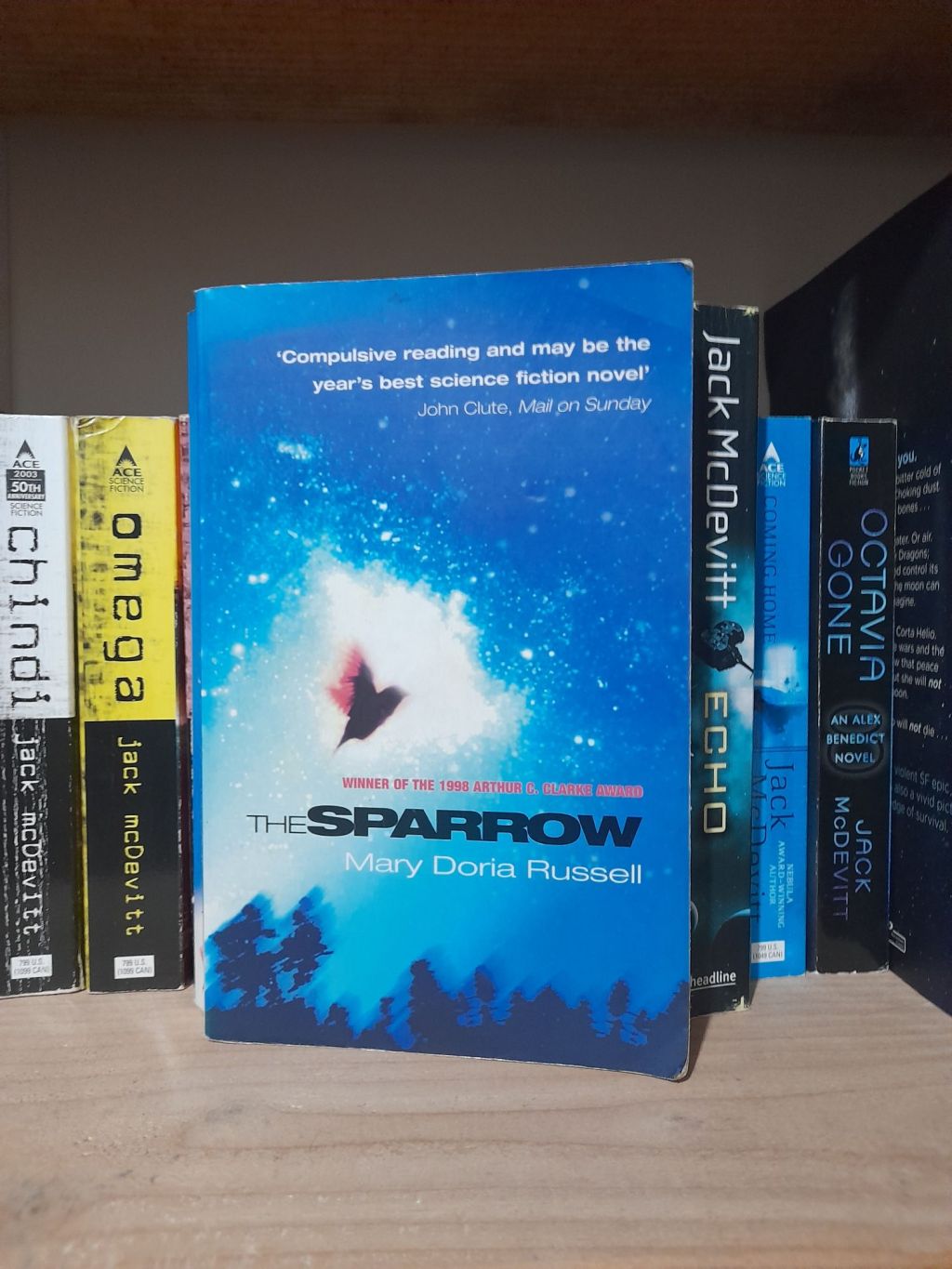
I have a slightly rocky relationship with religious science fiction. As someone who is not terribly religious, I find it fascinating to read about religious characters (and let’s be honest, a frightful number of books involve throwing priests out into space). But what I don’t want to read about is lectures on how gods are real and we should all join the One True Faith. Thus I enjoyed much of A Canticle for Leibowitz, but struggled with the climax of the Sun Eater series. Mary Doria Russell’s award-winning The Sparrow sits somewhere at the intersection between these two approaches. It’s not about God, per se, but it is very much concerned with human morality and the way priests should behave both privately and publicly.
I read this alongside my usual buddy reader, and I am immensely grateful for her company because the first half of The Sparrow is among the most spectacularly tedious experiences of the reading year. An inordinate amount of time is spent watching people refuse to speak to one another, while also suffering through the slowest build-up to a space launch you are likely to ever see. It doesn’t help that the narrative is split across two time periods, and there is very little momentum in either of them.
As an aside, it was also a little unsettling to read about a near-future in which humanity has asteroid mining projects and the ability to commit to interplanetary journeys, only to realise that the book is set seven years ago from my current perspective. The state of Earth is thankfully vague, but I do think Russell was close to the ball when people start worrying about AI coming to take their jobs.
Anyway, when there’s proof of life in a neighbouring star system, it’s inevitable that someone will go and say hello. The Sparrow sends a group of Jesuit priests, who adapt inconceivably well to spaceflight and are on their way in a matter of weeks. Is it plausible? No. But does it finally get the plot moving? Yes.
Once we are among the aliens, things improve dramatically. Russell has a background in anthropology, and it bears fruit. We get to see one of the most interesting and believable alien ecosystems and societies that I have ever come across. It’s not just a case of plopping human cultures down on another planet and giving people different hats. The relationships between aliens and their world is phenomenally well-developed. It is also inhuman in all the best ways. A lot of science fiction sees aliens as people. The Sparrow makes the aliens feel genuinely alien.
After four hundred pages that left me underwhelmed given the book’s reputation, I can happily say that the final hundred pages are up there with the best the genre has to offer. At last the revelations come thick and fast, with Sandoz’s experiences and final confession being genuinely harrowing to read. It’s strange to look back at how long I spent rolling my eyes and longing for the book to be over, only top now be hoping I find a copy of the sequel sooner rather than later. Yes, the pacing is glacial, but you have to trust in the process. the pay-off is worth it in the end.
And as for the religious aspects? I could definitely have done with less of the priests debating how one should lead a moral life. But it does give us a firm starting point against which to measure the morality of the aliens we meet along the way. Because inhumanity is not always monstrous, even if it appears that way to us. Can we ever say something is truly evil? Or is it just that we don’t understand?
Book Stats
- Children of God #1
- Published 1996
- 503 Pages


