Teaser
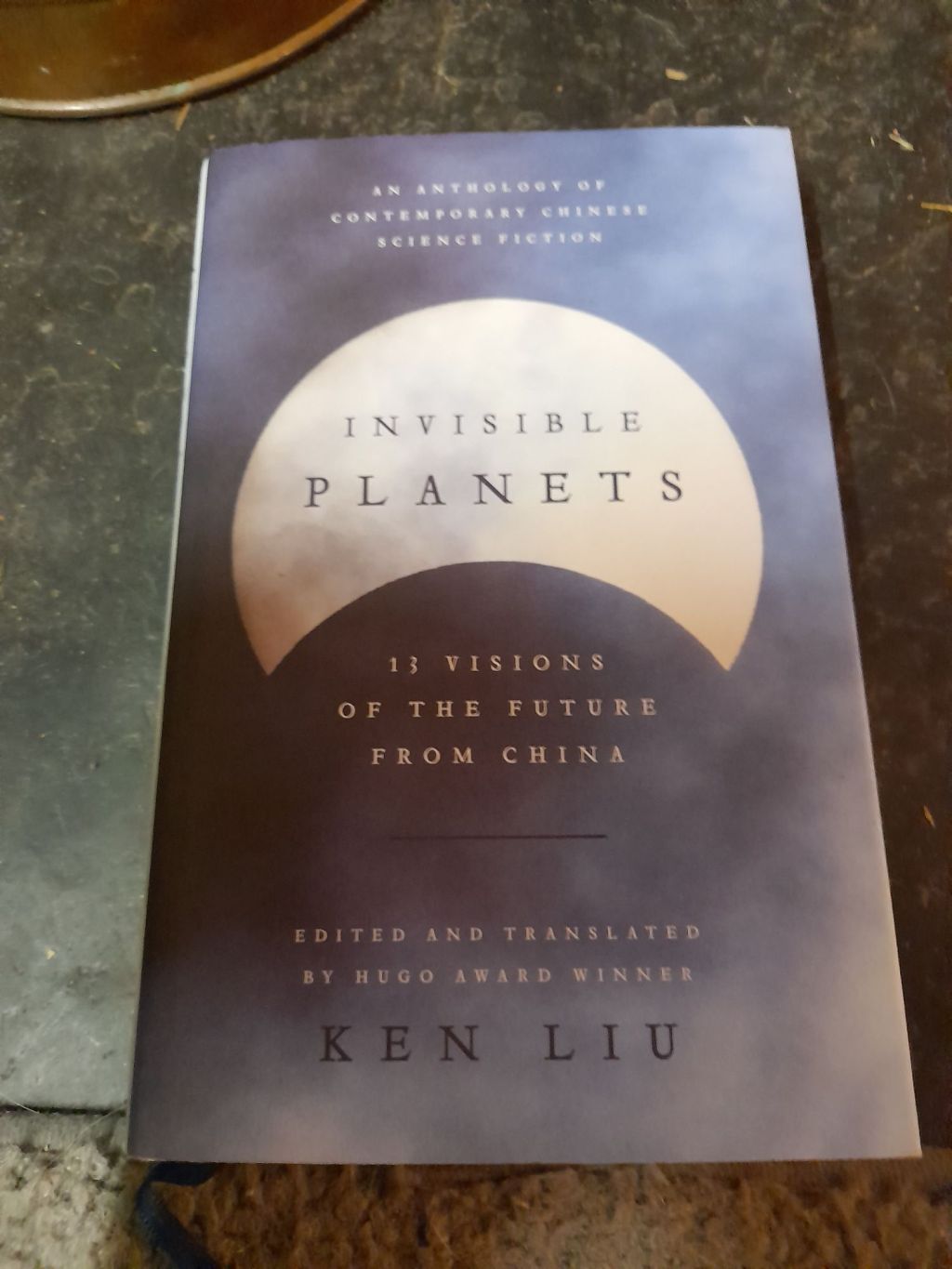
A collection of short stories by Chinese authors, translated by Ken Liu. Some of them appearing for the very first time in print . . .
Review
Like most Anglophone readers, my introduction to Chinese science fiction was Cixin Liu’s The Three-Body Problem. That book and its sequels remain one of my favourite series, and I have read all of Cixin Liu’s work currently available in translated into English. The UK publisher for these books is head of Zeus, and they have very much cornered the market in Chinese SF in translation. Along with Liu, they’ve published Hao Jingfang and Chen Quifan, and all three authors make an appearance in this anthology. A second anthology, Broken Stars, followed, and you can find my review of that HERE.
Invisible Planets serves as something of an appetiser for any reader interested in Chinese SF. Ken Liu’s introduction makes no claim at being comprehensive, and indeed argues against seeing anything definitive about this particular grouping of stories. This does, I feel, raise an interesting point. As readers, we are very quick to lump stories together. That is the basic principle behind literary genres, after all. yet ‘Chinese SF’ doesn’t have any more universality than ‘British SF’ or ‘American SF’ does. there may be commonalities, but equally there is a great diversity, as hinted at by this book.
Take Chen Quifan for example. ‘Year of the Rat’ is a coming-of-age story about young men tasked with fighting genetically engineered rats. ‘The Fish of Lijiang is a quieter piece about the erosion of history, and the way technology seeps into everyday life. ‘The Flower of Shazui’ is straight cyberpunk, with ties to his novel The Waste Tide. Perhaps those cyberpunk overtones are why Chen doesn’t work for me the way his contemporaries do, but given how that genre has broadly plundered Asian aesthetics, it’s fascinating to see a non-Anglophone approach to the same tropes.
Ma Boyong’s ‘The City of Silence’ is pure dystopia. Fittingly for a translated work, it deals with government control of language, and the small ways in which people can resist. Editor Liu warns us against reading this as a direct commentary on any specific government practices. Tempting as it is to do precisely that, what ‘The City of Silence’ shows us that some concerns are truly universal. Having spent a great deal of last year listening to early English dystopias, it’s also interesting to see the same ideas and motifs played over in different culture across space and time.
Cixin Liu (here named in the more accurate Chinese form Liu Cixin) has two stories. One is a modified extract from The Three-Body problem, while the other is ‘Taking Care of God.’ A gentle, ideas-driven story about humanity meeting its maker, and having to deal with their retirement. Some of the cultural aspects of caring for our elders feel, to my inexperienced eyes, uniquely Chinese, but more broadly Liu writes the sort of sweeping, epic SF that is more common in the English language. Small wonder that he has become the best known author in the Anglophone world.
Hao Jingfang is another author I hold in high regard. Oddly, I found her Hugo-winning novelette ‘Folding Beijing’ a little lacklustre. An interesting central idea, but the story surrounding it was neither here no there. However, ‘Invisible Planets’ is utterly brilliant, and worthy of loaning its name to the anthology as a whole. It’s essentially a series of vignettes about fictional, and increasingly unlikely, alien worlds. The amount of evocative imagery Hao fits into a paragraph is outstanding, as is the deft weaving together of disparate elements. I loved her novel Vagabonds and hope to get to Jumpnauts sooner rather than later, but if Hao ever puts out a solo short story collection, I’ll be first to buy it.
There is so much more in this anthology, and I encourage you to seek it out for yourself. If you’re interested in SF from around the globe, this is a great primer for Sinophone literature. But if all you’re after is some great short fiction, you’ll find more than enough in Invisible Planets to keep you busy.
Book Stats
- Translated by Ken Liu
- 13 short stories
- 3 essays
- First published 2016
- 383 pages

 At Boundary's Edge