Teaser
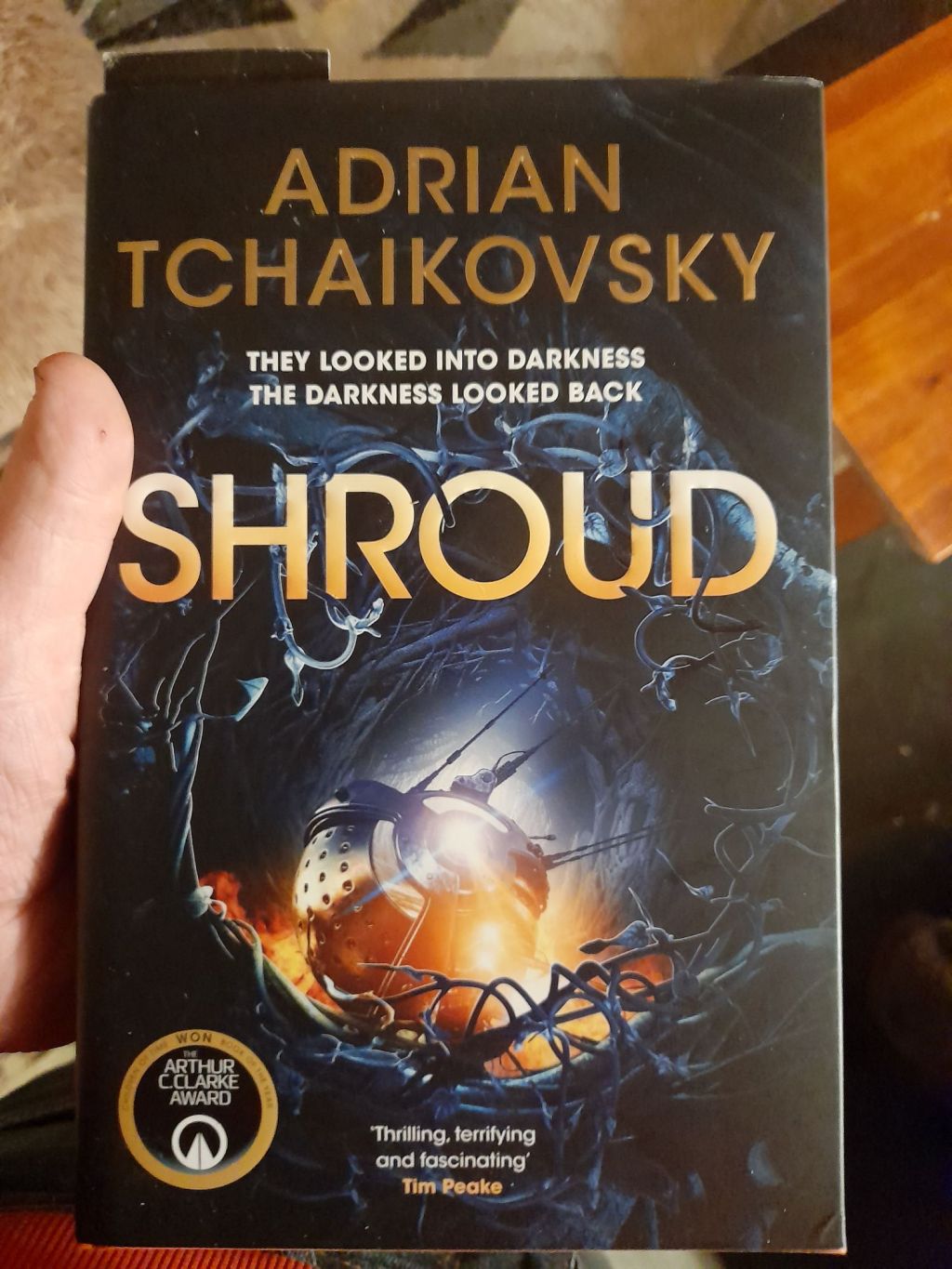
There is no light on Shroud, but that does not mean this moon is devoid of life. Forced into a first contact with humanity, can the two species find common ground, or is misunderstanding inevitable . . ?
Review
Adrian Tchaikovsky is one of my favourite living science fiction authors, and also a highly prolific one. In 2025 alone he’s published two science fiction novels, a novella, a Warhammer Age of Sigmar tie-in novel, an epic fantasy, and God alone knows how many pieces of short fiction. This makes it slightly odd that the only one of these new releases I’ve read this year is Shroud, his only standalone sci fi novel of the year. Though I did compensate for that slow intake by rereading Children of Time with a friend. Anyway, I came into Shroud with high expectations and higher hopes. True to form, it’s a book I’m still thinking about. Although in this case, not all of those thoughts are positive,
Last year saw the publication of Tchaikovsky’s Alien Clay, and Shroud really put me in mind of the former book. They are both standalones, but have a massive amount of thematic crossover. Indeed, file away some of the background details, and it’s easy to imagine them taking place in the same universe. Both feature a humanity that has only reached the stars by embracing its more fascistic impulses. Both feature scientists toiling under authoritarian thumbs towards goals they don’t agree with. Both feature aliens that are as unknowable as they are original. And both end on notes that are hardly optimistic for humanity.
That ending is something I don’t want to go into the details of, but there are some aspects that are definitely worth discussing. There is a notable streak in Tchaikovsky’s science fiction that paints baseline humanity as an obstacle to progress. Even when they form our viewpoints in his work, humans are frequently the villains of the piece. Not individual humans, but humanity as a whole. Shroud is another novel that sees a monolithic humanity expanding through space, devouring resources, and leaving nothing behind. At the same time, individuals are consumed by that same machinery. there are possibly too many characters stuffed into the first and last sections of this book, and a more depressed and downbeat team of scientists you’re unlikely to find.
The bulk of Shroud, however, takes place in a rather more alien environment. A small team of scientists find themselves stuck on the moon’s surface, where they struggle to make contact with their allies in orbit, while also attempting to understand the native Shrouded. Most of the book is told through the eyes of one of these scientists, with occasional chapters from the Shrouded perspective of the same events. This mirroring really works well, showing how different the two species’ interpretations of the universe are. I can say hands-down that the Shrouded are among Tchaikovsky’s greatest alien creations, and that’s a long list to approach the top of. The Shrouded perspective chapters alone would have made an excellent novella.
And that’s where my biggest grumble with the book comes in. It’s a little over four hundred pages long, and about three hundred are spent on the surface. Yet this entire section absolutely crawls along. It’s an interesting scenario, but there is very little narrative force to push events onwards. We just get endless and frequently repetitive scenes of the surviving scientists moving through a landscape they can barely interpret, and encountering increasingly strange alien creatures.
Having said that, it does all pull together in the end. the reveal of how the interludes fit into the grand scheme of things is a masterstroke. And even if does end on a downbeat note, that’s not necessarily a bad thing. Sometimes you need a little darkness to help you think. This may be one of Tchaikovsky’s weaker novels, but it’s still a fascinating piece of idea-driven science fiction.
Book Stats
- A Standalone Novel
- Published in 2025
- Published by Tor
- 436 Pages

 At Boundary's Edge