Teaser
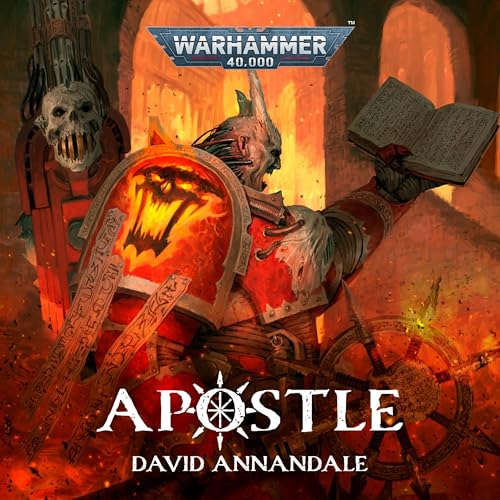
Legitur is an Imperial world. A world of knowledge, of scripture, and of faith. Yet there is discontent among the people. Discontent that, with the right Word, can be converted into open rebellion . . .
Review
Some time ago, when I reviewed his novel Ephrael Stern: The Heretic Saint, I remarked how David Annandale was one of the few authors who could get me fully invested in the more magical side of Warhammer 40,000. In that novel, he pitched faith in the God-Emperor against allegiance to the more tangible rewards offered by the forces of Chaos. Now he’s done it again, turning what could have been a story of one Heretic Astartes bringing down a planet into something infinitely richer and more rewarding. Buckle yourself in dear reader, because this book is about to get theological.
The most interesting thing Apostle does is interrogate the idea of ‘blind faith.’ As readers, we’re familiar with humanity all worshipping the God-Emperor. Why? Because he’s the God-Emperor. Because they are indoctrinated from infancy, and any other religious belief is denounced as heresy, and usually punished by death. Legitur is a world dedicated to printing religious propaganda. But if you look into that propaganda? If you look into the hard facts that the ecclesiarch tells us about He on Terra? Well that’s where things get messy. Because the facts don’t always line up. Even the official documents, the things that the Imperium has stated to be completely true, contain contradictions when you hold them up against one another. There’s not enough room in this book for Annandale to actually show us these endless scrolls, but in telling us of their existence, he makes the religion feel real. Of course there are contradictions. What religion doesn’t have those? the problem is that if you acquire knowledge, and if you ask questions, you start to see how the religion of the God-Emperor can’t be all it’s cracked up to be. You can either continue to question and be denounced as a heretic, or you can turn away and rely on blind faith. Knwoledge or faith. Those are the options presented here.
Which brings us to Cerastes. He’s a heretic, and proud of it. A space marine who has turned to the dark powers of Chaos. Tom alexander does a fantastic job of bringing the brooding thinker to life. Absoluetly stealing every scene he’s in, Cerastes doesn’t just monologue. He chews that scenery. When told that ‘the Emperor protects’ he responds as any logical man would. ‘Does he?’ Because surely if the God-Emperor were all powerful, the forces of Chaos would not be so much of a threat. The simple existence of Cerastes gives away the lie at the heart of the Imperial creed. After all, if a Space Marine can turn his back on Terra, why should anyone else continue to serve?
Of course, blind faith does have its advantages. As the book progresses we see heretics paying a terrible price for asking too many questions. There’s a distinct Lovecraftian edge to the way Warhammer treats daemons, and Annandale uses that horror to great effect. There are horrors lurking just off the page, never dulled by over exposure to the reader. You can see why the faithful pull the wool over their own eyes rather than face such monstrosities.
Towards the end, the book does fall back on the reliable violence and gore that Warhammer is famous for. The action is good, but it can’t hold up against the loftier ideas and debates of the first two acts. Nevertheless, this is a really good book, and my only real question is why it wasn’t released as part of the Renegades series, because it fits so neatly alongside those books in terms of both content and theme.
Apostle is the first of this year’s Black Library releases hat I’ve had the time to read, and I know for sure that it won’t be the last.
Audio Stats
- Narrated by Tom Alexander
- A Standalone Novel
- Published in 2026
- Runtime 9hr 52 mins


