Teaser
The Aztecs have conquered England. Forced into hiding in Wales, Catherine and the other surviving royals face an impossible choice: Collaborate with their conquerors, or resist and die . . .
Review
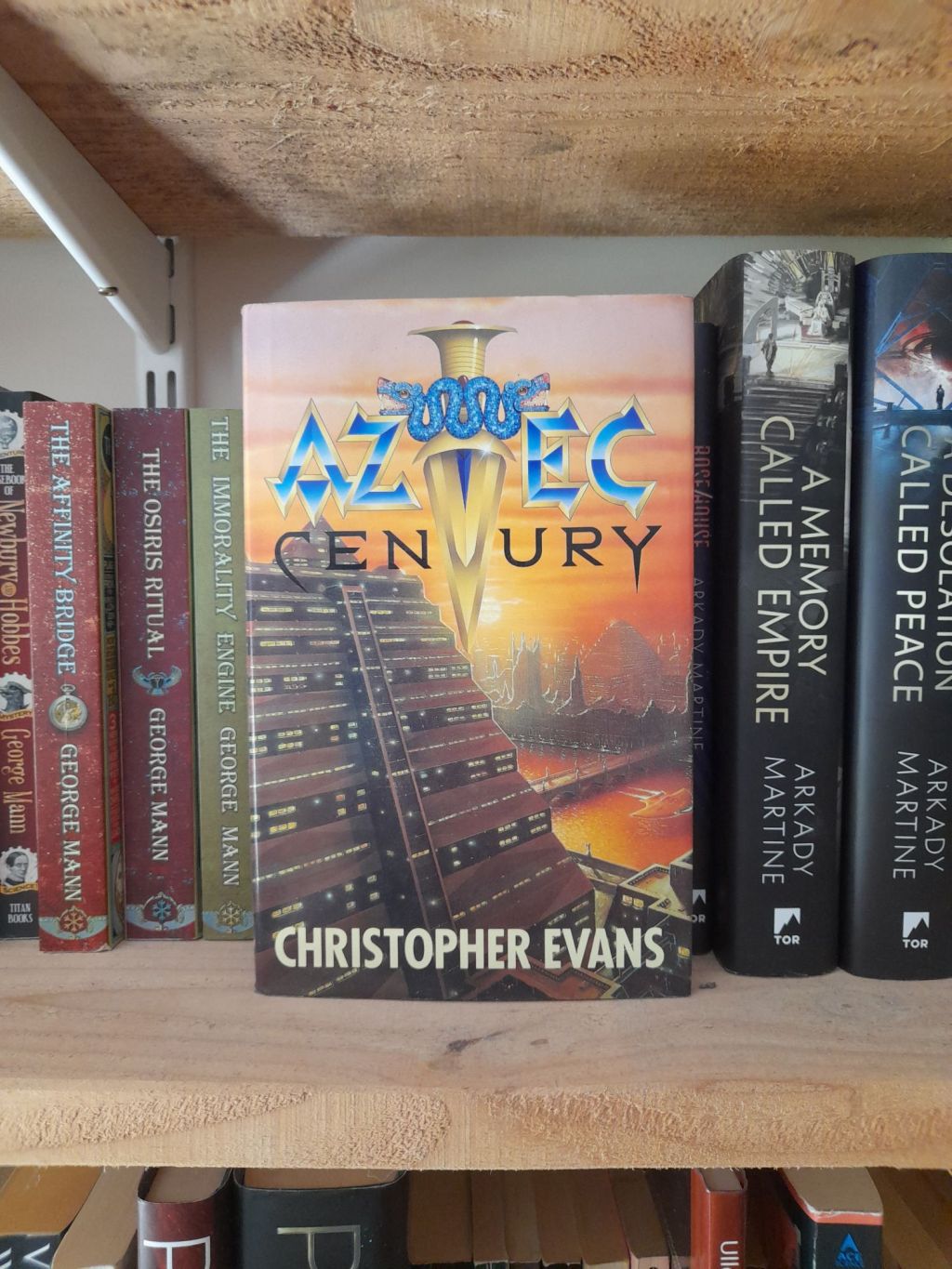
Given how much of British history involves sailing around the world invading people, it’s hardly surprising that a lot of alternative history stories feature Britain as the subjugated nation. Rome and the Nazis are common conquerors in these other realities, but the obvious suspects are not the only ones available. In his BSFA Award-winning novel, Christopher Evans imagines a world in which the Aztecs have taken not only the UK, but almost all of the world. By the late twentieth century, the only forces standing against the Mexican invaders are Tsarist Russia, Canada, and New England. It’s a vision of human history that doesn’t just hang on a single turning point, but sees multiple significant divergences from the real history readers are familiar with. The sense of alienation is palpable, and if it’s sometimes hard to grapple with how these events might have come to pass, it’s to the betterment of the story Evans is telling.
Our narrator for this tale is Catherine, Princess of the British royal family. Catherine is simultaneously sympathetic and incredibly frustrating as a character. If you’re here expecting a rousing tale of rebellion, you’ll be disappointed. There are hints of this early on in the novel, but it soon becomes apparent that Catherine is not a revolutionary. Instead she does the sane thing. Find a place within the new order and use it to improve the lives of those around her. She is a willing collaborator, albeit one disgusted by the excesses of the Aztec regime. Though she is our protagonist, Catherine lacks any real agency. Instead she is buffeted from one part of the narrative to the next. We see the occupation through her privileged eyes.
And yet, it’s this lack of agency that proves to be one of the novels greatest strengths. Catherine may be annoying, but she is realistic. No one person can stand against a conquering Empire, least of all a princess with a sheltered upbringing. All she is trying to do is survive, and through her we see that the Aztecs are trying to do the same. Aztec culture is so far removed from our own that it’s difficult to call them evil. Indeed, when Catherine bears witness to horrors during wartime, she is swiftly reminded that the British are hardly any more humane. It is easier to judge others than to judge oneself, after all.
Upon first finishing the book, my impression was that the climax came out of nowhere. There is still one choice that makes little sense to me, but given that it’s a character decision rooted in emotion, I’m willing to let it slide. As to the broader scope of the book’s alternative timeline, all the clues were there from the very first page. This was my book club’s June read, and it was fascinating to see people debating the existence of a piece of technology when I was far enough ahead to know the truth of the matter. At the time, it was a narrative device to get information moving. But in hindsight, it becomes a key plot point, and proof of how well-thought out the book really is. As it happens, Evans seemed to be several steps ahead of me at all times, even when I was wondering something as innocous as what the Pope was doing in this timeline. Incidentally, I did find it amusing to have a Pope Leo in both this book and the real world, though I think we can chalk that one down to coincidence.
Aztec Century is a stunning piece of alternative history. It’s a world that features major turning points, but also stops to consider how daily life might look had history taken a different path. The lack of a traditional narrative structure makes for a unique reading experience, but in a way that pays off. Ultimately, this is not a book about sweeping historic changes. It’s a book about coming to terms with defeat, with loss, and learning to live with yourself as you try and keep your head above the water. It’s a book that’s prompted thoughts I’ve had to sit with for a while, and now that I have, I think it’s in strong contention for my favourite book of the year.
Book Stats
- A Standalone Novel
- Published 1993
- 352 Pages

 At Boundary's Edge