Teaser
There is an organisation dedicated to safeguarding humanity against unknown threats. Except some of those threats are so unknown that they cannot be remembered . . .
Review
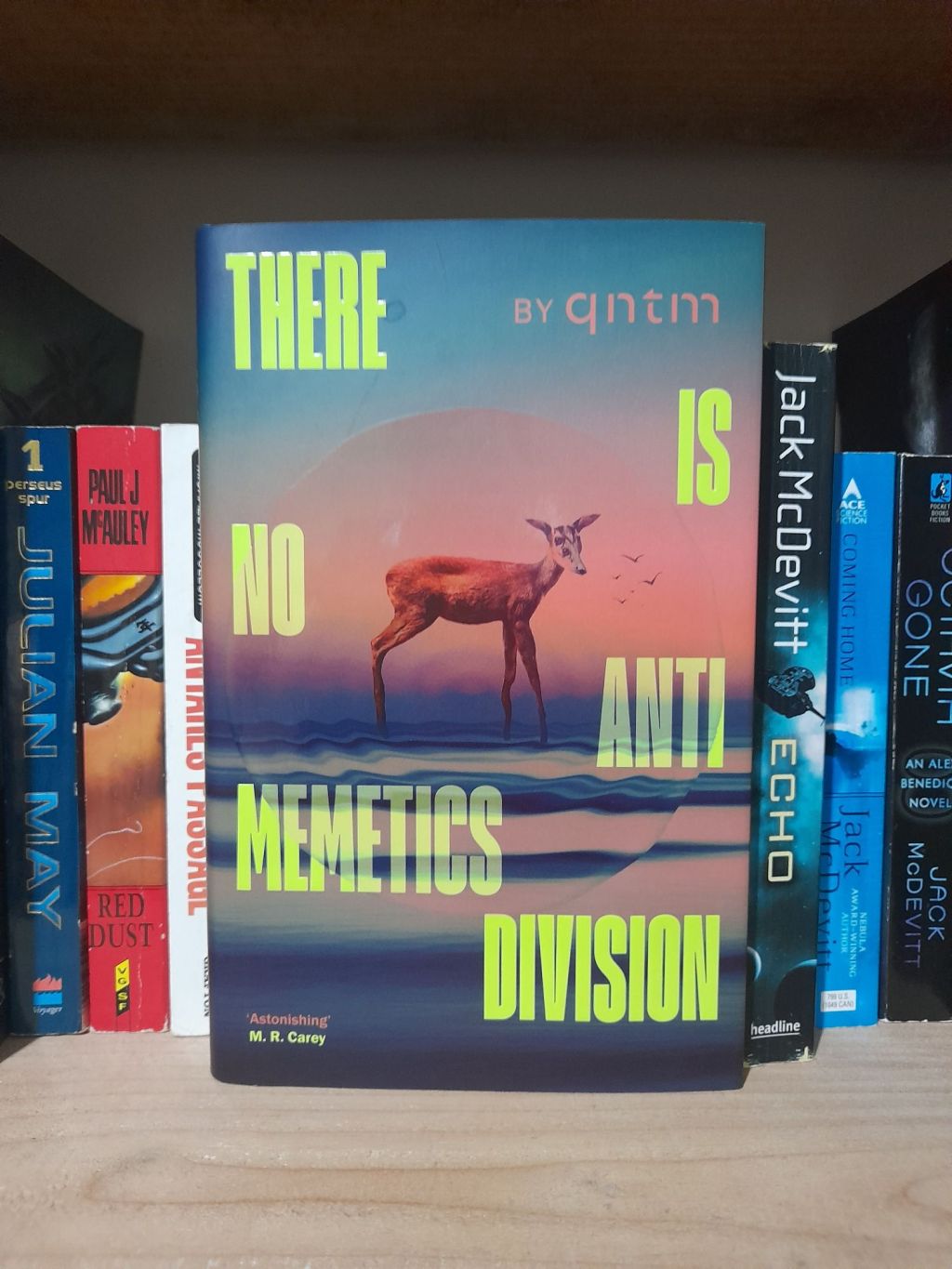
Those of you who are more chronically online than I am might be familiar with the SCP Foundation. It’s a multimedia collaborative worldbuilding and storytelling project that allows anyone to add to the canon of strange objects and phenomena being investigated by clandestine organisations. The first version of There Is No Antimemetics Division were written as a serial for that project, and later self-published as a collected work. Over time, both the story and its author became internet celebrities, and qntm picked up a traditional publishing contract. For various legal reasons, this new version of There Is No Antimemetics Division has been rewritten as a standalone novel, with no ties to the SCP canon. It’s therefore as accessible as any other debut to the uninitiated reader such as you or I.
Overall, There Is No Antimemetics Division is an account of the Organisation, who are tasked with studying various Unknowns that imperil the human race. The Unknowns range from a stone containing the ancient god of forgetting how to ride a bicycle, to a much creepier entity that constantly follows you around feeding on your memories. The common traits of these Unknowns are that they alter our memories and play with our perception of the world, and can even make us forget that they exist.
If all this sounds confusing, that’s because it is. There Is No Antimemetics Division is idea-based storytelling. It starts off episodic, but soon becomes entangled in a larger world-threatening plotline. Imagine a high-concept series of X-Files episodes, and you won’t be far off. The episodic structure stems from the books original serialisation, and the shorter early instalments are by far the strongest part of the book. As with so many high-concept ideas, the more it becomes obsessed with its own cleverness, the weaker the storytelling becomes. The core idea of antimemetics – things that cannot be perceived or remembered accurately – is a really interesting one, but I’m not convinced the story structure of the Organisation, and the way it faces threats in this book, is strong enough to carry the idea as far as the book wants to take it.
I mentioned the X-Files earlier, and I think that there’s another universe out there in which There Is No Antimemetics Division was a TV show rather than a book. Probably cancelled after one season for being too odd for its own good, but I dare say I’d have preferred a visual version of this story. It would certainly have helped keeping the characters separate, because here they all blend together somewhat. It’s also a conceit of the novel that words, paragraphs, and even entire pages are redacted beneath blocks of black ink. This works well for the found documents within the text, but in the general narrative it becomes irksome rather quickly. Though that is just my dislike of structural trickery rearing its grumpy head once again.
Despite my complaints, There Is No Antimemetics Division is a unique reading experience. That is probably why it’s on the Arthur C. Clarke Award shortlist. It is an openly experimental read, and even if it sometimes misses the mark, it hits it a fair amount too. The fact I’m comparing it to TV shows is proof that there are few comparable books out there. If you want to read something original, then this is the book for you. If you want to see science fiction pushed to the limits of creativity, then this is the book for you. If you want a book that you won’t soon forget, then this is the book for you. Ironic, perhaps, but true nonetheless.
Book Stats
- A Standalone Novel
- This Version Published 2025
- 275 Pages


 At Boundary's Edge