
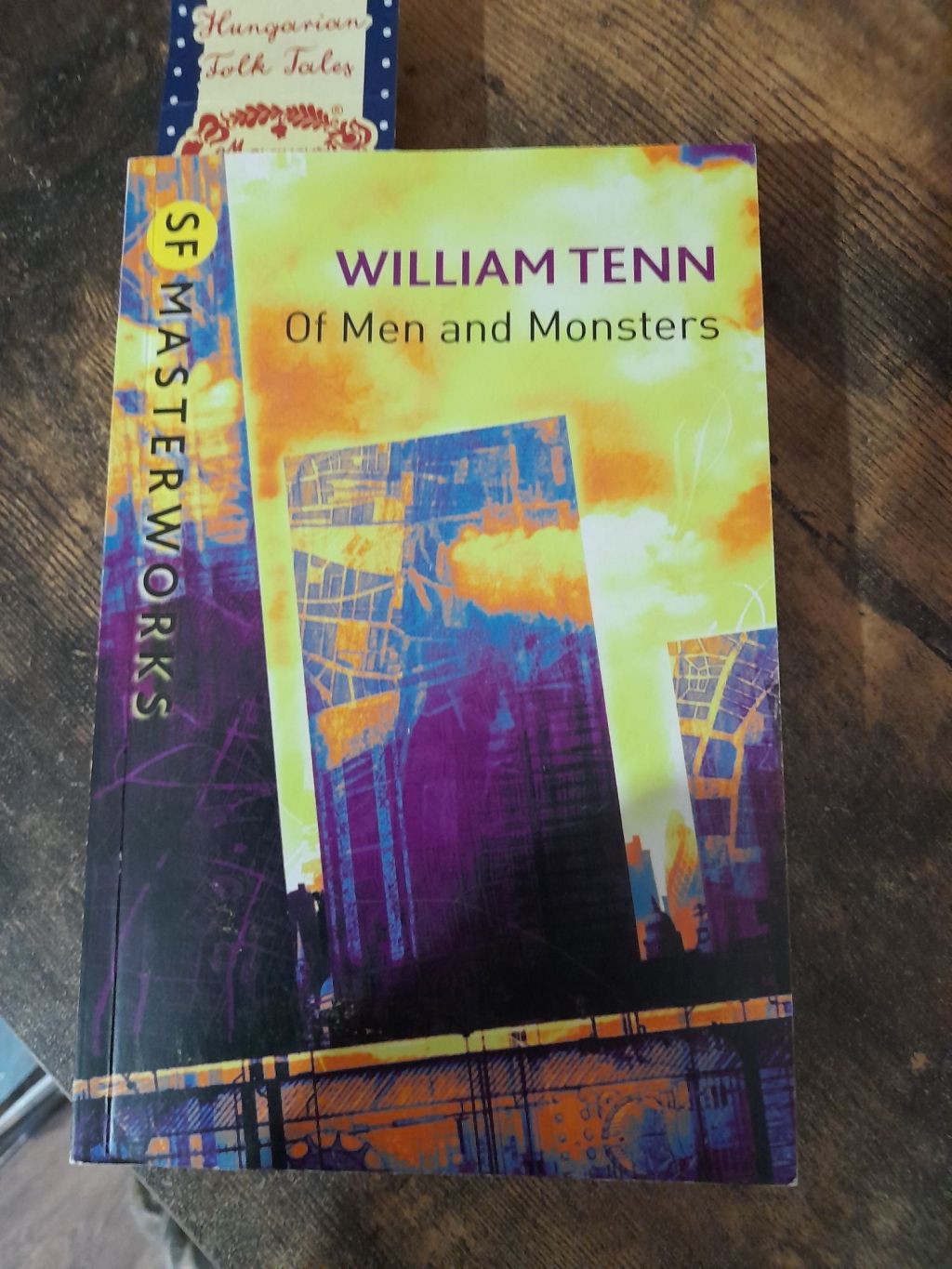
Teaser
Humanity has been defeated, forced to live as vermin in the walls of vast alien monsters. Eric, from the isolated tribe of Mankind, must now do his part for the human race . . .
Review
What qualifies a book as a masterwork? The standards applied by the editors of the Gollancz SF Masterworks project are all but impenetrable. Sometimes it’s a book that has made a clear impact on the genre (Dune). Sometimes it’s a lesser-known work by one of the genre’s titans (Flow My Tears, the Policeman Said). And sometimes it’s a book that has been so roundly forgotten that I’d never have encountered it had it not been reprinted as part of this famous collection. Of Men and Monsters is William Tenn’s only full-length novel, and it’s one I’ve never seen spoken about by modern day reviewers or critics.
The book opens with a quote from Jonathan Swift, which firmly establishes which part of the SF tradition Tenn is following in the footsteps of. Yes, there is an invasion by giant aliens, but by the time the book starts that invasion is long behind us. Humans have lost, and the aliens aren’t going anywhere. This isn’t a book about dashing heroes and massive battles. It’s closer to the social explorations of H. G. Wells, Edward Bellamy, and William Morris. It flips the expectations of its readership on its head and asks ‘what if people had to live like rats or cockroaches?’
The closest book I have to compare Of Men and Monsters to is Brian Aldiss’ Non-Stop, published a decade earlier. Both books feature isolated tribes of people who have forgotten much of their origins, and must now forage for supplies in a world that has become increasingly alien. Both books, if published today, could well be shelved as Young Adult, focusing as they do on young men encountering the complexities of the wider world for the first time. Both of them are Gollancz SF Masterworks.
For all the wonder of its setting, Of Men and Monsters is a deceptively simple story. Eric is our only perspective on his world, and even if his worldview is frequently rocked to its foundations, he doesn’t learn much that will surprise the average science fiction reader. Nor does he have any particularly engaging relationships with other characters. He has a mysterious uncle and a close friend. There are pretty young women flinging themselves at him. He wanders (and is frequently dragged) from place to place with limited agency or purpose. It’s quite a fun journey, but it does end up rather lacking in substance for much of its length.
What sustains the story then? It’s all in the delivery. Like all such social works of science fiction, Tenn’s novel taps the vein of satire. The disconnect between what we know and how Eric sees his world are a source of frequent amusement. More prominent, but unfortunately less successful, are the actual jokes. Almost every character name involves an attempt at humour, and people are happy to wax rhapsodic about the quirks of their homeland. As is so often the case, the less subtle humour annoyed me rather than amused me, but the overall storybook approach of the novel did win me over by the end. And what an ending it is, with Tenn going out on a high with an idea that might just be unique in all of science fiction.
I don’t know if I agree that Of Men and Monsters is a masterwork of science fiction. To earn that status I think it would need a more obvious influence on the books that came after it, or maybe some awards to its name. What I can say is that it is a good book, and I’m gad that the SF Masterworks list is allowing readers such as myself to rediscover it after all these years. If you’re still in the dark about William Tenn, I suggest seeking this one out.
Book Stats
- A Standalone Novel
- A Gollancz SF Masterwork
- First Published 1968
- 235 Pages

 At Boundary's Edge