Teaser
Three colony ships fled Earth during the great war. For over a century, they were presumed lost, but now one has been rediscovered. The people of Darien are about to find out how much the galaxy has changed during their years of isolation . . .
Review
Science fiction comes in waves. One book becomes popular, prompting agents, editors, and publishers to look for comparable titles to add to their lists. After a few years, the market gets flooded and demand decreases. A generation later, the youngsters who read those earlier works are inspired to create their own take on the story, and the cycle begins anew. Of course, some things are eternal. Space opera, that broad and sweeping genre of science fiction adventure, has been part of the SF biosphere for over a hundred years. Yet it too wanes and waxes in popularity. In the UK, one of the major innovators of space opera was the Scottish author Iain M. Banks, whose Culture novels left a ark that is still being felt to this day. Banks became a sensation in the eighties, and so it’s only natural that the early twenty-first century saw a spate of successors.
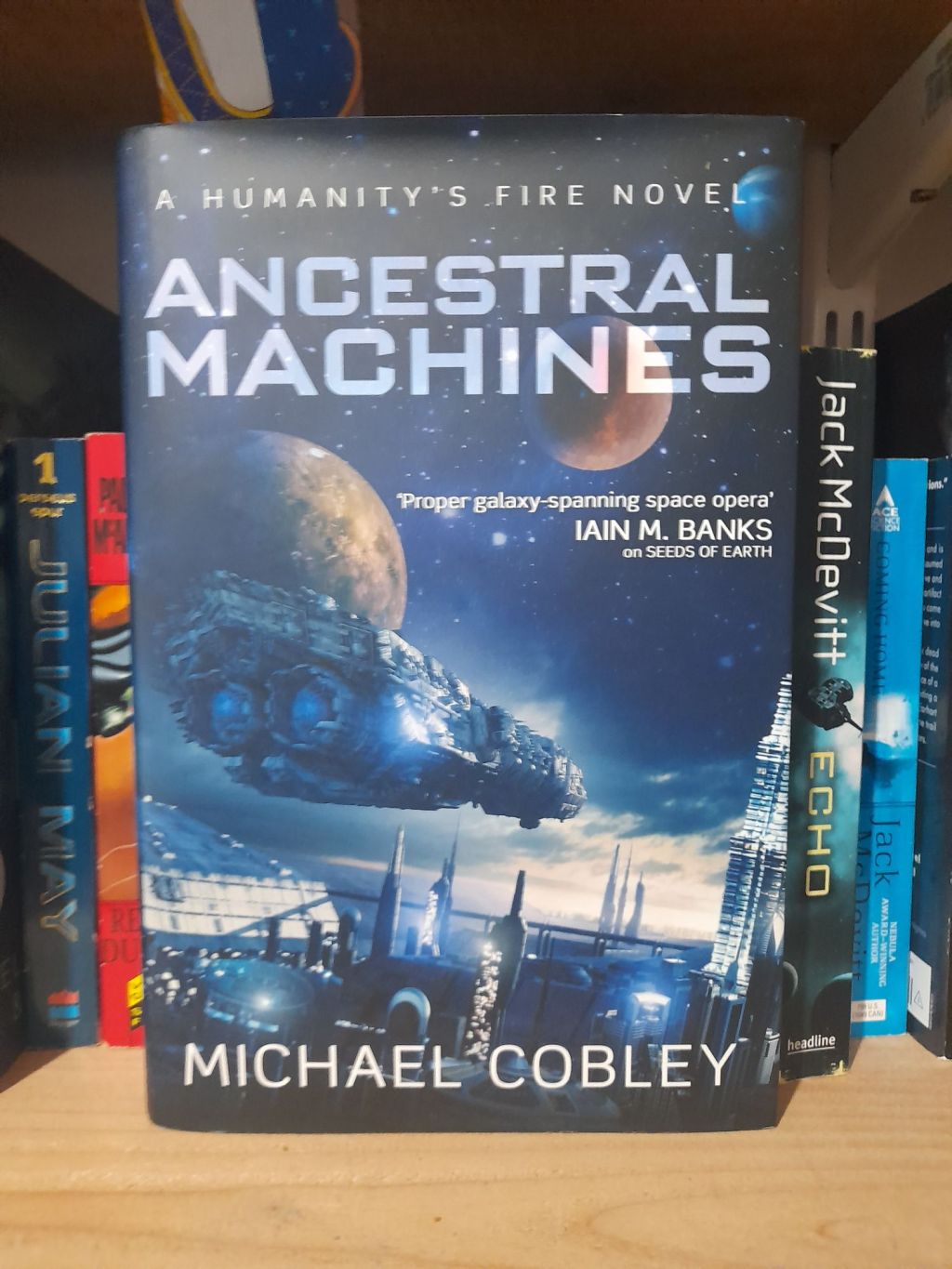
Michael Cobley’s Humanity’s Fire novels (consisting of one trilogy and two standalones in the same universe) owe a clear debt to Banks. They are, in many ways, the definition of Banksian SF. There is the same epic scope and multitudinous alien species one might find in many a space opera, but more directly Banksian ephemera such as the role of shipboard AI, the emphasis on ‘people’ as a nebulous concept, and the way Cobley treats hyperspace. There is, of course, the fact that Cobley is also Scottish, and inhabits the same circles as Ken MacLeod and Charles Stross, but there’s also a vein of working class heroism and gentle humour running through the whole series.
The original trilogy, Seeds of Earth, The Orphaned Worlds, and The Ascendant Stars saw publication 2009, 2010, and 2011 respectively, putting them just ahead of the curve that would see the likes of Gareth L. Powell enter the scene. Cobley’s contemporaries and forebears were the likes of Alastair Reynolds (just breaking away from Revelation Space), Peter F. Hamilton, and Gary Gibson. The trilogy was published by Orbit, and included the opening chapter of an upcoming space opera by another author as bonus material. Tellingly, one of these books being promoted was a hitherto unknown Leviathan Wakes, by James S. A. Corey, a book that has very much gone on to define modern space opera. By the time Cobley returned to his universe with the standalone Ancestral Machines in 2016, The Expanse had already become a global sensation.
Sandwiched in amongst such luminary company, it is is perhaps inevitable that Humanity’s Fire feels lacklustre. It lacks the sleek modernity of Corey or Powell, while also not holding the same scientific ambition as Reynolds or Stephen Baxter. The books themselves drown in different viewpoint characters, while the plot has little to offer that even a reader of twenty years ago would not have encountered before. Iain M. Banks, for better and worse, casts a long shadow over British space opera, and Humanity’s Fire makes little effort to step out of the shade.
Besides their bloat, there is very little that the series does wrong. It’s a little rough around the edges, and in need of a good trim here and there, but there is a good adventure herein. But it is undeniably old hat. Familiar without being comforting. Inspired without being inspiring. There are definitely worse places to start your journey into modern space opera, and I dare say this series, with all its excess, would be a good stepping stone for epic fantasy fans looking to branch out into fiction of the future, but for me it falls short of the mark. Not far short, but still too far for me to call it a win.


 At Boundary's Edge