Well, it’s that time of year again. The time of year when I collate the data and bring you my list of the best British science fiction writers. The maths is simple. I rate every book I read on a scale of 1 to 5, with 1 being a horrible mess, and 5 being brilliant. I then take the average and stick it in this list. There are three important caveats for the list. First, it only includes solo-authored works. So the collaborations between Arthur C. Clarke and Stephen Baxter are not taken into account for either author. Solo-authored short story collections are counted, but anthologies edited by the author in question are not. Secondly, I need to have read and rated at least three separate works by an author for them to be included. Thirdly, tie-in novels and franchise fiction are not included in the data, as this list is for original fiction only.
Are we all clear on that? Good, then let’s begin.
The Best of British SF
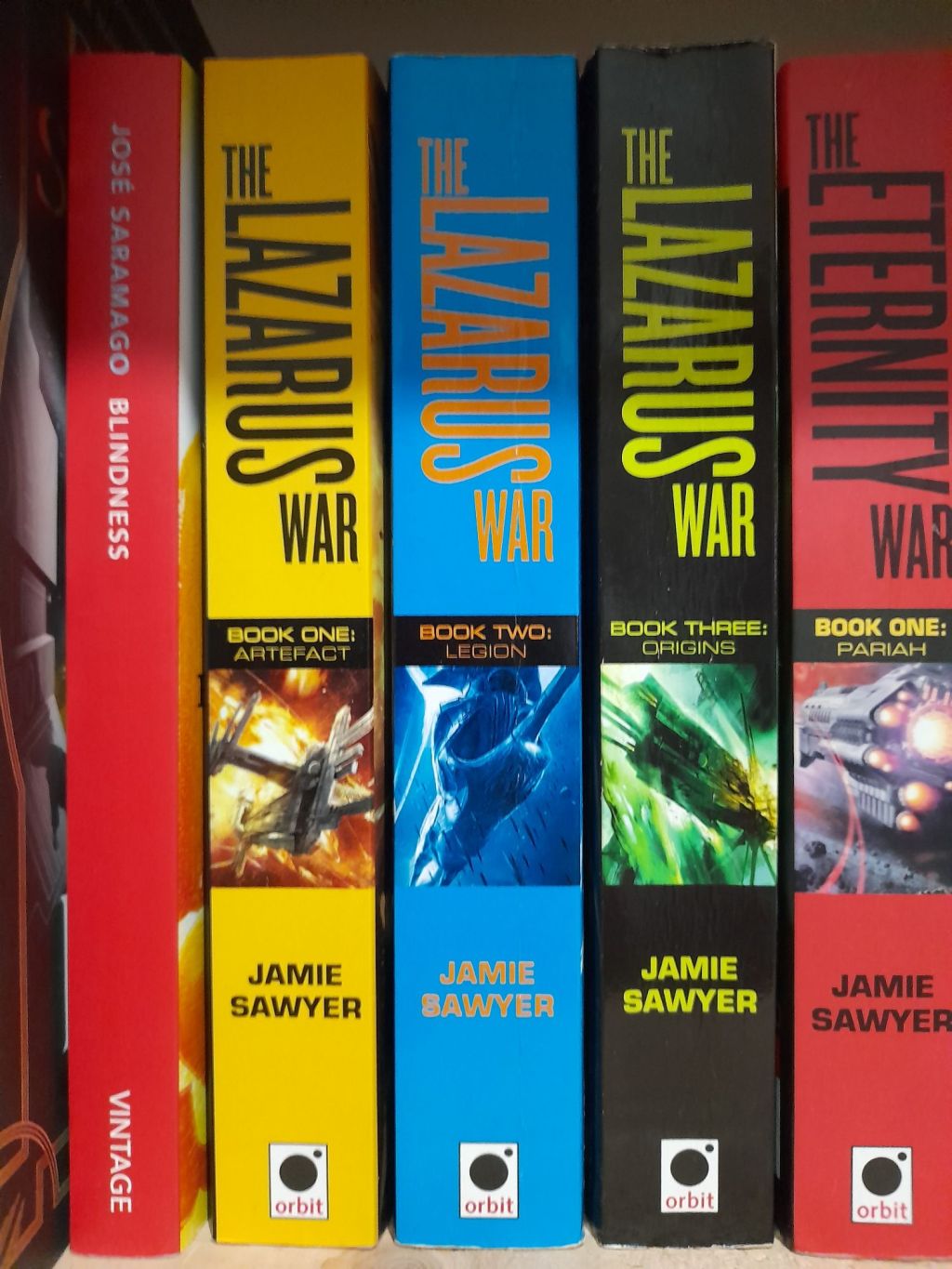
Jamie Sawyer (5.00) (No Change)
With six excellent military SF novels to his name and sadly no more on the horizon, it seems as if Sawyer will be remaining at the top of the list for the foreseeable future.
Philip Reeve (4.50) (No Change)
That rarest of things – an SF author writing for the younger market, Reeves’ work still holds up for an older audience. And with more Mortal Engines tales on the way, there’s a chance for him to climb further up the rankings
George Mann (4.33) (Up from 4.25)
The king of British Steampunk, Mann has secured his place in the top three thanks to Newbury & Hobbes. Time will tell if he returns to the universe he created, or continues to work elsewhere in franchise fiction.
Adrian Tchaikovsky (4.18) (Up from 4.11)
The modern master of science fiction is both highly prolific and reliable when it comes to quality. With a string of recent standalones under his belt, surely it’s only a matter of time before he wins the coveted Hugo Award.
Ian Whates (4.17) (Down from 4.25)
With a strong showing in both short fiction and novel-length stories, Whates is a reliably entertaining teller of space operas, with a publishing house to keep them in print.
N.C. Scrimgeour (4.00) (No Change)
Still my personal highlight of self published fiction, the Waystations trilogy is the perfect love letter to space opera, and I hope to see Scrimgeour return to the genre soon.
Stephen Baxter (3.93) (Down from 3.95)
Even the odd miss can’t outweigh the massive number of hits Stephen Baxter has to his name. If you’re looking for the best Hard SF has to offer, Baxter is your man, and it’s a crying shame he is not better known.
Gareth L. Powell (3.88) (Down from 4.17)
A recent run of disappointing standalones have seen Powell fall out of my list of must-buy authors, but if you’re in the mood for some fast and furious space opera, he’s still your man.
Edmund Cooper (3.80) (New Entry)
Edmund Cooper has been the great discovery of the past year. A forgotten gem from the seventies, his work combines social questions, action, and deep character work. I can’t wait to uncover the rest of his work.
Emma Newman (3.75) (Down from 3.77)
The slight decrease in score here reflects a maths error on my part, as Newman still only has four SF novels to her name. If you’re someone who enjoys their SF rooted in believable characters, Planetfall is the place to start.
Mike Brooks (3.67) (No Change)
While he’s best known for his Warhammer 40,000 work, and has a new fantasy novel out this week, Brooks’ early space opera books are still worth reading if you can track them down.
Bob Shaw (3.67) (New Entry)
Another big name of the past who has been largely overlooked in recent years, Shaw’s Orbitsville is a classic, and his other works aren’t half-bad either. Definitely someone I need to keep reading.
Brian Aldiss (3.50) (Up from 2.67)
Do not judge him by Helliconia alone, because Aldiss has so much more to offer. Indeed, it’s in his standalones that he thrives, with Non-Stop one of the great generation ship novels.
Alastair Reynolds (3.50) (Down from 3.54)
It’s no secret that I remain deeply unimpressed with the Revelation Space novels, but when it comes to standalones, there are few who do science fiction better than Alastair Reynolds.
Runners-Up
Arthur C. Clarke (3.40) (Up from 3.34)
Clarke comes in two flavours. His grand idea-driven stories are hit or miss, whereas his smaller-scale stories are often so impressively accurate in their anticipations of the future that you forget how long ago they were written.
Eric Brown (3.33) (Down from 3.40)
An author who should be better remembered than he is, Brown’s writing is so varied it’s hard to pin him down, but if you like Clarke and Baxter, you’ll probably like Brown too.
C. S. Lewis (3.33) (New Entry)
Best known for Narnia, Lewis’ SF outing is an explicitly religious trilogy of sadly diminishing returns. Out of the Silent Planet, however, is surely worth a read even if you follow him no further.
John Wyndham (3.33) (Up from 2.50)
Wyndham may be among the most respected SF figures in the larger literary community, but his slow apocalypses seldom reach the same heights as his excellent The Kraken Wakes.
James P. Hogan (3.25) (New Entry)
The individual books may each be less impressive than the last, but Hogan’s Giants series is a testament that not all intergalactic adventures need villains or monsters to weave a gripping narrative.
Olaf Stapledon (3.25) (New Entry)
As much a philosopher as a novelist, Stapledon stands as the pinnacle of science fiction as a thought experiment, be it super-intelligent dogs or the future of humanity and the universe as a whole.
H.G. Wells (3.18) (Up from 3.10)
Wells may have been outperformed in the genre he helped to establish, but novels such as The Time Machine and The War of the Worlds still hold up well over a century after they were written.
Neal Asher (3.00) (Up from 2.67)
Asher may be something of an acquired taste, but if you like your space opera mixed with cyberpunk and dipped in a rich dose of cynicism, there are few who do it better.
Honourable Mentions
Iain M. Banks (2.75) (down from 3.00)
Yes, I know, he basically created the modern British space opera, but Banks continues to leave me unimpressed. That said, he’s still worth reading for historical value even if you’ve read better elsewhere.
Peter F. Hamilton (2.67) (Up from 2.50)
With a rating heavily damaged by his Confederation trilogy, Hamilton is slowly creeping back up the rankings thanks to his more recent, and much better, space operas.
Andrew Bannister (2.67) (No Change)
It’s a shame that Bannister only write three novels, as he is by far the strongest of the Banksian imitators. That said, there remains a chance we’ll see more from him some day, and I know I’ll be reading it if we do.
John Brunner (2.67) (No Change)
John Brunner’s career started promisingly with some fun, albeit very pulpy, space operas. His mid-career turn towards more experimental though exercises may have won him awards, but I found them less interesting.
Ken MacLeod (2.50) (New Entry)
Macleod is a frustrating writer. His stories are interesting, and his writing strong. Unfortunately, it’s weighed down by an abundance of political discussion that drowns out everything else.
Michael Cobley (2.00) (New Entry)
Cobley’s Humanity’s Fire is space opera for the uninitiated, and fun on their own terms. But for those who have grown more experience (and perhaps more jaded), they have little new to offer.
And there we have it. Every author eligible for the list has been included. As always, I am open to more recommendations for both authors not on the list, and books by authors on the list that you think might change my mind. I look forward to hearing from you in the comments.


