Teaser
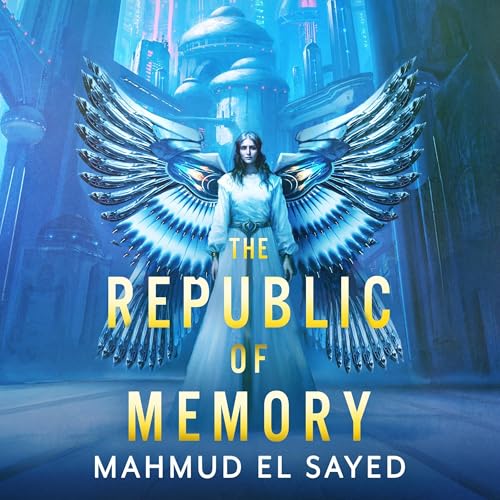
Two centuries on from its launch, the generation ship Safina has strayed from its purpose. Its crew are now divided by language, its precious cargo of sleeping ancestors at risk from power shortages, and in the shadows, a revolution is brewing . . .
Review
I love generation ships. Well, the idea of them. Stick a bunch of people on a spaceship and tell them it will be their great-great-grandchildren who arrive at their destination, and you’ve got an immediate source of drama. Because even if the original crew are happy to dedicate their lives to this noble pursuit, their children might not be so happy about growing up in such a confined space with no real options for their personal futures. If the history of generation ship literature has taught us anything, it’s that problems either arise when the destination is not all it was promised to be, or halfway through the voyage when the crew pass the point of no return. The Republic of Memory takes the latter approach, with a few curveballs along the way.
The first curveball is that alongside the generational crew there are several thousand people sleeping in stasis. Revered as ancestors by some, but seen as a drain on power by others, these sleepers come from the tyrannical Network that ruled Earth when the ship was launched, but which the current crew have since rejected. The debate over how these ancestors should be treated is a recurring theme throughout the novel, and fuels many of the revolutionary debates driving the narrative.
The other curveball is language. It’s common for generation ships to have enforced divisions in crew. Engineering hates navigation, etc. etc. The Republic of Memory handles this in a way I’ve never seen before. Yes, there are different departments, but the actual divisions stem from language. Each berth of the ship speaks a different language, with translators performing a crucial (but seldom trusted) role in bridging the gas between departments. This is where the choice to have multiple narrators really shines. The range of voices, accents, vocabularies, and the slang that crosses boundaries is phenomenal. Equally impressive is the book’s handling of culture. Tied deeply into language, but having developed in unexpected ways as different religions nestle against one another, while political systems and crime syndicates rub shoulders as discontent continues to grow.
The one thing I will say is that there are a lot of characters in this book, all with their own agendas, but we don’t spend an equal amount of time with all of them. Early on we get a chapter from someone’s perspective, but they don’t return until much later on, and then seen from someone else’s perspective. Then there’s the man I thought would be our protagonist, who suddenly (but with very good reason) disappears for much of the novel’s second half. It’s hard to know who will be important and who will be left by the wayside. Sometimes this is a struggle to keep track of, but it also serves to illustrate how many people are on the Safina, and in order to understand the ship, we have to understand as many of the crew as we can.
The Republic of Memory is the start of a series, and it’s one I’m going to be following very keenly. Opening books have a lot of groundwork to do, and while The Republic of Memory excels on that front, it also weaves together character arcs, moral debates, and big ideas in a way that’s satisfying even if this were a one-off. One of the strongest debuts of recent years, and I look forward to seeing how it all pans out.
Book Stats
- Narrated by George Greenland, Kaffe Keating, Lara Sawalha, and Sami Abu Wardeh
- The Song of the Safina #1
- First Published 2026
- Runtime: 15hrs 16mins


 At Boundary's Edge