Teaser
For its final mission, the Apollo programme will do what no other American space programme has done. Shake hands with the Russians while in outer space. Unfortunately, the monopoly these two nations have held on spaceflight for decades is about to come to a violent end . . .
Review
The phrase ‘genre-defying’ is thrown around a lot. A lot of the time it means epic fantasy, but the elves are aliens. Or a detective novel that happens to be set in another universe. Very few books actually defy genre, because genre is a loose concept we use to bundle similar stories together. And if we struggle, there’s always New Weird to store things in. I say this because Chris Hadfield’s fiction debut The Apollo Murders was an alternative history about a secret space flight, but which could theoretically have happened and been covered up. The sequel was effectively a thriller that happened to be set around the same time and characters. Now with the third in the series, Hadfield again dips his toes into the what if? of it all.
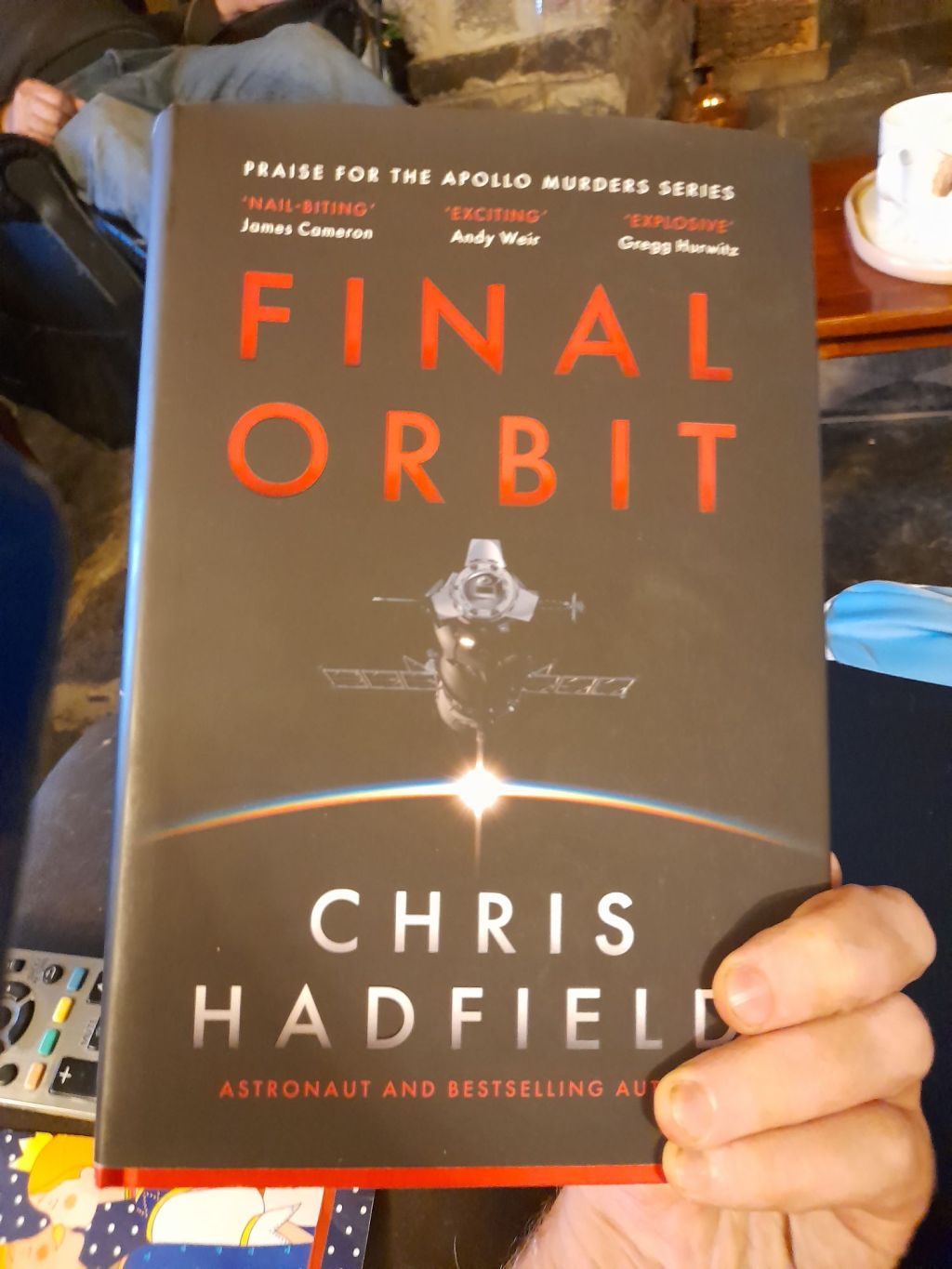
Final Orbit is centred on a famous moment from spaceflight history. The Apollo-Soyuz (or Soyuz-Apollo, depending on where you live) mission. For those not familiar, it involved a US Apollo capsule docking with a Soviet Soyuz capsule, and the crews shaking hands. Great publicity for all involved. As Hadfield tells it, this historic event is disrupted by domestic terrorists, and the launch of China’s first manned spacecraft. A lot of the book feels like historical fiction, which is a horrible thing to say about a time period in which my parents were alive. When exactly does history begin? However, during the course of the book, people are killed. Real people from that period, including at least one who is actually lived well into the twenty-first century. Does this qualify the book for alternative history status? I think it does. Though the logic extension of that argument is that Bernard Cornwell’s Saxon Epic The Last Kingdom is also an alternative history, and that just feels wrong. There are no great, sweeping changes to the timeline for the world as a whole, but things happen that change lives.
Questions of genre aside, I absolutely love Hadfield’s style. Multiple times throughout the narrative, he’ll pause and take a few pages to describe in great detail some obscure piece of technology or spaceflight trivia. It won’t work for everyone, but as a layman with a fascination with aeronautics, it’s exactly what I hope to encounter from the ex-astronaut. Hadfield imbues even the simplest piece of technology with a rich sense of history. You can tell this is a world he’s actually lived in, and those details bring history alive for the rest of us too.
As part of the book’s broad scope, Hadfield does a fair bit of head-hopping. characters appear for a chapter or two and then fade into the background for the rest of the novel. Some of these characters are Hadfield’s own creations, whereas others are historical figures like President Ford or future president George Bush. IF everyone in this were a fictional character, I’d be tempted to say there are too many viewpoint characters. But because many are real (and there’s a helpful index to tell you who is who and who did what in the real version of events), it adds to the sense of reality that Hadfield brings to this book, while never forgetting that the lynchpins of the story are the fictional characters created for the series.
There is another Apollo Murders novel on the way in the near future, and with Hadfield continuing to go from strength to strength, I can’t wait to see how his characters handle the dawn of the space shuttle era.
Book Stats
- The Apollo Murders #3
- First Published 2025
- 395 Pages

 At Boundary's Edge