Teaser
Mawukana na-Vdnaze is born into debt, and dies in servitude. But it is afterlife that will be remembered, for the thing that remembers being Mawukana will play a pivotal role in the end of several civilisations . . .
Review
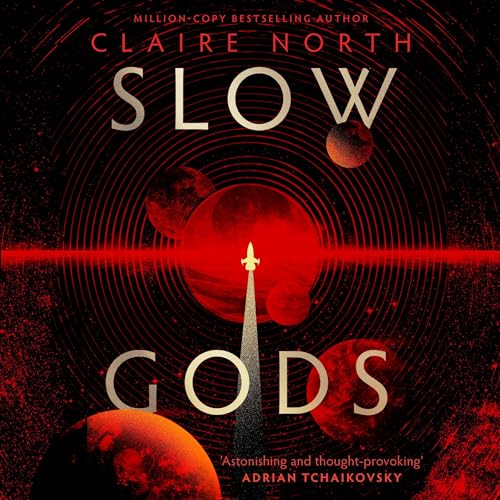
Space opera has a tendency to be a sprawling thing. When authors invent planets, lineages, and intergalactic empires, it’s only natural for things to be stretched across multiple novels. We’re lucky if this sprawl limits itself to trilogies. Big stories require big page counts. Or at least that seems to be the prevailing logic. Even back in science fiction’s heydays, the same universe could serve as the home for a multitude of stories. Just ask Poul Anderson. Claire North’s Slow Gods, then, is a rare thing. A space opera of truly epic scale that is nevertheless completely told within a single compact book. even if there were nothing else to commend the book, North would deserve praise for such restraint.
There is, however, much more to say in praise of Slow Gods than just its sense of pacing.
Common belief holds that books are about characters following their agendas. That is very much not the case here. Maw has wants and needs, but by and large he has no agency. Right from the outset he is powerless, and while he does go on several missions, it is largely because he has been pointed in a given direction and told to go that way. This makes for a refreshing change from the usual space opera characters who push and pull entire civilisations about as they go. It also gives Maw plenty of time to reflect on his situation without the book dissolving in maudlin philosophy. Because Maw might be the protagonist of the book, but the book isn’t really about him.
Rather, Slow Gods is an account of how different civilisations react in the face of their inevitable destruction. The dystopian Shine react by clamping down even tighter on their citizenry, then lashing out at their neighbouring states. Others take a more sombre approach. Some hold lotteries to see which fraction of their populace will be lucky enough to survive the impending apocalypse. Then there are those who accept the inevitability of their deaths, instead seeking to save relics and artefacts so that their way of life be remembered by the galaxy at large. Slow Gods may be direct, even blunt, for a space opera, but as a meditation on the decline of civilisations, it dives deep into society’s fears and asks important questions. If the end of the world was certain, who or what would you save?
The depth to which these civilisations are realised is impressive for any book, let alone one of such brevity. North has a knack for capturing what makes a society tick, giving us just enough to make sense of while leaving us able to fill in any leftover gaps. There are societies which ritually scar their people in accordance with their usefulness to society. Others that are so rigidly hierarchical that using the wrong form of apology is offensive, while still being so free with their bodies that I’m tempted to label them all a bunch of hippies. Across planets, languages change, and genders become a matter of some debate. And that is before we get to the artificial intelligences and hive minds.
As the title suggests, there is a religious aspect to Slow Gods. The Slow is a vast machine of unknown origin, which some see as a god. But is it a god? Does it want to be a god? How is a god supposed to act? These are all questions that the book tackles head on. All through Maw, who is resurrected after each death by the power of folk belief like the cat in an unopened Schrodinger’s Box. Maw may not be human, and the Slow may not be a god. Then again, maybe they are what they believe themselves to be. Or, more troublingly, what others believe them to be.
Slow Gods is a fantastic slice of science fiction by any measure. It’s unafraid to ask the big questions of life, death, and the liminal spaces in-between. If you read only one space opera book this year, make it this one.
Audio Stats
- Narrated by Peter Kenny
- A Standalone Novel
- First Published 2025
- Runtime: 12hrs 7mins


