Teaser
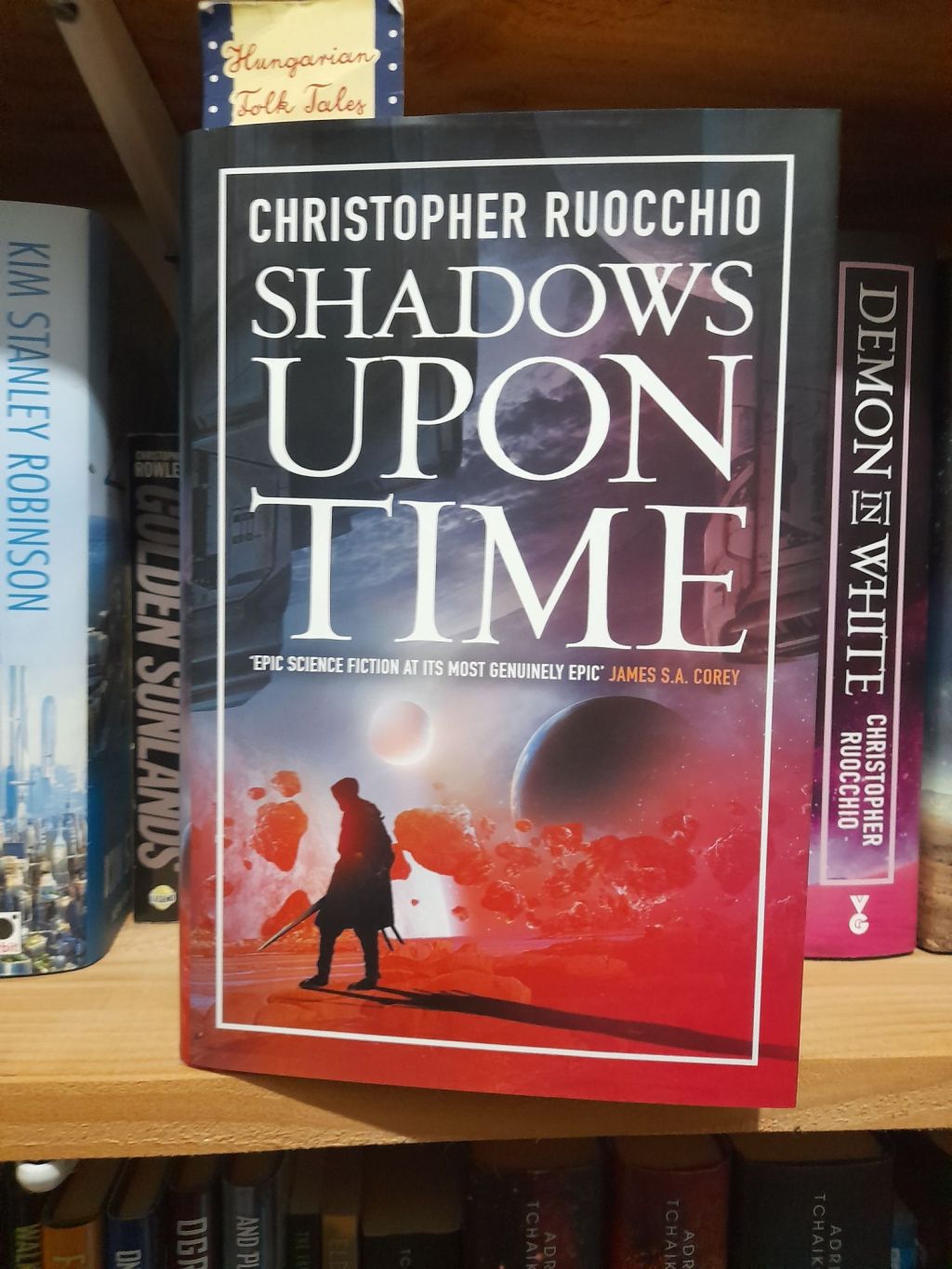
With his allies and his enemies alike gathering at Gododdin, Hadrian Marlowe prepares to meet his fate. The final hour is at hand, but is Hadrian willing to pay the price for victory . . ?
Review
Cast your mind back to 2018. In his local branch of Waterstones, a young man fresh out of university finds a debut science fiction novel and decides to give it a whirl. He finds it fascinating, but has no one to discuss the book with. No one out there seems to be discussing science fiction books. So he does what seems natural. He creates a blog dedicated to science fiction. That blog is At Boundary’s Edge. the young man is me. And the book in question is Christopher Ruocchio’s Empire of Silence.
The Sun Eater series has had a long and rocky road to its finale. In both US and UK markets, it’s been through two publishers. It has courted fame and infamy in equal regard for the sheer number of special editions being printed by specialists. Some people have said it’s too derivative of its influences, while others have championed the way it wears those influences on its sleeve. Some will say the prose is purple, while others laud its grandiose style.
I’ve stuck with the series from day one, looking forward to the long-awaited battle of Gododdin teased so many years ago. We know the destination, but the journey is the fun part. There have been rocky patches, to be sure, but by and large the series has stood proudly above its competition. The prose is overwrought and self-indulgent, but it fits the first-person narration. Kingdoms of Death slogged through a bland Orwellian dystopia, and an overly long prison sequence, but made up for it with one of the most devastating final acts I can think of. Throughout it all, one question remained. We know Hadrian Marlowe commits genocide, destroying both the alien cielcin and the Imperial fleet in the destruction of a star. But can such a choice ever be justified? Is Hadrian Marlowe a good man?
Disquiet Gods threw a spanner into the works. From the beginning, there have been religious undertones to the series. Philosophy and theology go hand in hand, and the mysterious alien Quiet, seemingly moving backwards in time provided one of the most alluring puzzles of the series. Who or what were they? And what did they want? Disquiet Gods gave an answer, and it was, for me, a deeply unsatisfying one. The Quiet is no less than the Absolute. The literal God and creator of the universe. And the cielcin were not merely an alien race with different morality to our own. No, they were tricked into serving the Watchers – fallen angels who seek to destroy creation. Over the course of a single chapter, the series had gone from a fascinating and rich future history to the most overtly Christian work of science fiction since A Canticle for Leibowitz.
Shadows Upon Time begins with Hadrian indoctrinating his own daughter into his newfound religious fundamentalism. Any questions about the rightness of his actions from here on out are brushed aside. God has commanded that this must be, and God is just. It’s a moral flattening of the entire series that does a major disservice to the complexity the other books strived to build. Any questions about Hadrian’s morality are rendered irrelevant if we consider the book’s central conceit that God is real and in charge. Granted, we only have Hadrian’s account of the Absolute to go on, but if we are to disbelieve Hadrian in this regard, why would we not then question the veracity of the entire series? If Hadrian is willing to lie, then what is the point of reading his first-hand account?
Then there are the pacing issues. The book is nine hundred pages long. The first hundred and fifty take the form of flashbacks, stalling us right out of the gate. Then we go into the brilliance of Hadrian returning to the Empire with his plan to end the war. There’s brilliant politicking and fantastic character-work. Then a brief mission to elsewhere, and a return to the Empire. This return features the same politics and scheming, but can’t help but feel like a re-tread of previous chapters. Then we have the battle of Gododdin itself. The final battle between Empire and cielcin is as awe-inspiring as I could have hoped. Edmond Hamilton would be proud of the carnage. Alas, it is coupled with the underwhelming end to the series’ primary antagonist, and some science fantasy that is utterly ridiculous in its silliness. And then, when you think it’s all over, it is. The book, and the series, fizzles out with barley a whimper.
And yet. There is no denying how much I enjoyed this book. I was turning pages late into the night. even with its issues, I was never bored. Certainly, the book could have been trimmed by a good two hundred pages and been the stronger for it. But equally, there could have been another book chronicling the aftermath of Gododdin and I would have welcomed it. I can’t help but wonder if the rocky road to Gododdin, coupled with editor changes and the need to split books in two has wounded the series as a whole, but I do know that, while not always satisfying, Shadows Upon Time is at the very least a fitting end to the series.
My blogging journey began with Empire of Silence. With Shadows Upon Time, this first phase of my own journey is now complete. The series has exploded in popularity, and if I played a small part in that, I’m happy to take credit. I will quibble with the shift to a more religious tone, but I don’t regret a moment of my reading. Eight years and seven novels later, for its merits and its flaws, there is no other series like Sun Eater.
Book Stats
- Sun Eater #7
- First Published 2025
- 903 Pages


 At Boundary's Edge