Teaser
Paradise was envisioned as a new home for humanity. But now the crops are failing, the wildlife is rampant, and the money is running out. One way or another, this is the end of Paradise . . .
Review
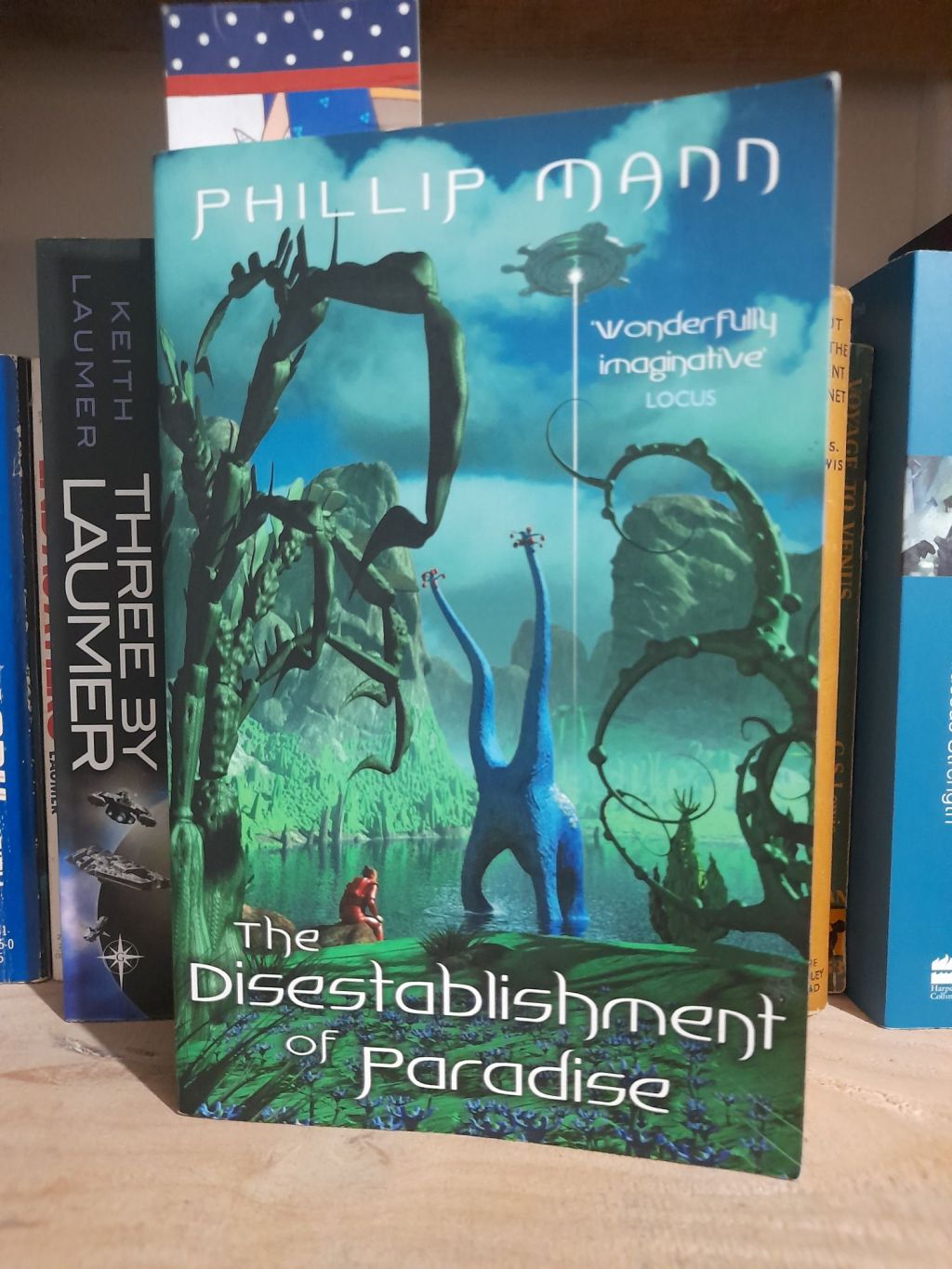
I’m almost there. I’ve almost caught up on my TBR. There are still two books on it that I received as Christmas gifts last year, but The Disestablishment of Paradise had been there since March(ish) 2025. The other twenty-something books looming over my bed at night are all acquisitions from the past eight months. Not bad going.
Phillip Mann’s 2013 release is one I didn’t know a whole lot about. It was part of a book bundle I nabbed off eBay because the books accompanying it were on my wish list. I also know that it’s been shortlisted for a couple of the big awards, and that the few people I know who have read it speak of it fondly. Other than that, it was a blank state. I haven’t read any Phillip Mann before either, so I had no idea what I was getting myself into.
If I had to pick a book to compare The Disestablishment of Paradise with, it would be Dune. Not for any plot similarities, but because of the way they approach narrative. On the face of it, The Disestablishment of Paradise is a very simple novel. A colony is mothballed due to the financial burden it places on the bureaucracy, and one woman remains behind for as long as possible to learn as much as she can about the planet while she still has a chance to do so. A simple premise, but an interesting one. While there are threats and drama along the way, the core of the book is a tale of exploration, the quest for knowledge, and seeking out the secrets of the universe.
Pull back from that, however, and things get more complex. We have one of my favourite things: a framing narrative. Hera might be the protagonist, but in the context of the book, she is relating her adventures to Olivia, an author of fantastic stories. Through the lens of Olivia, Mann is able to play around with styles and make some bold choices. At times, the narrative gives way to interviews between fictional author and protagonist. The book’s dedication is to a character who appears only briefly. Mann removes himself from the novel to such an extent that it feels like an Olivia novel, complete with a foreword and a series of footnotes leading the reader to a collection of in-universe documents gathered at the end of the book. There are almost eighty pages of these documents, which show different perspectives on life on Paradise, explaining the history and biology of this alien world. If you hadn’t gathered already, this is where my Dune comparison comes into play.
I have to admit, I enjoyed the structure of this book more than I enjoyed the story at its core. The novel starts off brilliantly. there are plenty of books that deal with the colonisation of alien worlds, but none that show it quite as plausibly as The Disestablishment of Paradise. I loved the debates over the purpose of colonies in these early stages. Once Hera is left alone, however, I found that there wasn’t as much to keep me interested. Especially when she is no longer alone and the inevitable romance creeps in. the latter half of the book slowed to a crawl that, while it had some great worldbuilding, left me wanting more.
That being said, The Disestablishment of Paradise is still a remarkable novel. It does things a little differently, and the experimentation largely works in its favour. So if you’re looking for science fiction that’s fallen off the radar a little in recent years, this is a great place to start.
Book Stats
- A Standalone Novel
- First Published 2013
- 515 Pages


