Teaser
Under the iron rule of Pater Aeternus, there is no freedom. You bear the children he commands. You ignore the crimes he commits. You follow his every order, or you pay the price . . .
Review
“It certainly is terrible to live in a dystopia.”
“Oh, it’s worse than that, it’s horrible.”
“Yes, it certainly is awful.”
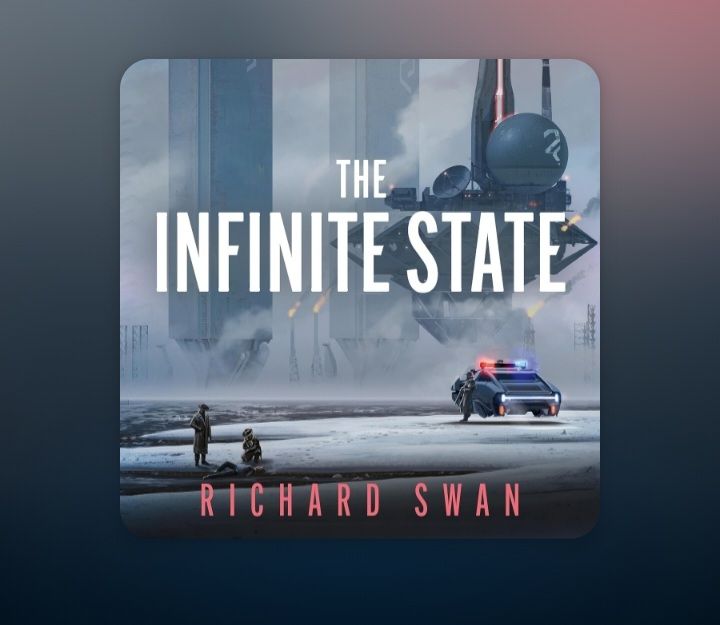
I could leave my review at that, but not even I am that glib. But those three lines of dialogue, while my invention, are a pretty accurate summary of the first half of this book. There’s an Isaac Asimov quote I half remember in which he talks about disliking dystopias because they are simply ‘this is bad, this is bad, this is bad.’ I find myself in agreement with that. Even barring the fact that I can experience my own personal dystopia by watching the daily news, I have never been a fan of dystopias. With his new novel The Infinite State, Richard Swan has perfectly synthesised everything I dislike about the genre.
Now, a key feature of dystopias is that they take place in societies where hope has been stamped out and everything is bleak. Bearing in mind that I think ‘telling’ is just as valid a literary technique as ‘showing,’ my main takeaway from the Decurion Empire is that it wouldn’t be half as bad if people didn’t stop going on about how bad it is. Granted, their world is a terrible place, but all people do in this book is complain. A great deal is made of how the state is always watching for signs of rebellion, but rather than building a sense of paranoia and tension, the constant reminders of oppression merely serve to grind away any sense of nuance, turning the book into a painful and miserable trudge through one dystopian trope after another.
Like all dystopias, the key influences here are the Soviet Union, pre-war Germany, and a healthy dose of North Korea. All the things us free-thinkers fear. Oh, and all good detectives are smokers, drinkers, and working on cases they’d rather not be. There’s also an explicit ban on homosexuality and any non-missionary or protected sex, because if you’re not producing children then you’re not serving the state. I bring up the insistence on the missionary position for two reasons. Firstly, because you can get pregnant from other positions, but secondly because despite this rule clearly being based on Christian missionary work (hence the name) the Decurion Empire is outright stated to be anti-religious. Sometimes a quirk in worldbuilding gets to me, and that’s what happened here. It’s as if the book is pulling from every available dystopia in both fiction and the real world, without ever really stopping to wonder why things might be the way that they are.
My own personal grievances against shoddy dystopias aside, there was one strand that kept me interested. Weirdly, it’s the sports. Hypersled racing feels an awful lot like Formula 1, and I genuinely enjoyed the way the on-track and off-track dramas crossed over with one another. If this had been a book focused on racing rather than politics, I’d have been a lot more interested, and that’s not something I find myself saying very often. Unfortunately, this plotline soon gets consumed by the other parts of the book, and the racing all but disappears by the second half of the story. I weep for what might have been. Truly, I do.
It’s possible I’ve been too harsh to this book. Had it not been so hyped up by people I usually trust, I’d probably have skipped it on account of the genre, and been a far less grumpy man as a result. Unfortunately for us all, I did read the book. No matter how good Swan’s writing is (and it is good), I ended up suffering through another bland dystopia. If you like being miserable, give the book a read. If you like nuance, maybe skip it. Because when not even an army of clone gorillas can raise my estimation of a book, I can only conclude that the book in question is not for me.
Book Stats
- Narrated by Helen Keeley, Nathaniel Priestley, and Chris Rowe
- The Decurion Saga #1
- Published 2025
- Runtime 15hrs 19mins


