
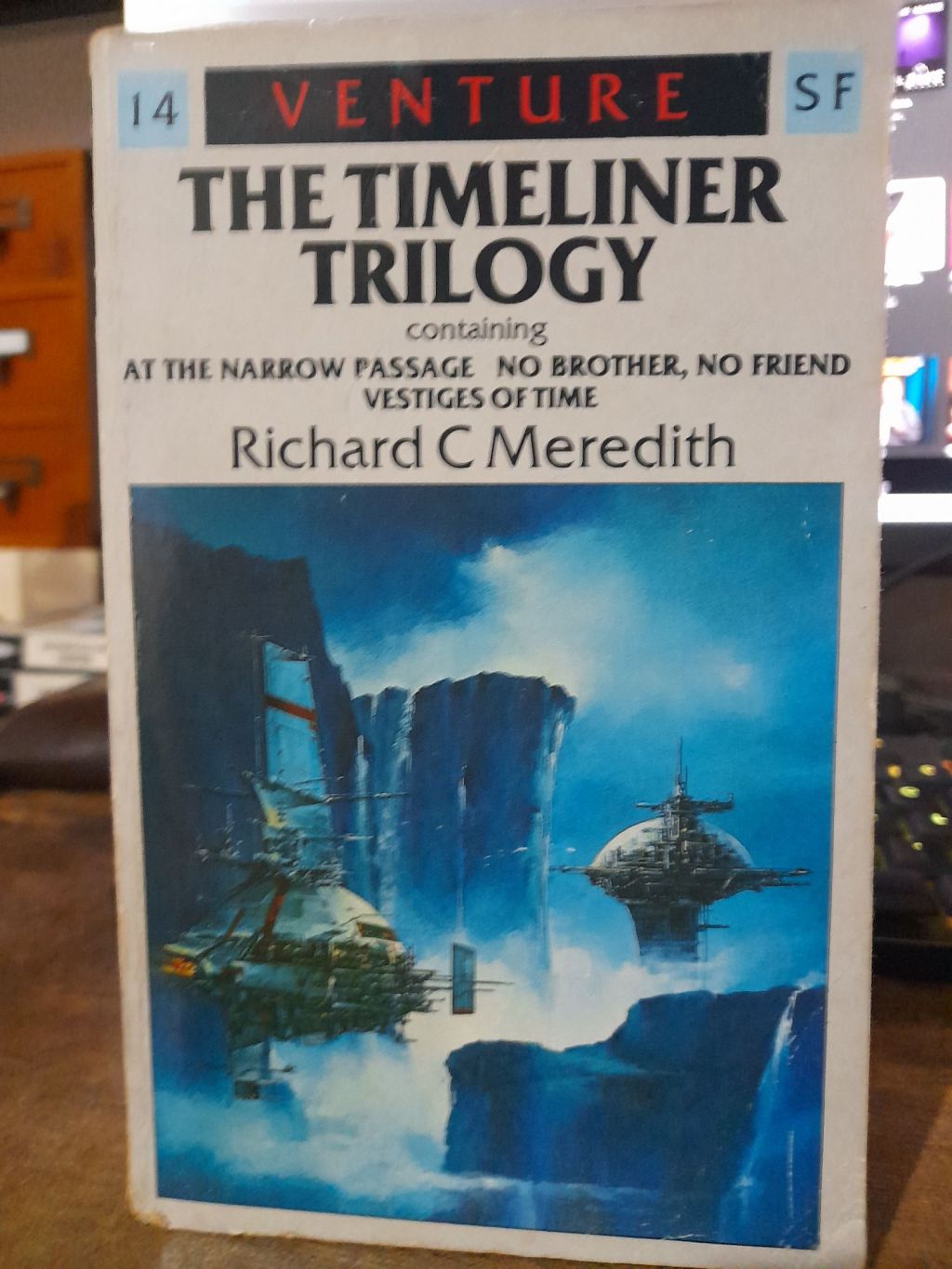
Teaser
Driven by a warning from the future, the alien Krith wage a silent war across multiple timelines. Working for and with them are humans, plucked from their homes and sent undercover to work as Timeliners . . .
Review
Of all the authors in the Venture SF range, Richard C. Meredith has proven to be the most reliable. We All Died at Breakaway Station is one of my favourite sci fi standalones, while Run, Come See Jerusalem is a fantastic slice of time travel. As a further hint that I might enjoy The Timeliner Trilogy was the fact that the first book is dedicated to none other than H. Beam Piper, for the influence that his Paratime stories had on the Timeliners. Indeed, a faction known as the Paratimers do show up later on, but if you were expecting time travelling police officers, you’d be mistaken.
In my spreadsheets (Yes, those are still around), I count these books as time travel stories. But that’s not entirely true. There’s a warning from the future, and the idea of time machines does factor into the final book of the trilogy, but for the most part it would be more accurate to label these as alternative realities. We open in a version of 1971AD that sees Europe consumed by a war between the British Empire and the Holy Roman Empire. There’s no single divergence point, but we are treated to some gory details about the failure of the American Revolution. Later on we find versions of Earth in which humanity has annihilated itself through nuclear warfare, or never evolved, or has remained at a very primitive level of technology. Our protagonist comes from a timeline in which the ancient Greeks conquered Britain, while in another version of Earth there are giant mushrooms covering the land. Honestly, this is the alternative history landscape that I wanted the Long Earth saga to be.
As you might expect from a series that covers a seemingly infinite number of alternate realities, things do get confusing. the writing itself is swift and great at action, but once the Timeliners and Paratimers come into conflict, it soon becomes apparent that neither side is telling the whole truth. Things got muddled quite quickly, not helped by the lack of clear motivation for, well, just about anyone in the book. By the time of the third book, we’re neck-deep in time loops and for some reason the narrative shifts from first to third-person without warning.
Another thing to be aware of is that this book was written in the seventies, and was published by Playboy. Yes, that Playboy. This goes some way towards explaining why every woman is reduced to a sex object at some point in the story. Our hapless hero can’t move two metres without someone offering him a nubile young beauty to go cavorting with. At one point we’re told that some of these beauties have been trained since childhood in the erotic arts, but the unsettling implications of that sentence are entirely glossed over. Likewise, I hope never to hear about the ample busts of sixteen year olds ever again. It’s all rather unpleasant, and can’t help but take the shine of an otherwise fun series of books.
All things considered, this is definitely the weakest of Meredith’s books that I’ve read so far. Especially No Brother, No Friend. But even with their flaws, the books in this omnibus are fun, and also provoke the odd thought about the nature of history. I also think it’s worth noting that this was the final book Meredith wrote, with the last in the series being published posthumously. He died fairly young, but left an impressive body of work behind him. I hope that, fifty years later, others are rediscovering his legacy and enjoying them as much as I am.
Book Stats
- Omnibus Edition of At the Narrow Passage, No Brother No Friend, and Vestiges of Time
- Published 1973 – 1978
- 712 Pages


