
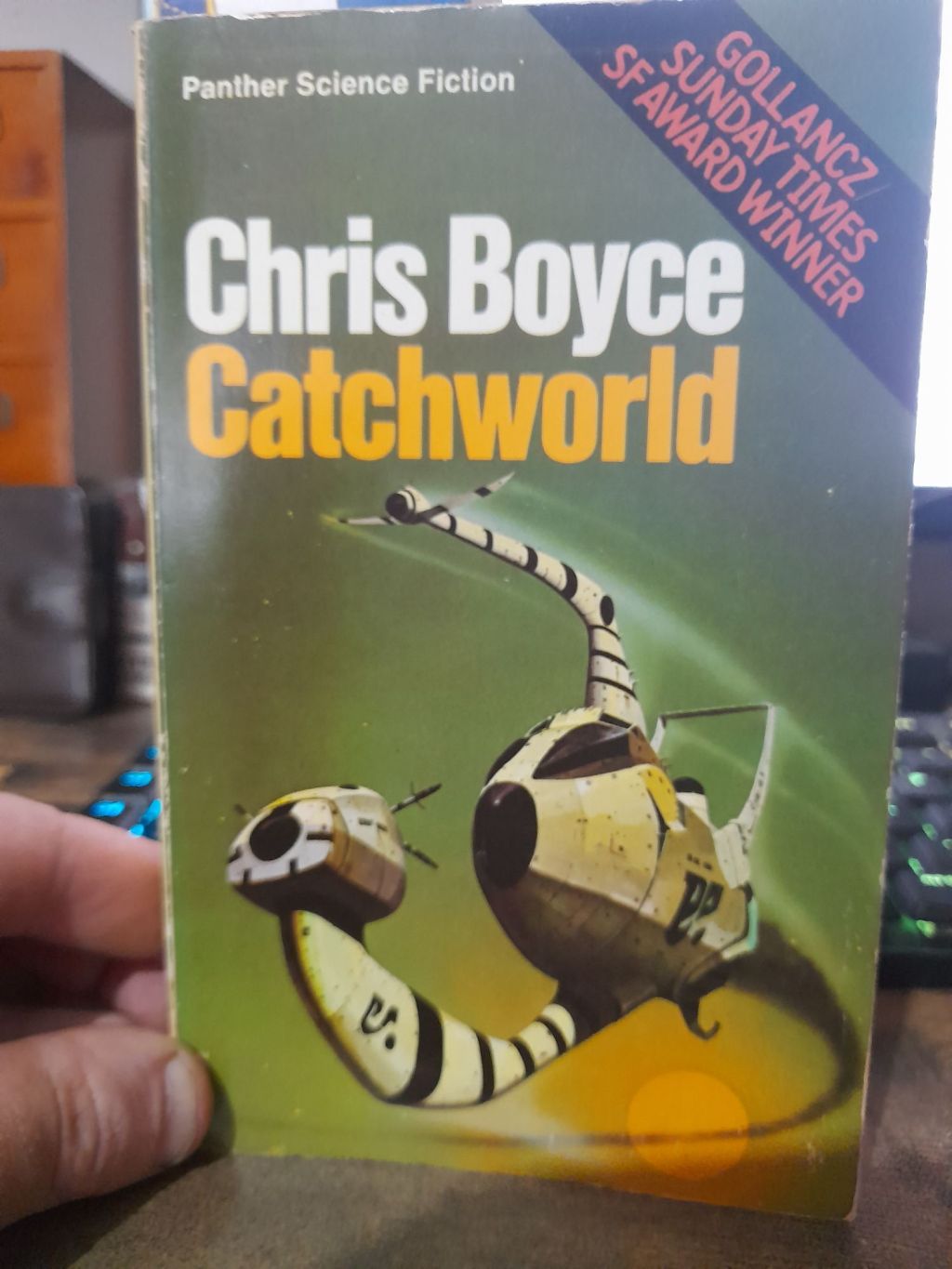
Teaser
War with the Altair star system is inevitable, and so a diverse taskforce is assembled and sent out on a vast warship. but the crew soon find that the real danger may come from within . . .
Review
I have a long list of books I want to read. at the time of writing, I have 14 books I plan to reread, 26 books on my TBR, and a wish list of about a hundred that I plan to purchase as and when I see them. It’s a reading strategy that has seen me kept well-stocked for many years. However, sometimes I want to push outside of my comfort zone a little and read something else. Occasionally, this will be a new release by an unfamiliar author that, for one reason or another, catches my eye in Waterstones. More often, it’s a random book that I see for cheap in a charity shop. This was the case with Catchworld. I had never heard of the book before, nor was author Chris Boyce a familiar name to me. All it had going for it was an interesting blurb and a typically wonderful piece of cover art by the legendary Chris Foss. Seriously, the man’s spaceships are second to none. So I bought it, with hopes it would be good, but no concrete expectations. It only cost me a few pounds in Oxfam, so what did I have to lose other than a few hours of my life?
I don’t really count those hours lost, but I have to say I was underwhelmed by my first run-in with Boyce. It started off promisingly, with a scene that very mush lived up to the cover (not always a sure thing with Foss), but rapidly faltered. One aspect that immediately stood out is language. To be fair to Catchworld, the book is over fifty years old, and it’s diverse cast was probably quite progressive for it’s time. It’s contemporaries are the likes of Isaac Asimov and Bob Shaw, neither of whom were, in my experience, particularly good are writing diverse characters. However, half a century on, language has changed, and that diverse crew now looks riddled with stereotypes and offensive descriptions.
The end of the book is also insane, and I do not use the word lightly. Boyce’s prose style is filled with gaps and sentences that make less sense the more you think about them. But beyond the stylistic, this is also a book in which ancient Mesopotamian deities start walking the corridors of a spaceship. The whole Ancient Aliens conspiracy has been done to death (and I say that as a lover of Stargate) but here it is just such a jarring shift in tone that I can make neither heads nor tails of it. there may or may not be an omnipotent crow involved too.
There is, however, one aspect of the book that has aged very well. Science fiction does not exist to predict the future, but sometimes it does so all the same. The ship’s Machine Intelligence is hauntingly prescient of our modern-day LLMs/AI. It studies humans, building a composite database and personality out of everyone it encounters. People’s whole lives are fed into the machine in the hopes of creating a super intelligence. Unfortunately, nobody on the ship is entirely sane, and as they turn against one another, so too does the ship’s AI become more vindictive. Some of this submission of humanity to the mechanical is part of a plan, but the enhanced threat of runaway AI rings all the more loudly fifty-ne years after the book was first published.
All in all, I don’t recommend this book to the average reader. There are definitely better stories out there. But as a piece of science fiction’s long obsession with artificial intelligence, I think Catchworld stands out for how close to reality it accidentally came.
Book Stats
- A Standalone Novel
- Published in 1975
- 254 Pages


