You might not think it to look at me, but I am old enough to remember the glory days of US Network TV. Back in the good old days, you could tune in once a week and get an entire story delivered over the course of 45 minutes. With a good show, you could have this experience over twenty times a year. Then things changed, but only a little. Instead of twenty separate stories, you had twenty stories that were standalone, but all tied together. You had season-long arcs, with each smaller story building up to a grand finale. It was a good time to be a viewer, especially if you could handle those epic two-parters that sometimes came along.
Then 24 happened. 24 took the idea of a season-long arc and ran with it. It had a single story, broken up into 24 episodes. Tune into a random episode and you wouldn’t know what was happening. Miss an episode and you’d be totally lost. It revolutionised TV, and led to the kind of shows we still have today. Because what are modern streaming shows if not movies dragged out across six to eight hours? A lot of people loved 24, but I’m not one of them. Why? Because in order for the story to carry across all those episodes, a lot of episodes were dead weight. I honestly cannot remember how many times Kim was kidnapped in the first two seasons, but it felt like a lot. The season premieres featured very little except the promise that something good would follow. If we were lucky. The show is riddled with false action, constantly escalating the tension and drama, but you know the important stuff is going to happen towards the end of the season. 24 was also constrained by its gimmick of having the action unfold in real time. Weird how nothing important ever happened during an ad break, isn’t it?
Why am I talking about 24 in a book review? Because having read (and enjoyed) fourteen novels across three different series by Marko Kloos, I’ve realised what’s holding me back from loving them. He’s not writing novels as part of a series. He’s writing series that happen to be broken up into novels. These may not be the chopped-up novels of the pulp magazines, but Kloos is writing serialised fiction nonetheless.
This is most evident in his Palladium Wars series, which now has four novels. At around a thousand pages in length so far, it’s strange to look back at this series and realise how little of consequence has occurred across four novels. They’re well-written, solid pieces of military SF, and I fully intend to keep on reading them. But, there is an issue. I feel like we’re still in the build-up phase of the series. I would like to have seen more movement so far. Will the alphabetical titles continue until we have twenty-six novels? I hope not. Maybe I’m just being impatient, but after four novels I feel like I should have a better idea of where this series is headed.
Then we come to Frontlines. The first six novels did indeed tell a complete story. Then we got two more, which felt a bit like an aborted attempt at a sequel series. These books were each similar in length to Kloos’ other work (all somewhere near the 300 page mark), but each was fairly self-contained, even if only because the took place on a different battlefield. I think they were helped in this by having a sole narrator, whereas the Palladium Wars novels are divided between four viewpoint characters.
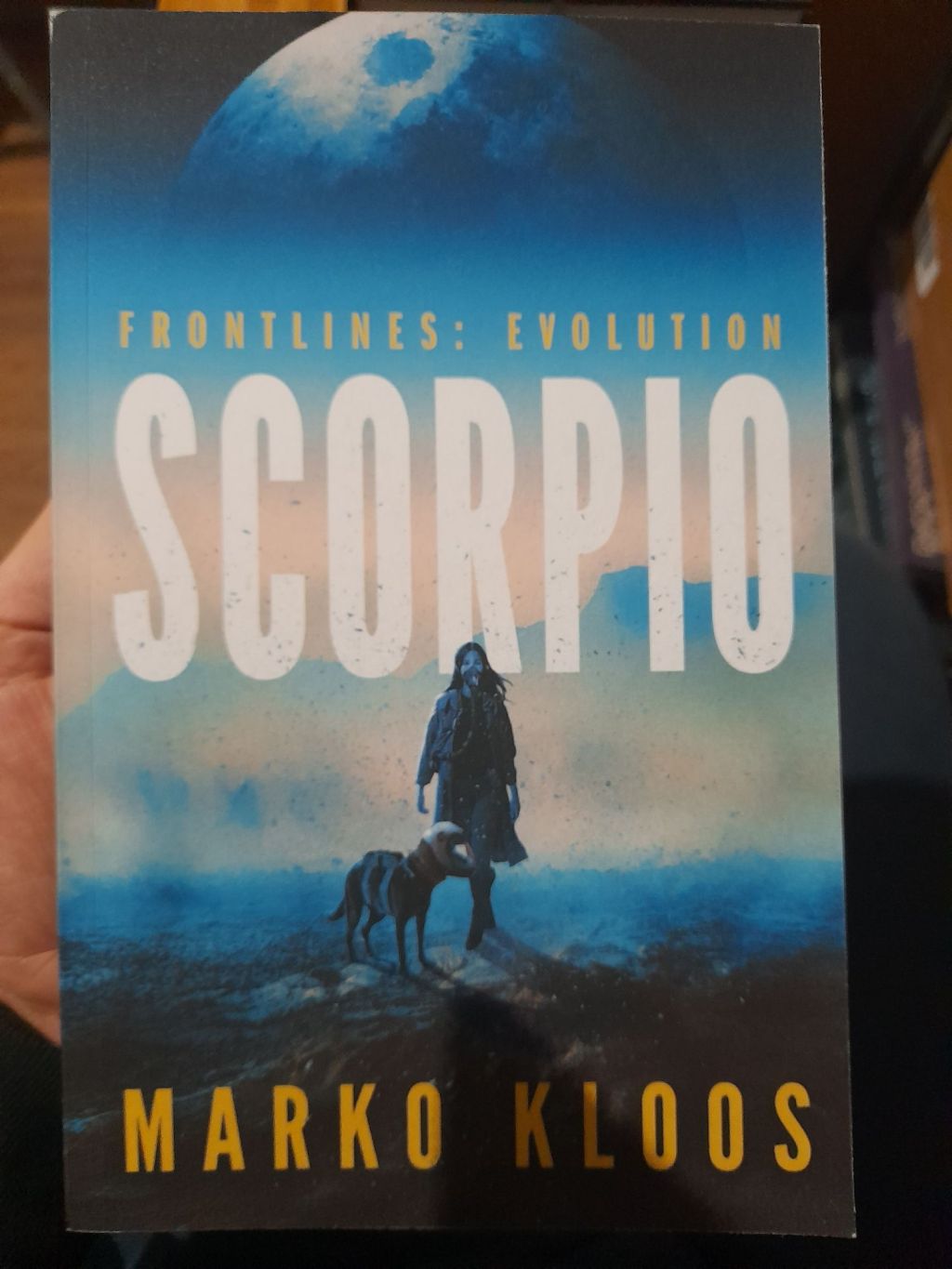
Now we do have a spin-off series. Frontlines: Evolution is two novels in, with a third on the way. Again we have a single protagonist (Alex Archer) and we’re right back into the middle of the war between humans and Lankies. The first book is almost entirely backstory for Archer, and works as a standalone. We see the colony world of Scorpio after eight years of Lanky occupation, with the remaining human population struggling to survive. Minor spoilers, I guess, but they do survive and Archer ends the novel heading off to a new destination.
That destination, as Corvus reveals, is another world occupied by Lankies. There are a lot of them about, and the constant battling for survival does feel a little repetitive. However, Corvus also works as a standalone, while clearly showing some trajectory for the series. The cameo appearances from familiar names are nicely woven into the narrative, and the changing shape of the war keeps things from being dull It’s strange that after ten novels in the Frontlines universe, it still feels a little fresher than the Palladium Wars, even if the latter series is the one that I think has more potential overall.
Is it nice to have an annual feed of Kloos’ books? Absolutely. They’re quick and fun. But would I also be happy to wait just a few months more for something a bit more substantial? Again, yes. There’s everything needed for a great series in both of Kloos’ universes, but it is being stretched out a little. If you’re going to have a fully serialised story like this, it needs to have a bit more substance. Learn from the mistakes of 24, and make sure each book has something to offer not just as part of something larger, but also on its own terms.

 At Boundary's Edge