Teaser
In our world, the Allies won the Second World War. But in another world, the Axis Powers have divided America, and the world, between them. Their power is unchallenged, except by those who dream of a different world altogether . . .
Review
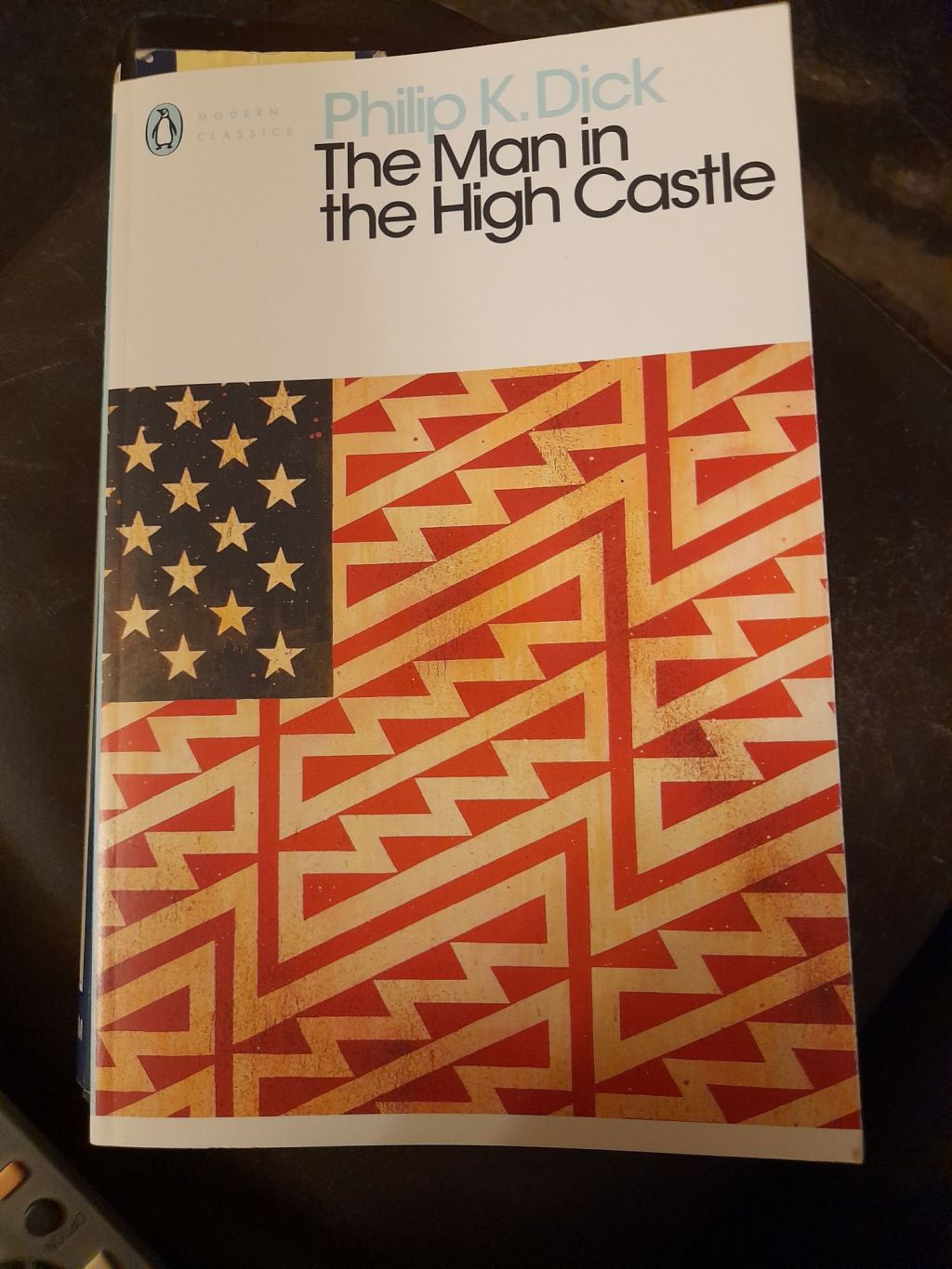
Alternative histories are a staple of the science fiction genre. They take the timeless question of ‘what if?’ and apply it to the past. Often there’s a single event that goes differently. Sometimes it’s a cascade of historical changes. With thousands of books on the topic, some historical changes are more popular than others. The entire subgenre of steampunk arises from ‘What if the Victorians had robots?’ while ‘What if the Roman Empire never fell?’ also remains popular. The most iconic alternative history, however, is of course, ‘What if the Nazis won?’ Murray Constantine’s Swastika Night actually predates the Second World War, but the topic has been tackled by everyone from Len Deighton (SS-GB) to Star Trek (too many times to count). Arguably the most famous of these texts, however, is Philip K. Dick’s Hugo Award-winning The Man in the High Castle.
Often when I tackle a book this well-known, it’s hard to think of anything that hasn’t been said before. Especially with a book like this, whose ideas and imageries have become commonplace throughout and beyond science fiction. In a strange turn of events, I find I do have something to contribute to the conversation, because I appear to be in a small minority of people who don’t think this book is actually all that good.
This is my third novel by Dick, and I find that I have the same complaints about each of them. There’s some genuine brilliance in them. Some powerful themes, and some neat little ideas. Unfortunately, there’s also a lot of weirdness. Weirdness that I imagine stems from the copious amounts of narcotics Dick was taking at the time of writing. In pursuit of some great literary truth (that almost every other reader I know seems to find in his work) Dick’s structure falls apart and he forgets the most important part of fiction: telling a coherent story.
The Man in the High Castle is only a little over two hundred pages long. That’s quite short, though about standard for Dick. You might expect a book of that length to have a laser-like focus, or to be a deep dive into one character. Nope. Across those two hundred and a bit pages we follow spies, soldiers, antiques dealers, jewellery makers, and others spending their lives under Axis occupation. Alongside these we have news broadcasts telling us about the wider world (sadly we never learn more about the missions to other planets or the draining of the Mediterranean), and extracts from a novel called The Grasshopper Lies Heavy.
The Grasshopper Lies Heavy is the most fascinating part of the novel. It depicts another world in which the Allies won the War, but which is radically different from our own. As The Man in the High Castle progresses, we learn that there may be more to The Grasshopper Lies Heavy than there first appears. Dick isn’t interested in multiverses, but instead seems to be acknowledging the fictionality of his own work. This is not an approach I particularly enjoy. If you’re going to do away with the façade of reality, why not write a thought experiment not a novel? It’s also telling that the history presented in The Grasshopper Lies Heavy is infinitely more interesting than the one in the main novel. Some of that is because six decades have rendered the rest of the book fairly trope-ridden, but it’s also a sign that Dick didn’t write the best version of the story. He came up with a fictional character to do what he could not.
As it stands, the largest problem with The Man in the High Castle is the absence of a story. Juliana and Joe could easily have supported the novel on their own, but instead we have to suffer through Childan and chapter after chapter of stilted (and borderline offensive) English dialogue from the Japanese characters. The stories of Baynes and Frink, both hiding their identities, could have been interesting, but instead end up feeling more like a sideshow to the main event.
This was a buddy read for me, and thanks to my charming buddy reader, I learned that Dick did not just have his characters using the I Ching to make decisions, but also used it himself when writing the novel. So on the plus side, I guess there’s more to the man than just drugs. On the downside, this is a book that would benefitted greatly from less pursuit of theme, and a tighter focus when it comes to the actual narrative. This is clearest in the climax, when everything stops. Not with a bang, not even with a whimper, but with the carelessness of another turned page. If you told me this was the first half of a book, I’d believe you. There’s no resolution. No grand finale.
It just stops.
Book Stats
- A Standalone Novel
- First Published 1962
- 228 Pages

 At Boundary's Edge