Teaser
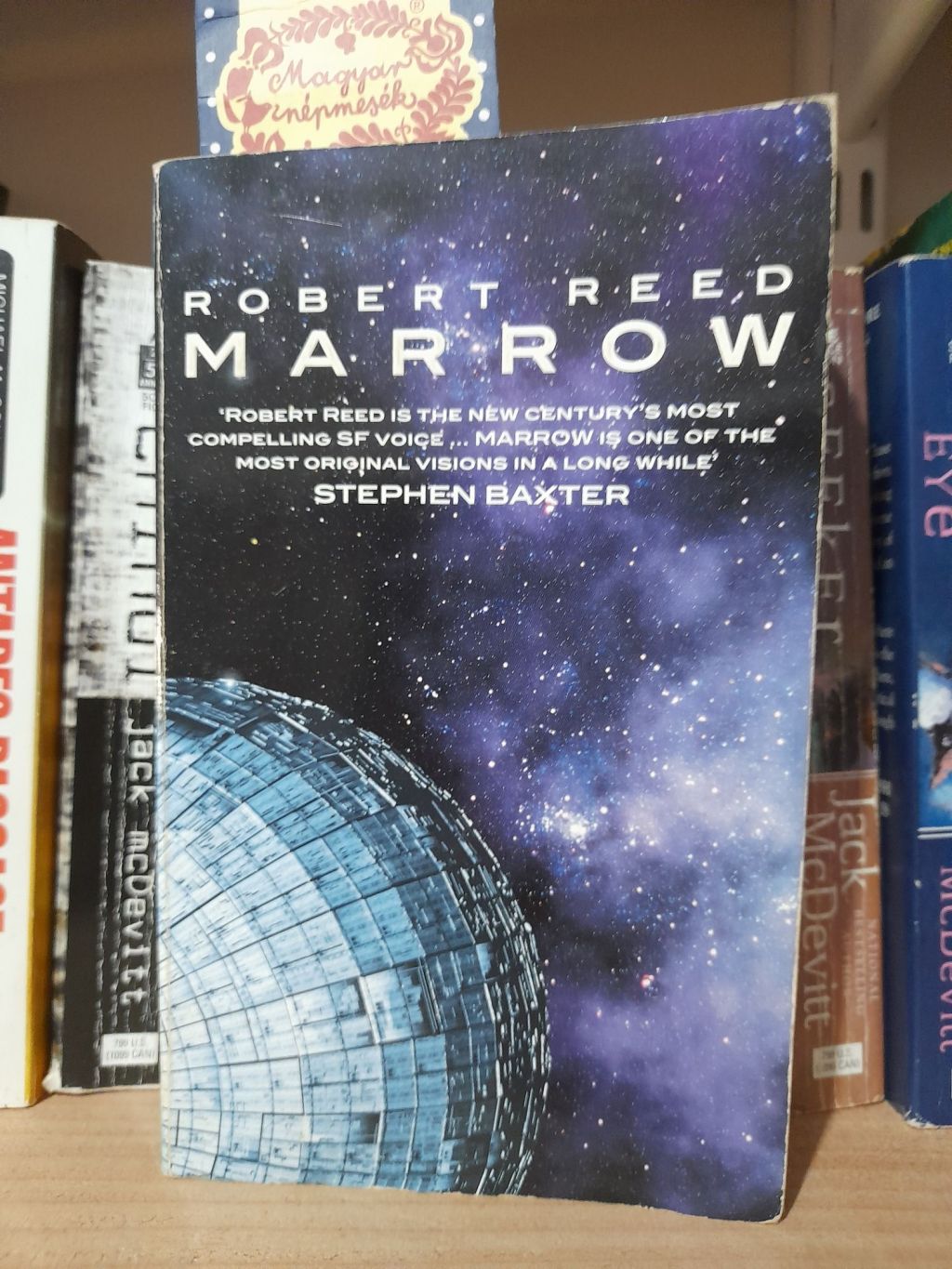
Entering our galaxy from regions unknown, the great ship is an enigma. Who built it? When? Why? Humans are not alone in entering the ship in search of answers, but humans might just be the ones to uncover the truth . . .
Review
If there’s one science fictional thing guaranteed to get me excited, it’s a megastructure. From Larry Niven’s Ringworld to Bob Shaw’s Orbitsville, there’s something about massive artificial structures of unknown origin that provides ample fodder for this science fiction reader. The bigger, the better. Robert Reed’s Marrow has been on my planned reading list (albeit a hazy concept) for some time, and when I found others interested, I was more than happy to make it the July read for the Boundary’s Edge Book Club.
Marrow opens with a massive sphere arriving in the Milky Way, and humans landing on it pretty soon afterwards. The humans set themselves up as the new owners of the mysterious ship and quickly decide to stay onboard as it continues it’s journey through space. Other alien species arrive too, but it’s clearly the humans who are in charge.
What follows is a story of two halves. One strand takes the expected route for a megastructure (sometimes called a Big Dumb Object, or BDO) novel, with humans exploring ever deeper layers of the ship and slowly unravelling the truth of its purpose and origins. As I had hoped, this throughline is brilliant stuff. There is plenty going on in the ship, especially when it is revealed what exists deeper down in the heart of the vessel. There’s a whole load of exploring, meeting aliens, and a glut of information. I love boardroom meetings in science fiction, and Reed is very good at using them to reveal key pieces of information in a way that feels natural. When we get to the final answers, there’s a suggestion of still more layers to be peeled back in future novels, and I am definitely interested in reading them.
The second thread running through the book is somewhat less successful. This is, of course, the human drama. Though rarely the draw of a book like this, the human drama takes up the bulk of the middle act. As you might expect, not everyone has the same idea of what to do with the ship, or who should be in charge. All fairly standard stuff. However, this is a story that unfolds over thousands of years. Usually, this would only make me more interested. I love a good multigenerational epic. Having entire civilisations rise and fall over the course of a single novel? Yes please! Unfortunately, Reed decides to take a different route.
Marrow is set at some unspecified point in the far future, and Reed’s humans are immortal and nearly invulnerable. People live for thousands of years, and can be regrown from severed heads. This could make for an interesting story in itself, and there is indeed some fascinating musing on what to do with memories when you reach such an advanced age. However, keeping the same characters around for the whole book (even with children arriving on the scene early on) has a side effect of making it all much less epic. If the human drama is all about mothers and their sons, then it’s hard to care that thousands of years are supposedly passing. At one point a character is told that they have been unconscious for over a century, but there are so few changes to the broader community that it may as well have been a week. Indeed, this whole novel could have been shortened to take place over a single century or so and lose none of its sense of wonder.
Overall, Marrow is reminiscent of an early Stephen Baxter novel. It’s a little bloated in both scope and page count, but there’s no denying that it paints a fascinating image of a megastructure. I doubt this will be my last encounter with Reed, and I look forward to seeing what else he’s written.
Book Stats
- Marrow #1
- First Published 2001
- 501 Pages

 At Boundary's Edge