Teaser
Avrana Kern was not the only scientist running terraforming projects as humanity fell apart. Now the Portiids, Nodans, and a mantis shrimp called Cato must face an entirely unfamiliar form of Life . . .
Review
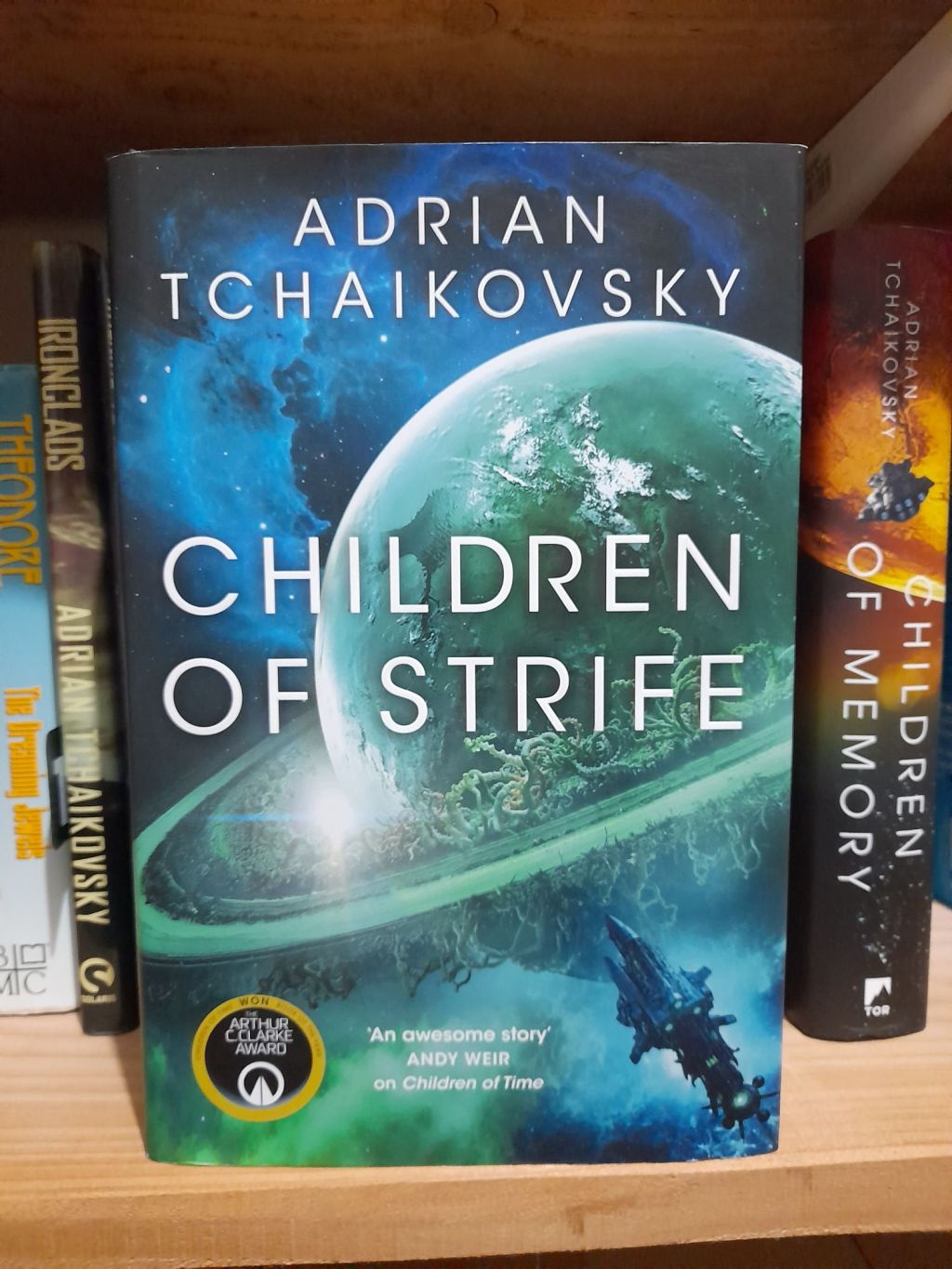
Coming off the back of an impressive run of standalone novels (three Hugo nominations in two years!), Tchaikovsky returns to the spiders that put his name on the science fiction map. A decade on from the publication Children of Time, I think it’s safe to say that Tchaikovsky has written a modern classic. Children of Ruin followed in a similar vein, but Children of Memory took big swings that didn’t always land. What, then, are we to make of Children of Strife? First off, while the story is as standalone as its predecessors, the worldbuilding has accumulated to the point that I definitely wouldn’t recommend tackling it without reading the other three first. That said, if you do stumble across this fourth book by purely random chance, you’re still going to get a good story out of it.
Like the rest of the series, Children of Strife is split between different time periods, a method at which Tchaikovsky excels. He also opens with a handy timeline recapping major events from the past three novels. In this book, we get to look at all three ages. In the First Age, a group of scientists attempt to terraform a planet, but their efforts are stymied by infighting. The Second Age sees a refugee ship fleeing a dying Earth and aiming for the stars. We don’t see as much of this strand as we do of the others, which is really my only complaint against the novel, as I would have loved to see more. In the Third Age, we follow the now-familiar mix of uplifted animal species, uploaded scientists, and unusual aliens.
The Third Age also introduces us to the real star of the novel. Having tackled spiders, octopodes, corvids, and a handful of other species over the series, Tchaikovsky now gives us a solitary member of a new uplifted species. Cato the mantis shrimp absolutely steals every scene he’s in with his curmudgeonly approach to teamwork and frequent bouts of violence. Through Cato we get glimpses of the larger mantis shrimp civilisation, but it’s his unique psychology and worldview (both ethical and literal) that really sets him apart from Tchaikovsky’s other animal characters. His dialogue is also presented in an unusual fashion, which just serves to make him that little bit more special.
Typically, this series has been quite optimistic. If there’s one overall theme, it’s that the world is a better place when we can learn to get along with one another. Children of Strife, fitting enough given the name, has more of a sense of tragedy about it. In the Second Age, we see people trying to rebuild after cataclysm, only to fall back into old patterns. The scientists of the First Age are a unanimously awful bunch of people, all in their own special ways. It’s a wonder they found any time to terraform with the way they are constantly at each other’s throats. Of course, we know from the structure of the novel that their efforts are at least partially doomed. Yet it’s never bleak or pessimistic. The sense of lost grandeur and missed opportunities is not depressing, though it is sad. And by the time the Third Age rolls around, we have Cato to show that not everyone is lovey-dovey in the multi-species alliance, alongside the usual feuding between Portias and Fabians.
Tinged by sorrow though it may be, Children of Strife is still a book about the wonders of the galaxy. A book where science wins out over violence, and where there is no greater gift than the ability to communicate with those who are different to you. Life, as a great man once said, finds a way. Tchaikovsky does nothing more, and nothing less, than prove that to be true.
Book Stats
- Children of Time #4
- Published 2026
- 678 Pages


