Teaser
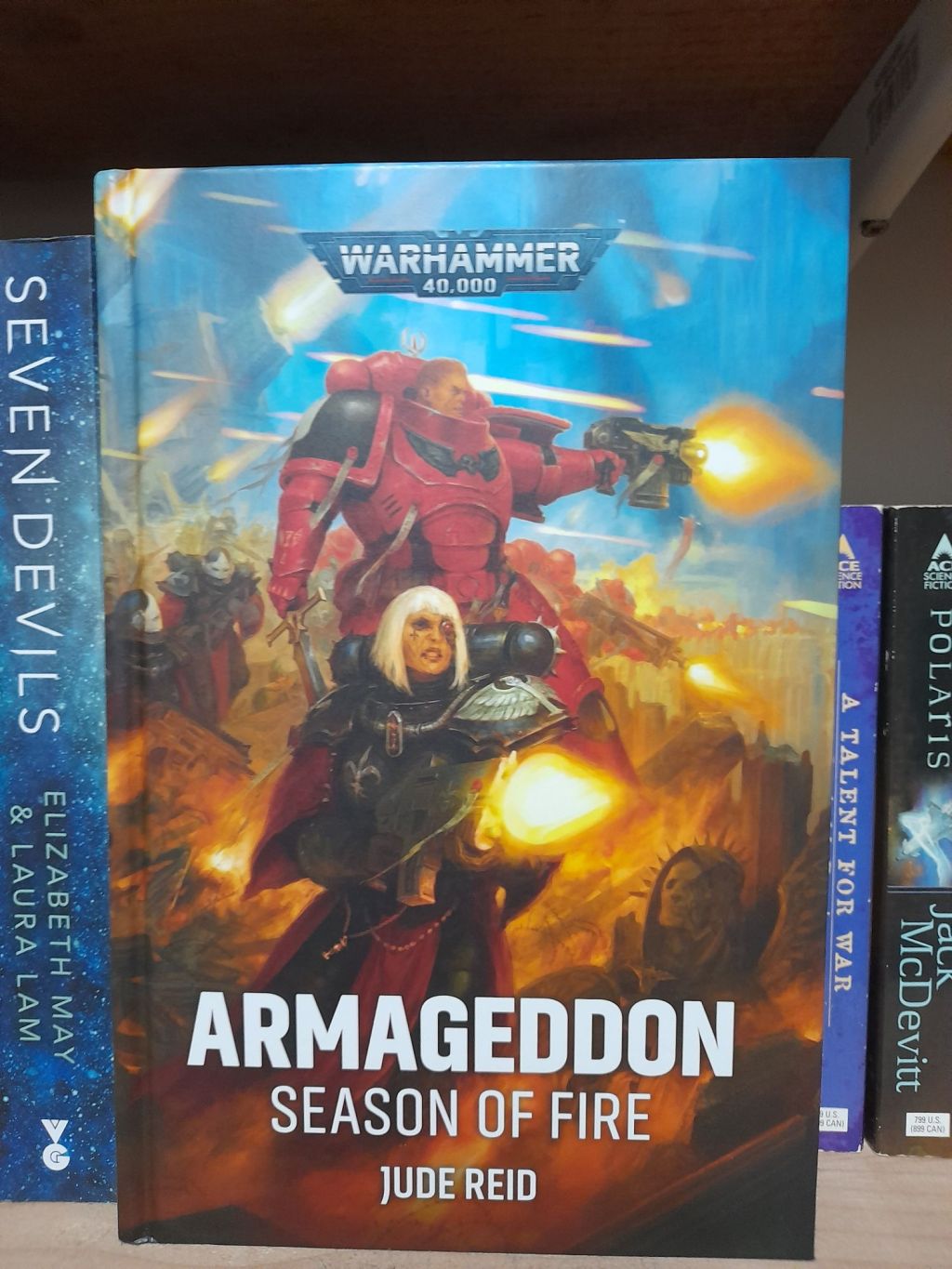
Armageddon is a world at war, and Hive Tartarus is on the frontline. Soldiers, sisters of battle, and space marines alike must stand against the ork hordes. But in the grim darkness of the far future, can there be any hope of victory . . ?
Review
With the arrival of a new edition of Warhammer 40,000 (complete with a boxed set) comes a new hardback to promote that edition. Obviously, one hopes that headline releases such as this are entertaining stories in their own right, but they do come with an additional set of expectations. Firstly, they have to tie-in more directly to the new edition of the game than a regular book, which in this case means being set on Armageddon. Secondly, they have to be an advert for the larger game, drawing in new potential fans for whom the game might look a bit daunting, but a single book much more manageable. In practice, this means the new edition tie-ins have to feature a broad spread of characters and ideas to show what the game world is like.
As a tie-in to the Armageddon boxed set, Season of Fire is an unqualified success. Reid takes us to one hive city teetering on the brink of destruction, and fully explores it from murky hidden alleyways to the sprawling trenches around the city. The war might be raging across the whole planet, but narrowing the scope to one location lets Reid settle in deeper. Wisely, the story is also told only from the perspective of the city’s defenders. The nature of the threat is clear, and the orks are frequently on the page, but we never see the battle through their eyes. Again, this narrowing of the scope reinforces the idea that defeat here would be total, and avoiding the orky shenanigans we see in Black Library as a whole helps keep the tone consistently bleak.
It’s as a showcase for the larger game that Season of Fire really shines, however. The book is divided into three distinct acts, which almost makes it feel like three novellas rather than a single story, with each act focusing on a different character. In the first act, we follow the regular human defenders of Hive Tartarus. As familiar a viewpoint as you’re likely to get in Warhammer, and a great way of easing in new readers. In the second, we follow a Sister of Battle, and learn more about how faith and organised religion are a key part of the grim dark future. It’s not until the third act that the space marines – the poster boys of Warhammer 40,000 – really show up, and by then we’ve heard enough about them to see them as the monstrous angels they are. Each of the three acts picks up from the one before, with a little connective tissue between the three to give the novel some narrative cohesion. Threaded through all of the novel is the enigmatic character of the Ghost, through whom we get to experience some of the more mystical elements of Warhammer that lurk in the darker corners of the setting.
Being designed to appeal to newer readers, Season of Fire might not push the boat out as far as some other recent books. But that is not to take away from Reid’s achievement. This is a masterfully crafted novel, and certainly the best introduction to Warhammer 40,000 I’ve seen in recent years. If someone comes up to me and asks me where to get started with the sprawling literary universe of Warhammer’s grim dark future, this is the book I’ll be recommending they read. And if you like this one, you’ll love what else Reid and her fellow Black Library authors have to offer.
Book Stats
- A Standalone Novel
- Published 2026
- 289 Pages


